



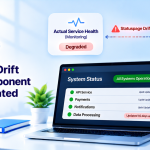



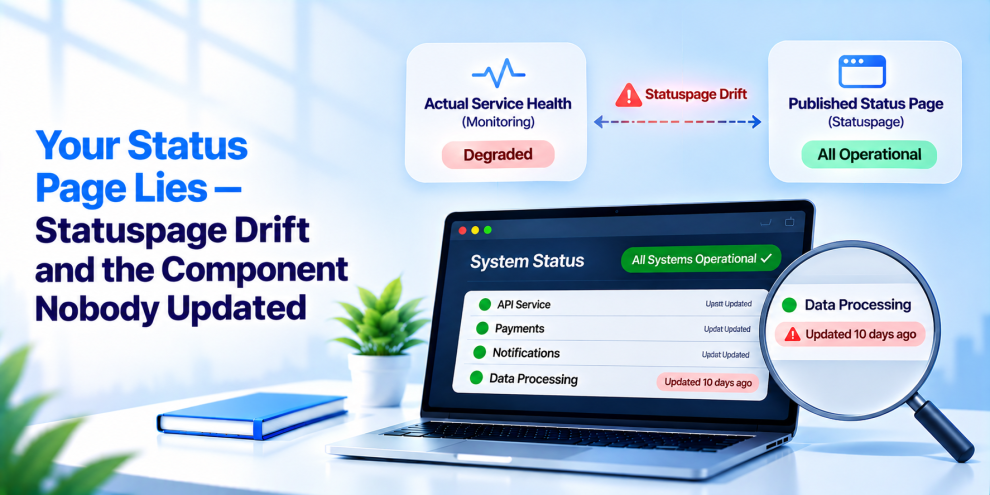

A production incident begins. Monitoring detects elevated API latency, error rates increase, and customers report failed transactions. Engineers identify the affected service and begin investigating. Yet the public status page still shows green indicators across every component.
The problem may not be monitoring failure. It may be statuspage drift, the gap between the actual health of production systems and what a status page communicates.
As distributed applications become more complex in 2026, keeping status pages accurate is becoming an important DevOps and Site Reliability Engineering (SRE) responsibility. Services are renamed, databases migrate, dependencies change, and infrastructure evolves. But status page components often remain unchanged.
A status page is only useful when its components, monitoring signals, and incident updates reflect the infrastructure teams actually operate.
What Is Statuspage Drift?
Statuspage drift occurs when a public or internal status page no longer accurately represents the operational condition of the services it describes.
It often develops gradually. A team introduces a new payment service, replaces an authentication API, or migrates workloads to another cloud region. Monitoring is updated, but the corresponding status page configuration is overlooked.
Consider an application with five components: authentication, payments, inventory, database, and notifications. After a migration, the notification service is replaced, but the status page still tracks the retired component.
When the new service fails, customers may see a green indicator because the status page is checking something that no longer represents the production architecture.
The page is working. Its information is outdated.
Why Statuspage Drift Happens
Several operational gaps contribute to statuspage drift.
1. Monitoring and Status Pages Are Disconnected
Monitoring platforms such as Prometheus, Grafana, and Datadog detect performance issues and service failures. However, public status pages may depend on separate integrations or manual updates.
A monitoring alert does not automatically guarantee that the corresponding status page component will change. If the integration is missing or broken, both systems can report different conditions.
2. Microservices Complicate Component Mapping
A customer-facing feature may depend on several APIs, databases, queues, and external providers.
For example:
Checkout → Authentication → Inventory → Payment Gateway → Order Database
A failure in one dependency can affect the complete checkout experience. If the status page tracks only the checkout API, it may miss the underlying problem.
Teams need dependency mapping that connects internal infrastructure to customer-facing functionality.
3. Infrastructure Changes Outpace Documentation
New services are deployed, old workloads are retired, and databases move between environments. Infrastructure-as-code makes these changes repeatable, but it does not automatically ensure that status page definitions remain synchronized.
Without status page configuration in the change-management process, outdated components accumulate.
4. Manual Incident Updates Create Delays
During an outage, engineers prioritize investigation and recovery. Updating the status page can become a secondary responsibility.
When incident communication depends entirely on someone remembering to update a component, customers may receive inaccurate information during critical moments.
Monitoring Drift vs. Statuspage Drift
These problems are connected but serve different purposes.
| Monitoring drift | Statuspage drift |
|---|---|
| Monitoring no longer reflects actual system health | Published status no longer reflects actual service health |
| Caused by missing alerts or outdated checks | Caused by stale components or broken integrations |
| Primarily affects engineering teams | Primarily affects customers and stakeholders |
| Can delay incident detection | Can create misleading incident communication |
A team can have excellent observability and still maintain an inaccurate public status page.
How to Detect Statuspage Drift
Status page accuracy should be reviewed as part of production reliability, not treated as a documentation task.
Compare Components With the Service Catalog
Maintain a service catalog containing production services, owners, dependencies, and monitoring sources.
Compare the catalog with the status page component list. Identify services that are missing, renamed, retired, or mapped incorrectly.
Tools such as Backstage can help maintain service ownership and metadata through a centralized developer portal.
Connect Components to Real Health Signals
Every important status component should have a defined health source.
For example:
- Authentication: login success rate and API latency
- Payments: transaction success rate and gateway availability
- Database: connection availability and query latency
- Notifications: delivery success and queue backlog
- Web application: synthetic checks and request success rate
A database being reachable does not necessarily mean the payment workflow is healthy. Health checks should measure customer-facing behavior rather than simply checking whether a process is running.
Detect Missing and Stale Components Automatically
Teams can compare their production service inventory against status page configuration.
production_services = {
    "auth-api",
    "payment-api",
    "inventory-service",
    "notification-service"
}

status_components = {
    "auth-api",
    "payment-api",
    "inventory-service",
    "legacy-notifications"
}

missing = production_services - status_components
stale = status_components - production_services

print("Missing:", missing)
print("Stale:", stale)
This simplified example identifies production services missing from the status page and components that may no longer exist.
In production, use stable service identifiers and exclude internal services that intentionally do not require public reporting.
Build a Reliable Status Page Architecture
A dependable status page should not rely entirely on manual updates during an incident.
A stronger architecture connects service inventory, monitoring, incident management, and customer communication.
Service Catalog → Dependency Mapping → Monitoring → Health Evaluation → Incident Management → Status Page
Each layer has a specific responsibility:
- Service catalog: Defines services, owners, and operational metadata.
- Dependency mapping: Connects internal components to customer-facing features.
- Monitoring: Collects latency, availability, errors, and synthetic test results.
- Health evaluation: Determines whether services are healthy or degraded.
- Incident management: Coordinates investigation and response.
- Status page: Communicates verified customer impact.
This approach reduces the gap between what engineering teams observe and what customers see.
Use Infrastructure as Code to Reduce Drift
Infrastructure-as-code practices can help teams manage status page configuration alongside other operational resources.
Where the status page provider supports it, teams can manage components through Terraform or API-based automation.
When introducing a service, the change process can include:
- Creating the service.
- Registering monitoring checks.
- Defining dependencies.
- Assigning an owner.
- Creating or updating its status page component.
Not every provider supports every operation through infrastructure-as-code. Teams should verify available integrations before implementing this workflow.
The important principle is to treat status page configuration as operational configuration rather than informal documentation.
Avoid Automating Every Alert Into a Public Incident
Connecting every monitoring alert directly to a public status page can create unnecessary noise.
A temporary CPU spike or isolated health-check failure does not always indicate customer-facing downtime.
Status automation should include alert deduplication, evaluation windows, dependency-aware impact analysis, severity mapping, and recovery confirmation.
For ambiguous or high-impact events, human review may still be necessary.
The objective is not to publish every monitoring event. It is to communicate accurate information about service impact.
Measure Status Page Accuracy
DevOps teams commonly measure uptime, latency, error rates, and mean time to recovery. They should also measure whether status page information reflects actual production conditions.
Useful metrics include:
- Status update latency: Time between detecting an incident and publishing its status.
- Component mapping coverage: Percentage of relevant production services represented on the status page.
- Drift detection rate: Number of outdated or missing mappings identified.
- Integration reliability: Successful delivery and processing of status update events.
- Communication accuracy: Whether published information matches verified customer impact.
- Resolution synchronization: Time between service recovery and status page resolution.
These metrics make status page accuracy part of the reliability engineering process.
Where Engineering Teams Fit
Preventing statuspage drift involves more than maintaining a public communication page. It requires application architecture, observability, infrastructure automation, dependency mapping, and reliable incident workflows. Teams such as GeekyAnts and Thoughtworks work across application engineering and modern software architecture, making this broader engineering perspective relevant for organizations improving the reliability of distributed applications.
Your Status Page Is Part of Your Reliability Architecture
Statuspage drift often begins with small operational gaps: a component nobody updated, a service nobody mapped, or an integration nobody monitored.
The solution is to connect status page management with the systems that define and observe production infrastructure.
Maintain an accurate service catalog, map dependencies to customer-facing capabilities, automate configuration checks, monitor integration failures, and assign clear ownership.
In 2026, reliable service communication should not depend on whether someone remembers to change a green indicator.
Your status page should describe the system you actually operate, not the architecture you used to have.
Frequently Asked Questions
What is statuspage drift?
Statuspage drift is the difference between actual production health and the availability information displayed on a public or internal status page.
Why do status pages show green during an outage?
Outdated component mappings, broken monitoring integrations, and delayed incident updates can cause status pages to show incorrect information.
How can DevOps teams prevent statuspage drift?
Teams can synchronize service catalogs with status page components, automate configuration checks, monitor integrations, and assign component owners.
Should every microservice have a public status page component?
No. Public status pages should generally represent customer-facing services. Internal dependencies should be mapped to those services without exposing unnecessary infrastructure details.
How do you measure status page accuracy?
Track component mapping coverage, status update latency, integration reliability, drift detection rate, and incident communication accuracy.
For more, visit our homepage!



Add Comment