






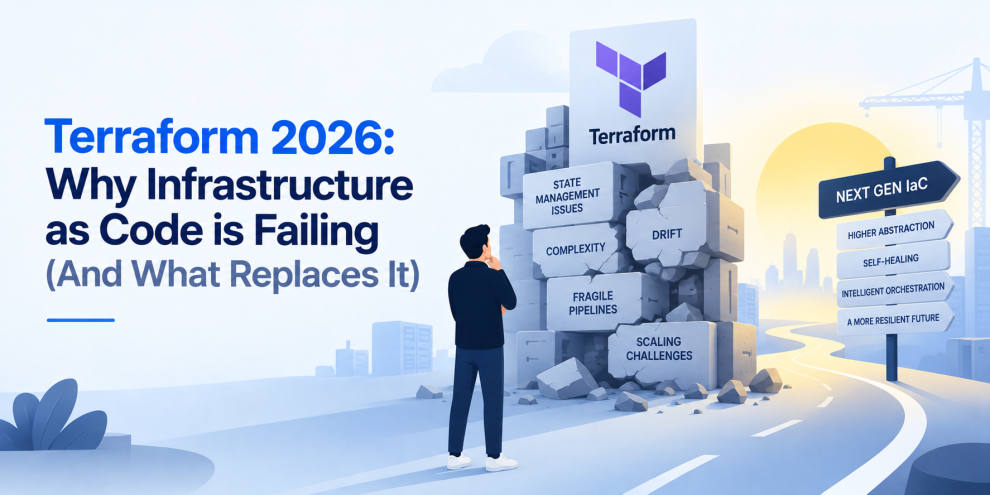

Infrastructure as Code changed how DevOps teams manage infrastructure. Instead of manually creating servers, networks, databases, and cloud resources, teams could define infrastructure in code, store it in Git, review changes, and automate deployments. Terraform became one of the most widely adopted tools for this approach. But modern infrastructure has become far more dynamic. Kubernetes, platform engineering, ephemeral environments, multi-cloud architectures, automated scaling, and continuous delivery have created situations where traditional Terraform workflows can feel increasingly difficult to manage. Terraform itself is not disappearing. The bigger shift is that teams are questioning whether one provisioning model should control every layer of infrastructure.
Where Traditional IaC Starts to Struggle
Terraform works by comparing declared configuration with infrastructure state and determining what needs to change. This works particularly well for relatively stable resources. Modern environments, however, can include Kubernetes workloads, autoscaling systems, managed services, service meshes, identity policies, secrets, observability platforms, and constantly changing application resources. Many of these resources change without anyone editing a Terraform file. This can create a growing difference between the configuration Terraform manages and the environment’s constantly changing runtime state.
The State File Problem
Terraform state is central to its operating model, but it also creates operational responsibility. Teams need to protect state, manage access, handle locking, understand dependencies, and recover from accidental or inconsistent changes. Large organizations may maintain numerous state files across environments, cloud accounts, regions, and teams. Splitting state improves isolation but introduces additional coordination. As infrastructure grows, state management can become a platform engineering concern rather than simply a Terraform configuration concern.
Plan and Apply Is Not Always Enough
Terraform’s plan and apply workflow provides an important review process, but highly dynamic infrastructure increasingly benefits from continuous reconciliation. Kubernetes controllers continuously compare desired and actual state and attempt to correct differences. This is fundamentally different from running an infrastructure deployment when a configuration changes. For infrastructure that changes continuously, reconciliation can be a more natural model than repeated manual or pipeline-triggered application.
Kubernetes Changed the Infrastructure Model
Kubernetes introduced a different approach to infrastructure management. Engineers define desired state, and controllers continuously work toward that state. This model has expanded beyond application workloads. Kubernetes-native technologies can now manage databases, networking, cloud resources, certificates, and other infrastructure through declarative APIs. For teams already operating Kubernetes as a platform, this can reduce the number of different infrastructure management models engineers need to understand.
The Kubernetes-Native Alternative
The Kubernetes-native model generally uses custom resources and controllers. A platform engineer can declare an infrastructure resource through a Kubernetes API, while a controller reconciles that resource with the underlying cloud or infrastructure provider. Technologies such as Crossplane demonstrate this approach. The major architectural change is that infrastructure becomes part of a continuously reconciled control plane rather than something that is simply provisioned and left alone.
Does Crossplane Replace Terraform?
Not automatically. Terraform and Crossplane overlap, but they fit different operating models. Terraform remains useful for provisioning a broad range of infrastructure, particularly foundational resources and environments built around established Terraform workflows. Crossplane is attractive when platform teams want infrastructure to become part of a Kubernetes-based control plane and expose higher-level infrastructure capabilities to developers. An organization can also use both, with Terraform managing foundational infrastructure while Kubernetes-native controllers manage application-facing resources.
GitOps Changes Infrastructure Management
GitOps introduces another important layer. Instead of an engineer manually applying infrastructure changes, configuration can be committed to Git and continuously reconciled by a controller. The workflow becomes Git change, validation, reconciliation, and infrastructure update. This creates an auditable desired state and allows the system to detect and correct drift continuously. GitOps tools such as Argo CD and Flux are commonly associated with Kubernetes workloads, while infrastructure controllers can extend the same principles to external resources.
The Platform Engineering Alternative
Platform engineering takes the abstraction one step further by reducing the amount of infrastructure configuration developers need to manage themselves. Instead of asking developers to write complex Terraform modules, an internal developer platform can expose capabilities such as application environments, databases, queues, or deployment infrastructure through self-service interfaces. The platform manages the underlying implementation. This changes the goal from making every developer an infrastructure expert to giving developers safe access to the infrastructure capabilities they actually need.
Abstraction Can Create More Complexity
Platform engineering does not automatically eliminate IaC complexity. A poorly designed internal platform can simply hide Terraform behind another layer of YAML, templates, APIs, and custom tooling. Developers may still need to understand the same infrastructure concepts, just through a different interface. The purpose of platform engineering should therefore be meaningful abstraction. Developers should interact with clear platform capabilities while implementation details remain controlled by the platform team.
Policy as Code Becomes More Important
Infrastructure is increasingly constrained by security, compliance, cost, and organizational policies. Teams may require approved regions, encryption, network controls, identity policies, resource tags, or spending limits. Policy as code allows these requirements to be enforced automatically instead of relying entirely on manual reviews. Terraform can participate in this model, but modern infrastructure governance increasingly combines provisioning with policy engines, admission controls, continuous compliance, and automated remediation.
Infrastructure Is Becoming Event Driven
Traditional IaC often assumes that infrastructure changes begin with a human or deployment pipeline. Modern platforms increasingly react to events. A new application can trigger environment provisioning, a capacity change can initiate scaling, a policy violation can trigger remediation, and a new application version can initiate a deployment workflow. This event-driven environment requires infrastructure systems capable of responding continuously rather than waiting for a scheduled or manually initiated provisioning process.
Ephemeral Infrastructure Changes the Equation
Development teams increasingly create temporary environments for pull requests, testing, previews, and experiments. Provisioning each environment through large Terraform configurations can introduce additional state and lifecycle management. Kubernetes-native environments and platform abstractions can make these workloads easier to create and remove. Infrastructure increasingly needs to behave like a disposable application resource rather than a permanent collection of manually maintained resources.
Terraform Still Has a Role
Despite these challenges, Terraform remains highly relevant. It has a mature provider ecosystem, established workflows, extensive community knowledge, and significant adoption. Organizations may also have years of Terraform modules and operational processes already in place. Replacing everything simply because newer approaches exist can create unnecessary migration risk. A more practical strategy is to identify where Terraform continues to work well and where another control model provides a better operational fit.
The Hybrid Infrastructure Model
Many organizations will use a combination of technologies rather than replacing Terraform completely. Terraform can manage foundational infrastructure such as cloud accounts, networking, identity, and core services. Kubernetes-native controllers can manage application-facing infrastructure. GitOps can continuously reconcile workloads, while policy engines enforce organizational requirements. Internal developer platforms can expose these capabilities through simplified self-service interfaces. Each technology then has a defined responsibility instead of one tool attempting to manage everything.
What DevOps Teams Should Stop Doing
Teams should be cautious about creating enormous Terraform configurations that attempt to manage every infrastructure and application concern through one workflow. They should also avoid unrestricted infrastructure permissions, poorly managed state, excessive module duplication, and treating Terraform as the only solution for highly dynamic environments. Not every infrastructure problem requires another Terraform module. Sometimes the appropriate solution is a controller, platform API, GitOps workflow, or policy engine.
What Platform Teams Should Build Instead
A modern platform should make infrastructure easier to consume without hiding important controls. Developers should be able to request approved capabilities without understanding every underlying cloud resource. The platform can provide standardized templates, secure defaults, automated provisioning, observability, policy enforcement, and lifecycle management. Terraform, Crossplane, Kubernetes controllers, or cloud-native services can operate behind the platform interface. Developers interact with the platform contract rather than infrastructure implementation details.
Where Engineering Teams Add Value
Modernizing infrastructure requires coordination across cloud architecture, Kubernetes, CI/CD, security, observability, and platform engineering. Engineering organizations such as GeekyAnts, Thoughtworks, and other DevOps and platform engineering teams work across these areas when modernizing infrastructure environments. They work on cloud architecture, CI/CD systems, Kubernetes platforms, infrastructure automation, and developer-focused internal platforms. The objective is not simply to remove Terraform, but to create an infrastructure operating model where every layer has a clear responsibility.
A Practical Migration Strategy
Organizations considering alternatives to Terraform should avoid starting with a complete replacement. First identify infrastructure that changes frequently, infrastructure that requires continuous reconciliation, and resources developers interact with directly. Terraform can continue managing stable foundational resources while a Kubernetes-native controller or internal platform manages a targeted workload. Teams can then compare provisioning time, recovery, developer effort, operational overhead, security, and drift management before expanding the new approach.
What DevOps Leaders Should Audit
DevOps and platform engineering leaders should ask which infrastructure actually needs continuous reconciliation, how much effort goes into state management, whether developers are writing infrastructure configuration they should not need to understand, whether policies are automatically enforced, whether ephemeral environments are easy to manage, and whether infrastructure ownership is clear. They should also examine whether Terraform modules are becoming difficult to maintain and whether the current provisioning model is creating more operational work than it removes.
The Future of Infrastructure as Code
Infrastructure as Code is not disappearing. Its role is changing as infrastructure becomes more dynamic and platform engineering becomes more mature. The next generation of infrastructure management is likely to combine declarative configuration, continuous reconciliation, GitOps, policy as code, Kubernetes controllers, cloud services, and internal developer platforms. Terraform can remain part of that architecture, particularly for foundational provisioning, without being the interface through which every engineer manages every resource.
The larger shift is from infrastructure configuration toward infrastructure platforms. Instead of asking developers to understand every resource and dependency, platform teams can provide secure, automated, self-service capabilities while controllers continuously maintain desired state. That is not the end of Infrastructure as Code. It is its evolution into a broader platform engineering discipline.
For more, visit our homepage!


Add Comment