








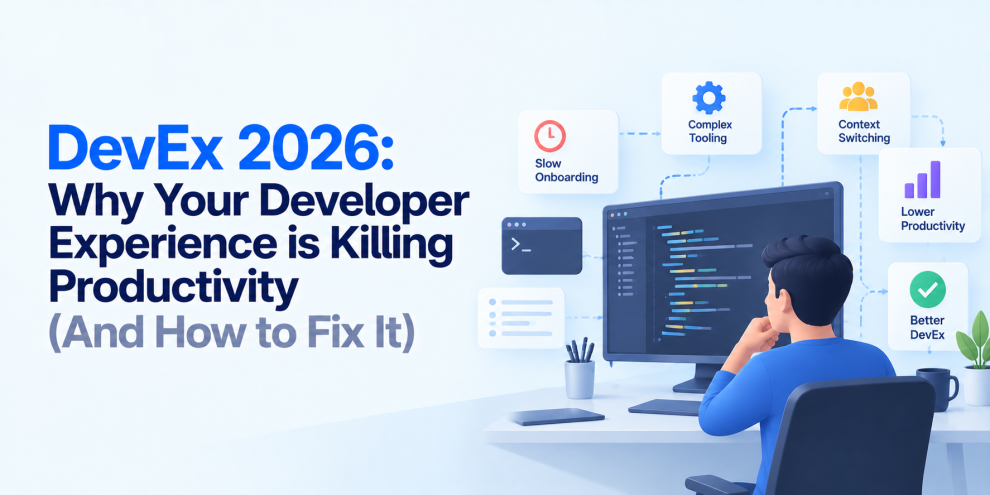

Developer experience, or DevEx, has become a serious DevOps concern. Engineering teams can have modern CI/CD pipelines, Kubernetes clusters, infrastructure as code, and observability platforms, yet developers can still spend hours waiting for builds, configuring environments, debugging deployments, finding documentation, or figuring out which internal service owns a broken dependency. The problem is not necessarily a lack of tools. In many organizations, the problem is that developers have to understand too much infrastructure just to deliver a small change.
In 2026, DevOps teams are increasingly being asked to solve this problem. The goal is no longer simply to automate deployments. It is to create an engineering environment where developers can move from code to production with less friction while infrastructure teams retain the control required for security, reliability, and governance.
DevEx Is Now a DevOps Problem
DevOps originally focused on bringing development and operations closer together. CI/CD automated software delivery, infrastructure as code standardized infrastructure changes, and observability improved production visibility. But automation can create another problem when every tool introduces another workflow.
A developer may need to understand GitHub Actions, Kubernetes, Terraform, cloud permissions, container registries, secrets management, monitoring dashboards, deployment environments, and internal documentation before shipping a relatively simple feature. The infrastructure may be technically sophisticated while the developer workflow remains unnecessarily complicated.
That is where DevEx becomes important. Good DevEx does not mean hiding infrastructure completely. It means giving developers simple and reliable interfaces for interacting with complex infrastructure.
The Hidden Cost of Developer Friction
Developer productivity is affected by more than how quickly engineers write code. Consider what happens when a developer starts a new service. They may need to create a repository, configure a CI pipeline, define infrastructure, request cloud permissions, create deployment manifests, configure secrets, register monitoring, and understand the organization’s deployment process.
If each step requires a different team or manual request, delivery slows down. The cost appears in places that traditional DevOps metrics may not capture. Developers wait for environments, investigate broken pipelines, search through outdated documentation, repeatedly solve the same infrastructure problems, or avoid making changes because the deployment process feels risky.
The result is operational friction that compounds across hundreds or thousands of engineers.
More DevOps Tools Can Make DevEx Worse
Adding another tool does not automatically improve engineering productivity. An organization might introduce a new deployment platform, another observability system, a service catalog, an internal developer portal, or an AI coding assistant. Each tool may solve a legitimate problem, but developers experience the entire toolchain as one system.
If the tools are poorly integrated, the result can be more context switching rather than less. A useful DevEx principle is therefore: optimize the developer workflow, not the number of DevOps tools.
The Golden Path Matters
One of the most effective approaches is creating a well-supported “golden path” for common engineering workflows. A developer building a standard backend service should not have to design the entire infrastructure architecture from scratch.
Instead, the platform can provide an approved template that automatically creates the repository structure, CI/CD pipeline, deployment configuration, observability integration, security controls, and required infrastructure.
The developer still owns the application. The platform team owns the underlying capabilities. This creates standardization without forcing every developer to become a Kubernetes or cloud infrastructure specialist.
Internal Developer Platforms Are Becoming More Important
Internal developer platforms can provide a consistent interface over complex infrastructure. Instead of asking developers to interact directly with dozens of infrastructure systems, the platform can expose common workflows such as creating a service, deploying an application, requesting an environment, viewing deployment status, or accessing service documentation.
The important distinction is that an internal platform should reduce complexity rather than simply create another dashboard. A portal that links to twenty different systems without simplifying any workflow does not solve the underlying DevEx problem.
Self-Service Is the Real Goal
A strong platform enables developers to complete common tasks without opening infrastructure tickets. For example, a developer should ideally be able to create a development environment through an approved workflow rather than waiting for an operations engineer to provision infrastructure manually.
Self-service can apply to development environments, CI/CD pipelines, service creation, database provisioning, observability, secrets integration, deployment environments, and temporary test infrastructure. The platform should provide guardrails automatically so that self-service does not become uncontrolled infrastructure creation.
CI/CD Should Feel Boring
A healthy developer experience often means developers do not have to think about the CI/CD system very much. They commit code, automated tests run, security checks execute, an artifact is produced, and the application is deployed through the appropriate environment. Failures should provide actionable feedback.
When developers regularly need to investigate YAML configuration, runner problems, permission failures, container issues, or deployment mechanics, the pipeline itself becomes a productivity problem.
The objective is not to eliminate pipeline configuration entirely. It is to provide reusable defaults that cover the majority of common workflows.
Local Development Is Part of DevEx
DevEx does not begin when code reaches CI. Local development can become one of the largest sources of engineering friction. A developer may need a database, message broker, authentication service, object storage, APIs, background workers, and multiple dependencies just to run the application locally.
If setting up the environment requires following a 40-page document, the development workflow already has a problem. Containerized development environments, local service emulation, automated setup scripts, dependency management, and standardized configuration can significantly reduce this friction.
The objective should be simple: a new developer should be able to reach a productive development environment quickly and consistently.
Documentation Should Be Connected to the Workflow
Documentation becomes less useful when developers have to search multiple systems to find it. Service ownership, deployment instructions, API contracts, architecture information, runbooks, environment details, and operational guidance should be accessible close to the systems they describe.
Documentation should also have clear ownership. An internal platform can help connect documentation with services, repositories, deployments, and operational metadata. This is particularly important in large organizations where architecture changes faster than static documentation.
Observability Is Part of Developer Experience
Observability is usually discussed as a production operations concern, but it directly affects developers. When a deployment fails, developers need to know what happened. When an API becomes slow, they need to understand where latency was introduced. When a service crashes, they need enough context to identify the cause.
If developers must manually search through multiple monitoring systems to reconstruct an incident, the observability experience is poor. Modern DevEx therefore connects deployment information with logs, metrics, traces, ownership, and recent changes.
A developer should be able to move from “my deployment failed” toward “this dependency started returning errors after this configuration change” without manually reconstructing the entire system.
Security Should Be Invisible When Possible
Security controls are necessary, but unnecessary security friction can create dangerous workarounds. Developers should not need to bypass security systems simply to perform routine engineering tasks.
Platform teams can embed security into developer workflows through automated dependency scanning, secret detection, container scanning, policy enforcement, identity federation, and environment controls. The developer receives a secure default rather than a long checklist of manual security tasks.
The best security experience often feels like the platform is preventing mistakes automatically.
AI Is Changing DevEx Again
AI coding assistants and DevOps agents are introducing another layer of automation. AI can generate code, explain failures, create infrastructure configurations, analyze logs, summarize incidents, and assist with troubleshooting.
But AI can also increase operational complexity if generated code and infrastructure changes enter production workflows without sufficient validation. DevOps teams therefore need to integrate AI into existing engineering controls rather than treating AI as a replacement for them.
Generated infrastructure should still pass policy checks. Generated code should still run through testing and security validation. AI-generated deployment changes should still follow appropriate approval and authorization boundaries.
The objective is to reduce cognitive load without removing engineering controls.
Measure Developer Experience Like a Production System
DevEx should not be evaluated only through developer surveys. Operational measurements can provide useful evidence. Teams can track build duration, CI failure rate, deployment frequency, deployment lead time, environment provisioning time, time required to recover failed deployments, pull request waiting time, failed deployments caused by infrastructure, developer support requests, and time spent on repetitive platform tasks.
These measurements help platform teams identify where friction is actually occurring. A platform team should be able to demonstrate that a change made the developer workflow faster, more reliable, or easier to understand.
Developer Experience Needs Platform Ownership
DevEx problems often fall between organizational boundaries. Developers own application code. DevOps owns delivery systems. Platform teams own infrastructure. Security owns controls. Architecture teams define standards.
Without clear ownership, developers become responsible for integrating all of these systems themselves. Platform engineering provides a way to bring those capabilities together.
The platform team can create reusable infrastructure, standardized workflows, self-service capabilities, deployment templates, observability integrations, and security guardrails.
Engineering organizations such as GeekyAnts work across platform engineering, cloud infrastructure, Kubernetes, CI/CD, infrastructure as code, and application engineering, which are the same layers that increasingly shape modern developer experience.
The Platform Should Hide Complexity, Not Control
There is an important difference between abstraction and restriction. A good platform hides unnecessary complexity while preserving access to advanced capabilities when developers need them.
A developer building a standard service should be able to follow the golden path. An experienced engineer working on an unusual workload should still be able to access lower-level infrastructure capabilities through controlled interfaces.
This balance prevents the platform from becoming another bottleneck.
What DevOps Leaders Should Audit in 2026
Before investing in another DevOps tool, engineering leaders should ask where developers are actually losing time. How long does it take to create a new service? How long does it take to provision an environment? How often do developers wait for infrastructure teams? How frequently do CI/CD pipelines fail for reasons unrelated to application code? Can developers deploy safely without understanding every underlying infrastructure component? Can developers find service ownership and operational documentation quickly? Are security controls built into the workflow? Can platform teams measure whether their tools actually reduce engineering friction?
These questions are more useful than simply asking whether the organization has adopted the latest DevOps technology.
The Future of DevEx Is Less Friction, Not More Automation
The next stage of DevOps is not about automating every possible engineering task. It is about creating an environment where the common path is simple, secure, observable, and predictable.
Developers should not need to understand every infrastructure detail to deploy a service. Platform teams should not need to manually provision every environment. Security teams should not need to review every routine change manually. Operations teams should not need to explain the same deployment process repeatedly.
The platform should provide sensible defaults, automated controls, self-service workflows, clear feedback, and escape hatches for unusual requirements.
The real measure of DevEx is therefore not how many tools an engineering organization has adopted. It is how much unnecessary work developers have stopped doing.
In 2026, DevOps teams that treat developer experience as a first-class engineering problem can turn infrastructure from a source of friction into a product that developers actually want to use.
For more, visit our homepage!





Add Comment