







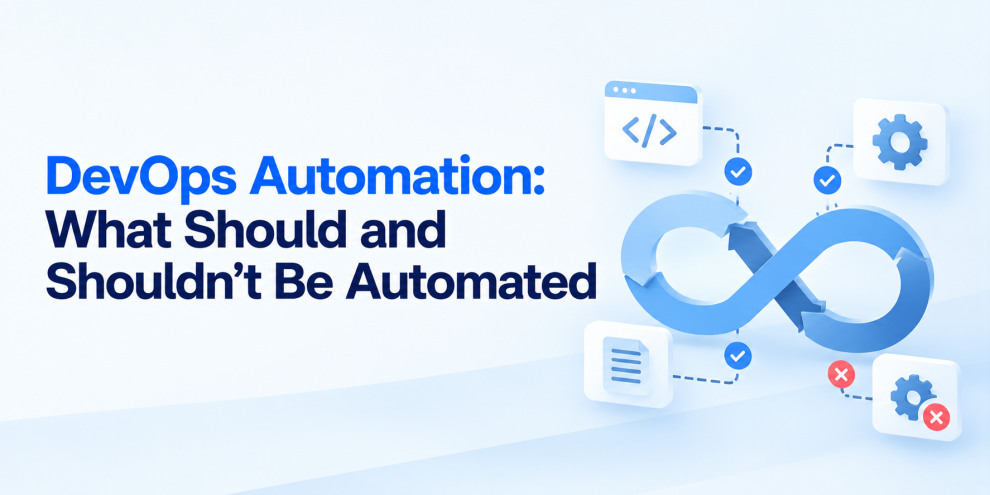

DevOps automation has become one of the most effective ways for engineering teams to increase delivery speed, reduce repetitive work, and improve operational consistency. CI/CD pipelines can build and test applications automatically, infrastructure can be provisioned through code, deployments can be triggered from approved changes, and monitoring systems can respond to common operational events without waiting for an engineer. But there is a limit that is often overlooked: not every engineering decision should be automated. Automating a predictable task is very different from automating a decision that depends on incomplete information, business context, or potential production impact. A pipeline that automatically runs tests is straightforward. A system that automatically rolls back production, modifies database infrastructure, or changes security policies requires considerably more control. The objective of mature DevOps automation is therefore not to automate everything. It is to automate the right things while keeping appropriate human oversight around decisions that carry significant risk.
What DevOps Automation Should Actually Achieve
Good automation removes unnecessary manual effort without removing engineering control. A useful DevOps automation strategy should improve deployment frequency, reliability, consistency, recovery time, developer productivity, infrastructure efficiency, and operational visibility. The key question is not simply, “Can this task be automated?” It is: “Can this task be automated safely, repeatedly, and with a predictable outcome?” If the answer is yes, automation is usually a strong candidate. If the task requires significant judgment or can create irreversible consequences, automation should usually be bounded by additional controls.
What Should Be Automated?
The strongest candidates are repetitive, deterministic, and well-understood operations.
Build and Test Execution
Software builds are one of the clearest automation opportunities. Every code change can trigger compilation, dependency installation, unit tests, integration tests, static analysis, security scanning, and artifact generation. The advantage is consistency. The same process runs regardless of who created the change. Teams should avoid relying on developers to remember which tests need to be executed before every deployment. CI pipelines should establish that baseline automatically.
Code Quality and Security Checks
Linting, formatting validation, dependency scanning, static analysis, container scanning, secret detection, and policy checks are also strong candidates for automation. These checks can run continuously and provide fast feedback before code reaches production. Automation works particularly well here because the rules are generally explicit. A dependency with a known critical vulnerability can trigger a defined policy. A leaked credential pattern can block a build. A container that violates an established security requirement can be rejected automatically.
Artifact Creation
Application packages, container images, mobile builds, infrastructure bundles, and other deployment artifacts should generally be generated automatically from controlled source revisions. Automated artifact creation improves reproducibility and reduces the possibility of deploying something that was manually modified outside the normal development process. Production deployment should ideally consume a known artifact rather than rebuilding arbitrary source code at deployment time.
Infrastructure Provisioning
Infrastructure provisioning is another area where automation provides substantial value. Infrastructure as Code allows teams to define cloud resources, networking, Kubernetes environments, databases, policies, and supporting services in version-controlled configuration. Instead of manually creating infrastructure through a cloud console, teams can review and apply standardized configurations through controlled workflows. However, infrastructure automation should still include approval boundaries for high-impact changes.
Routine Deployments
Deployments that follow a well-tested and predictable process are excellent automation candidates. A mature pipeline can automatically deploy approved artifacts to development and staging environments and, depending on organizational risk tolerance, production environments as well. Progressive delivery techniques such as canary releases and blue-green deployments can further reduce deployment risk by limiting the initial exposure of a change.
Environment Creation
Development, testing, preview, and temporary environments can often be created automatically. For example, a pull request can trigger an isolated preview environment where developers and QA teams can validate a change before it is merged. Automated environment creation can also make it easier to remove unused resources, provided lifecycle policies are enforced.
Monitoring and Alerting
Monitoring systems should automatically collect metrics, logs, traces, and infrastructure signals. Alerts can also be automated when clearly defined thresholds or behavioral conditions are reached. For example, a system can automatically notify the responsible team when error rates exceed a defined threshold or when a service becomes unavailable. The important distinction is between detecting an event automatically and deciding what major production action should happen next. Detection is usually easier to automate safely than remediation.
Backup and Recovery Checks
Backups should not depend on someone remembering to create them. Scheduled backups, replication checks, backup integrity tests, retention enforcement, and recovery verification can all be automated. Automated recovery testing is particularly valuable because a backup that has never been successfully restored should not be treated as proven recovery capability.
What Should Not Be Fully Automated?
The most dangerous automation decisions are usually those that combine incomplete information with significant production impact.
High-Risk Production Changes
A system should not automatically make unrestricted changes to production infrastructure simply because a metric crosses a threshold. Restarting a stateless service may be relatively low risk. Changing production networking, modifying database configuration, deleting infrastructure, or altering access policies can have much larger consequences. These operations should have explicit guardrails, scoped permissions, and, where appropriate, human approval.
Database Schema Changes
Database migrations deserve particular caution. Some schema changes are routine and can be included in deployment pipelines. Others can affect large datasets, application compatibility, replication, locking, or rollback procedures. Automatically applying destructive schema changes without validation can create an incident that is difficult to reverse. A safer approach is to automate migration testing and deployment mechanics while maintaining controlled approval for changes with significant production impact.
Security Policy Changes
Security automation is valuable, but security decisions should not become completely autonomous. Automatically rotating a credential or blocking a known malicious request can be appropriate. Automatically changing firewall policies, identity permissions, network access, or authentication rules based on ambiguous signals can create a different type of outage. Security automation needs clear policy boundaries and reliable rollback mechanisms.
Irreversible Operations
Deletion is one of the clearest examples. Automating the creation of infrastructure is relatively straightforward. Automatically deleting production resources based on a loosely defined condition is considerably more dangerous. The same principle applies to permanent data deletion, destructive database operations, irreversible configuration changes, and actions that cannot easily be rolled back. Automation should become more conservative as reversibility decreases.
Business-Critical Decisions
Not every production decision is purely technical. An automated system may detect that a particular service is generating significant infrastructure costs. That does not necessarily mean it should automatically reduce capacity if doing so could affect customers. Similarly, an automated deployment system should not decide whether a business-critical release should happen during a major customer event simply because all technical checks have passed. Engineering automation should support business decisions rather than silently making them.
The Automation Spectrum
Automation does not have to be binary. A useful model is to divide operations into several levels. Level 1: Fully automated. Routine, low-risk, deterministic tasks such as builds, tests, formatting, artifact creation, and standard deployments. Level 2: Automated with safeguards. Operations such as scaling, rollback, configuration changes, or remediation where predefined limits and validation are required. Level 3: Human-approved automation. High-impact changes where automation prepares and validates the action but an engineer approves execution. Level 4: Human-led operations. Rare, complex, ambiguous, or irreversible decisions where engineering judgment is essential. This model prevents teams from treating automation as an all-or-nothing choice.
The Problem With Over-Automation
Automation can create a false sense of safety. A process may run perfectly every time and still be wrong. Consider a deployment pipeline that automatically rolls back whenever error rates increase. That sounds sensible. But what if the error increase is caused by an unrelated dependency? What if the new version introduced an API contract required by another service? What if the rollback creates a second failure? The automation may execute exactly as designed while making the overall system less stable. This is why production automation needs context.
AI Makes the Boundary Even More Important
AI-driven DevOps introduces another layer of complexity. An AI agent can analyze logs, metrics, traces, deployment history, configuration changes, and incident records. It may identify a likely cause and recommend or execute a remediation. That can be valuable for repetitive operational tasks. But AI reasoning is probabilistic. The system may have incomplete telemetry, stale documentation, missing dependency information, or an incorrect interpretation of the incident. The safer architecture is therefore not Telemetry → AI → Production. Instead, it is Telemetry → AI Analysis → Risk Evaluation → Policy Controls → Approved Action → Verification. The AI can provide reasoning and recommendations, while deterministic systems continue to enforce permissions, limits, and operational boundaries.
Guardrails Are Part of Automation
Good automation is not simply about adding more scripts and pipelines. It is about defining what automated systems are allowed to do. For example, an automated scaling system might have limits on maximum replicas, resource consumption, scaling frequency, and infrastructure cost. A deployment system might only deploy artifacts that have passed required checks. An autonomous remediation system might only restart approved workloads and require human approval for database or networking changes. These constraints turn automation into a controlled engineering capability rather than an unrestricted execution mechanism.
Observability Must Be Automated Too
Automation without observability creates operational blind spots. Every important automated action should leave enough telemetry to answer basic questions: What triggered the action? Which system initiated it? Which identity executed it? What configuration changed? What artifact was deployed? What happened afterward? This becomes even more important when automation spans multiple systems. A deployment might begin in source control, trigger a CI pipeline, create an artifact, update infrastructure, change Kubernetes resources, and eventually affect production traffic. End-to-end telemetry allows engineers to reconstruct that chain when something goes wrong.
Automation Needs an Escape Hatch
Every autonomous system should have a way to stop. Circuit breakers, emergency disablement, deployment freezes, permission revocation, rollback mechanisms, and manual override capabilities are essential components of production automation. If an automated system starts producing unexpected behavior, engineers should not have to fight the automation to regain control. The ability to disable automation is itself a reliability feature.
Where Engineering Teams Fit
Building effective DevOps automation requires more than implementing CI/CD tools. It involves cloud architecture, Infrastructure as Code, Kubernetes, observability, security, release engineering, backend systems, and platform engineering. Engineering organizations such as GeekyAnts, Thoughtworks, and other engineering teams work across these areas when designing automated delivery and infrastructure environments. Its platform engineering work includes cloud infrastructure, Kubernetes, Terraform, Crossplane, CI/CD, GitOps-oriented tooling, and deployment practices, aligning with the broader shift toward controlled and reusable DevOps automation. The objective is not maximum automation. It is a platform where developers can move quickly while production changes remain observable, governed, reversible where possible, and appropriately controlled.
A Practical DevOps Automation Audit
Before automating a new operational process, engineering teams should ask: Is the task repetitive? Is the expected outcome predictable? Can the action be reversed? What happens if the automation is wrong? Does the operation affect production? Does it modify data, identity, networking, or security controls? Can the action be constrained with explicit policies? Is there sufficient observability? Can engineers immediately stop the automation? Does the automation require business context that a system may not have? These questions help teams distinguish between tasks that should be automated and decisions that should remain under human control.
The Future of DevOps Automation
The future of DevOps is not a world where engineers stop making operational decisions. It is a world where engineers spend less time performing repetitive work and more time designing systems, policies, guardrails, and reliable automation. Builds should run automatically. Tests should run automatically. Infrastructure should be reproducible. Deployments should be consistent. Monitoring should detect problems continuously. But high-impact production decisions need context. The most mature DevOps organizations will therefore automate aggressively where outcomes are predictable and cautiously where consequences are uncertain. The goal is not maximum automation. It is maximum safe automation. That distinction is what separates a fast DevOps environment from an automated system that can fail faster than its engineers can respond.
For more, visit our homepage!




Add Comment