







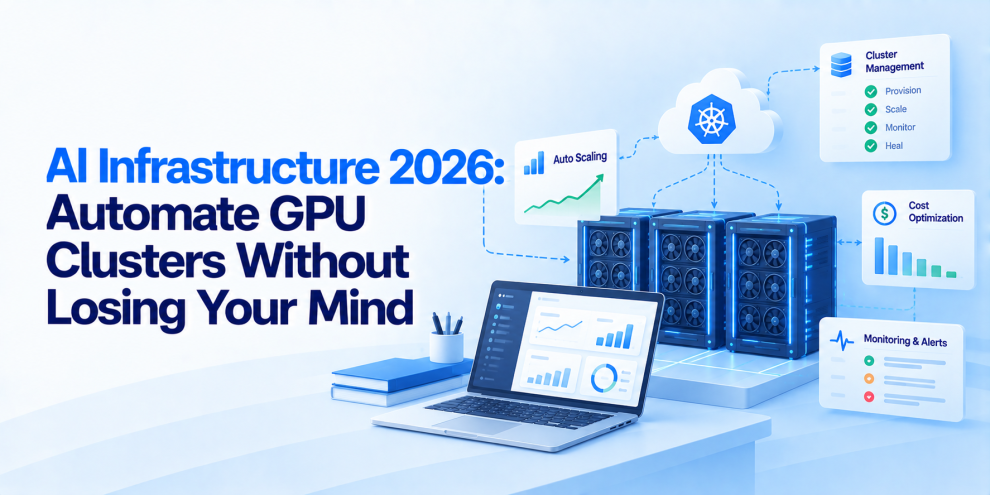

AI infrastructure has become one of the most demanding parts of modern DevOps. Training models, serving large language models, running inference workloads, and supporting AI agents require infrastructure that behaves very differently from a conventional web application stack. GPU clusters introduce specialized scheduling requirements, expensive compute resources, complex networking, high memory demands, and unpredictable workloads. A deployment problem that might cause a minor delay in a standard application can leave expensive accelerators idle or disrupt multiple AI services.
The challenge in 2026 is no longer simply provisioning GPUs. It is operating GPU infrastructure reliably, efficiently, and at scale without turning every workload into a manual DevOps exercise. Teams need automation that handles provisioning, scheduling, scaling, observability, capacity planning, and recovery while preserving control over cost and performance.
Why GPU Infrastructure Is Harder Than Traditional DevOps
Traditional infrastructure automation often assumes that workloads can be distributed across interchangeable compute resources. AI workloads complicate that assumption. GPUs differ in memory capacity, architecture, interconnect capabilities, and supported software configurations. A model that fits on one accelerator may require several others when its memory requirements increase. Some workloads need tightly connected GPUs, while others can run independently across available capacity.
Resource utilization also becomes harder to interpret. A GPU can appear active while delivering poor throughput because of CPU bottlenecks, slow storage, inefficient data loading, memory constraints, or communication overhead between accelerators. Simply adding more GPUs does not guarantee better performance.
For DevOps and platform engineering teams, this means GPU infrastructure requires more than ordinary infrastructure-as-code scripts. It needs workload-aware automation that understands resource requirements and makes scheduling decisions based on actual operating conditions.
Kubernetes Is the Starting Point, Not the Entire Solution
Kubernetes provides a familiar foundation for orchestrating containerized AI workloads. It supports workload scheduling, service discovery, health checks, resource requests, and automated recovery. GPU workloads can be exposed to Kubernetes through vendor device plugins and related integrations, allowing workloads to request accelerator resources.
However, basic Kubernetes scheduling does not automatically solve every GPU scheduling problem. A cluster can have available GPU capacity while still being unable to place a workload because the available devices do not meet its memory, topology, or placement requirements. Large distributed training jobs may need multiple compatible GPUs to become available together. Inference workloads may need predictable latency rather than simply the first available accelerator.
Teams should therefore treat Kubernetes as the orchestration foundation and add the scheduling, queueing, and capacity-management capabilities their workloads require. Depending on the environment, that may include specialized batch schedulers, workload queueing systems, GPU sharing mechanisms, or distributed training frameworks.
Automate Provisioning With Infrastructure as Code
Manually configuring GPU nodes is difficult to scale and easy to get wrong. Driver versions, container runtimes, CUDA compatibility, device plugins, networking, storage mounts, and monitoring agents all need to work together. A small configuration difference can create a workload that deploys successfully but fails when it attempts to initialize a model.
Infrastructure as code helps make GPU environments reproducible. Tools such as Terraform can provision cloud infrastructure, while configuration management and automated node initialization can establish the required software stack. Kubernetes manifests, Helm charts, and GitOps workflows can then manage cluster-level components and application deployments.
A production workflow should define the desired configuration, validate changes before rollout, and test the resulting environment before accepting workloads. GPU drivers and runtime components deserve particular care because an incompatible upgrade can affect every workload scheduled on a node.
The objective is to make a GPU node replaceable rather than dependent on undocumented manual setup.
Build a Repeatable GPU Deployment Pipeline
AI infrastructure should have a deployment pipeline just like application infrastructure. Changes to drivers, container images, model-serving runtimes, device plugins, and cluster policies should be reviewed, tested, and released through controlled workflows.
A practical pipeline can validate infrastructure definitions, scan container images, test runtime compatibility, deploy changes to a staging cluster, run a representative GPU workload, and promote the configuration only after required checks pass.
Versioning is especially important. Teams should track the combinations of GPU hardware, drivers, CUDA libraries, framework versions, and serving runtimes that have been tested together. When a deployment causes an inference failure or performance regression, this information makes it easier to identify the change responsible.
For critical AI services, canary deployments and controlled node-pool upgrades can reduce the impact of infrastructure changes. Instead of upgrading an entire cluster at once, teams can introduce changes to a limited group of nodes and validate their behavior before proceeding.
Scale GPU Capacity Based on Workloads
GPU scaling is not the same as scaling a stateless web service. Adding replicas may require finding available accelerators, pulling large container images, loading model weights, allocating GPU memory, warming up inference engines, and establishing communication between distributed workers. These steps can make scale-out slow and expensive.
Scaling policies should therefore account for workload characteristics. An inference service might scale based on request rate, queue depth, token throughput, or latency targets. A batch workload might scale according to queued jobs, deadlines, and available accelerator capacity. A training workload may require coordinated allocation of multiple GPUs rather than independent replica scaling.
Cluster autoscaling can add or remove nodes when resource demand changes, but it needs realistic provisioning and startup assumptions. If a workload requires a GPU type that is unavailable in the selected region or quota, an autoscaler cannot create capacity that does not exist.
Teams should also distinguish between scaling application replicas and scaling the underlying cluster. Both are necessary, but they solve different problems.
Stop Paying for Idle GPUs
GPU infrastructure can become expensive even when the applications running on it appear healthy. Dedicated nodes may remain allocated between training jobs, development environments may sit unused overnight, and inference services may reserve more capacity than their actual traffic requires.
A useful starting point is to separate GPU workloads into operational categories. Production inference may need warm capacity to protect latency. Development workloads can often use shared or scheduled resources. Batch inference and experimentation may tolerate queues and scheduled execution.
From there, teams can automate environment shutdown, job scheduling, capacity reservations, and scale-down policies where the workload permits them. GPU sharing or time-slicing may improve utilization for compatible workloads, but it is not a universal solution. Memory isolation, interference, reliability, and latency requirements need to be considered before multiple workloads share an accelerator.
Cost optimization should measure useful output, not just GPU utilization. For inference, that could mean cost per thousand requests or per million tokens. For training, it could mean cost per completed experiment or training run. These metrics help teams determine whether an infrastructure change actually improves economic efficiency.
Treat GPU Scheduling as a Platform Capability
When several teams share a GPU cluster, scheduling becomes an organizational problem as well as a technical one. Research workloads, development experiments, production inference, and model training may compete for the same expensive resources.
Without explicit policies, a long-running experiment can occupy capacity needed by a production service. Teams may also reserve accelerators they rarely use because they cannot predict whether resources will be available later.
A mature platform should define workload priorities, quotas, queueing policies, resource requests, and rules for preemption where appropriate. Production workloads may receive guaranteed capacity, while flexible batch jobs can use spare resources. Multi-tenant clusters also need clear ownership and usage reporting so teams understand how they consume shared capacity.
The goal is not to maximize utilization at any cost. It is to allocate GPU resources according to business priority, workload requirements, and service-level objectives.
Make GPU Observability Work Beyond Utilization
A dashboard showing GPU utilization is not enough to operate AI infrastructure reliably. Teams need to understand what the accelerators are doing, how efficiently workloads are using them, and where bottlenecks occur.
Infrastructure telemetry should include GPU utilization, memory consumption, power usage where available, temperature, errors, node health, and accelerator availability. Kubernetes metrics should reveal scheduling delays, pending pods, resource requests, restarts, and node pressure. Application-level metrics should cover inference latency, request throughput, queue depth, tokens per second, model loading time, and failures.
For distributed training, communication overhead, data-loading performance, and synchronization delays can explain why adding GPUs fails to improve training speed. For inference, time to first token and total request latency can reveal bottlenecks that hardware utilization alone misses.
Correlating infrastructure metrics with application traces and deployment events makes these signals more useful. An engineer should be able to determine whether a latency spike came from model-serving behavior, GPU memory pressure, a scheduling problem, a storage bottleneck, or a recent infrastructure change.
Automate Recovery Without Creating New Incidents
Self-healing mechanisms can reduce operational effort, but GPU recovery needs to be designed carefully. Restarting a failed inference pod may be straightforward. Recovering a distributed training job may require checkpoint restoration, coordinated worker replacement, and validation that the training state remains consistent.
Automation should distinguish between failures that can be retried safely and those that require intervention. Failed jobs should have retry limits and backoff policies. Repeated node failures should trigger isolation or escalation rather than endless rescheduling. Training workflows should use checkpoints and recovery procedures that have been tested under realistic failure conditions.
For production inference, readiness checks should verify that a model has loaded and is ready to serve traffic, not merely that the container process is running. During node maintenance or a hardware failure, traffic should be redirected only when replacement capacity is actually available.
The guiding principle is simple: automate recovery paths that are understood, observable, and reversible. Escalate when the system cannot establish that a remediation is safe.
Secure the GPU Infrastructure Supply Chain
AI infrastructure depends on more than the model itself. Container images, model weights, framework packages, drivers, plugins, deployment manifests, and external dependencies can all introduce security risks.
Teams should use trusted image registries, scan and sign relevant artifacts, pin dependencies, restrict administrative access, and manage credentials through approved secret-management systems. GPU nodes should run only the services and workloads they need, with network access restricted according to their role.
Model artifacts deserve specific attention. A model downloaded from an external source should not automatically be trusted simply because it is popular or compatible with a framework. Teams should verify its origin, review licensing and security considerations, and control how model files enter production environments.
Multi-tenant GPU platforms also need isolation appropriate to the sensitivity of their workloads. Namespace separation alone may not be sufficient for every threat model, particularly when workloads from different trust levels share underlying hardware. Stronger isolation may require dedicated node pools, restricted scheduling, or separate clusters.
Build a Unified AI Infrastructure Control Plane
As GPU deployments expand, teams can end up managing cloud provisioning, Kubernetes, model serving, batch scheduling, monitoring, cost allocation, and security through disconnected tools. This fragmentation increases operational complexity and makes it harder to understand the overall state of the platform.
A unified control plane does not necessarily mean buying or building one giant platform. It means creating consistent workflows and policies across the components. Developers should have a standard way to request GPU resources, deploy a model, inspect workload health, review usage, and understand deployment status.
Internal developer portals and self-service templates can make these capabilities accessible without requiring every team to understand the details of GPU drivers, cluster networking, or autoscaling. Platform teams can maintain the underlying guardrails while application teams focus on their workloads.
The best platform is not the one with the most abstractions. It is the one that reduces the number of infrastructure decisions developers must make manually without hiding important operational constraints.
What DevOps Teams Should Audit Before Scaling GPU Infrastructure
Before expanding a GPU platform, engineering teams should ask whether node configurations are reproducible, whether driver and runtime combinations are tested, and whether workloads request resources accurately. They should verify that autoscaling reflects actual demand, that priority policies protect critical services, and that idle capacity can be reclaimed safely. They should also check whether cost metrics reflect useful AI output, whether GPU failures trigger tested recovery procedures, and whether model artifacts and deployment permissions are adequately protected.
Most importantly, teams should know who owns the platform, which workloads depend on it, and how an infrastructure change will be validated before it reaches production.
Where Engineering Teams Fit
Building production-ready AI infrastructure requires coordination across DevOps, cloud architecture, Kubernetes, backend engineering, model deployment, observability, and security. GeekyAnts works across modern application architecture and AI engineering, making this broader engineering perspective relevant for organizations developing AI products that need dependable infrastructure behind them. The objective is to connect model-serving requirements with reliable deployment workflows, controlled infrastructure, and the operational practices required to support AI workloads beyond experimentation.
The Future of GPU Automation
GPU infrastructure will continue to evolve as organizations deploy larger models, expand inference workloads, and introduce AI agents into business-critical applications. The resulting challenge is not just obtaining more accelerators. It is ensuring that every GPU is provisioned correctly, assigned to the right workload, monitored effectively, and used in a way that justifies its cost.
The strongest DevOps teams will treat GPU clusters as managed platforms rather than collections of expensive machines. They will automate provisioning through infrastructure as code, standardize deployment pipelines, use workload-aware scheduling, optimize capacity around real demand, and connect GPU telemetry to application performance and cost outcomes.
The objective is not to automate every decision blindly. It is to make routine operations repeatable, failures recoverable, and resource allocation measurable. A well-automated GPU platform should reduce operational chaos, not simply make it happen faster.
For more, visit our homepage!



Add Comment