






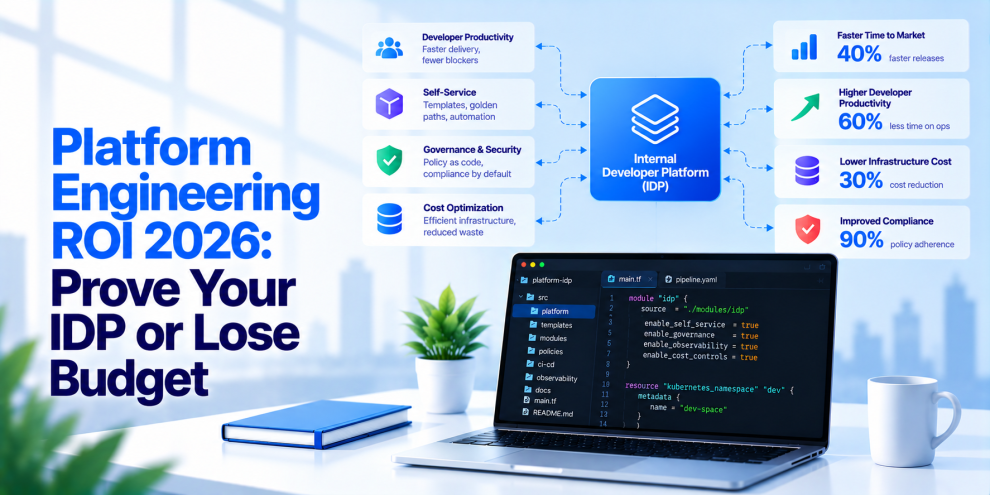

Platform engineering has become a strategic investment for organizations trying to scale software delivery without increasing operational complexity. Internal Developer Platforms (IDPs) promise faster deployments, standardized infrastructure, improved developer productivity, stronger security, and reduced cognitive load across engineering teams.
But there is a growing challenge in 2026: platform engineering teams are being asked to prove that their platforms deliver measurable business value.
Building an IDP is not the same as demonstrating its return on investment. A platform may have an impressive developer portal, automated infrastructure provisioning, reusable templates, and integrated CI/CD pipelines. Yet if engineering leaders cannot show how these capabilities improve delivery speed, reduce operational costs, or strengthen reliability, the platform risks being viewed as another expensive internal tool.
For CTOs, VPs of Engineering, and platform leaders, the question is no longer simply whether an organization needs platform engineering. It is whether the investment is producing measurable outcomes.
Why Platform Engineering ROI Matters in 2026
Engineering organizations are under pressure to deliver more with existing resources. Cloud spending is increasing, software systems are becoming more distributed, security requirements are expanding, and development teams are adopting AI-assisted coding tools.
In this environment, platform engineering needs to demonstrate that it reduces friction rather than creating another layer of processes.
An Internal Developer Platform can help developers access infrastructure, deployment workflows, observability, security controls, and approved services through standardized self-service experiences. However, these capabilities only create value when developers actually use them and when they improve measurable engineering outcomes.
A platform that developers avoid, work around, or find difficult to navigate may increase operational overhead instead of reducing it.
That is why ROI measurement needs to become part of the platform strategy from the beginning.
Start With Business Outcomes, Not Platform Features
One of the most common mistakes in platform engineering is measuring activity instead of impact.
Platform teams often report metrics such as:
- Number of developer portal users
- Number of golden paths created
- Number of reusable templates
- Number of services onboarded
- Number of infrastructure workflows automated
- Number of teams connected to the platform
These metrics help demonstrate adoption and platform activity, but they do not independently prove business value.
Engineering leaders need to connect platform capabilities to outcomes such as faster delivery, lower operational effort, improved reliability, reduced cloud waste, and stronger security.
For example, creating a self-service environment provisioning workflow is an activity. Reducing the time required for a development team to obtain a working environment is an outcome.
The distinction matters because budgets are justified by results, not feature counts.
Measure Developer Productivity Without Reducing It to Lines of Code
Developer productivity is one of the most important areas where platform engineering can create value. But it is also one of the easiest areas to measure incorrectly.
Lines of code, commits, pull requests, and hours spent coding do not provide a reliable picture of engineering productivity.
Instead, platform teams should measure how much time developers spend dealing with infrastructure, deployment processes, environment configuration, access requests, and repetitive operational tasks.
Useful indicators include:
Environment provisioning time: How long does it take a developer to obtain a usable development or testing environment?
Time to first deployment: How quickly can a new developer or service team move from onboarding to a successful deployment?
Self-service completion rate: How many common developer tasks can be completed without opening a ticket or contacting another team?
Developer waiting time: How much time is spent waiting for infrastructure, approvals, credentials, or platform support?
Developer experience feedback: Do developers find the platform easier to use than the previous processes?
These metrics help establish whether the IDP is removing friction from everyday engineering work.
Use DORA Metrics to Connect Platform Work With Delivery Performance
DORA metrics provide a useful framework for understanding software delivery performance. They help engineering leaders evaluate whether platform capabilities are improving the way teams build, deploy, and operate software.
The commonly used delivery metrics include:
- Deployment frequency: How often teams successfully release changes.
- Lead time for changes: How long it takes for a code change to reach production.
- Change failure rate: How frequently deployments cause failures requiring remediation.
- Failed deployment recovery time: How quickly teams recover from unsuccessful deployments.
These metrics should be interpreted in context. A platform should not be judged solely by whether deployment frequency increases. Faster delivery is not valuable if it comes with more production incidents or unstable releases.
For example, standardized CI/CD pipelines may reduce manual deployment steps and make releases more repeatable. Automated testing and security checks may help reduce change failures. Better rollback mechanisms and observability may improve recovery.
The objective is to connect specific platform capabilities with changes in delivery performance rather than assuming that platform adoption automatically improves every DORA metric.
Calculate the Cost of Developer Toil
Developer toil is repetitive operational work that consumes engineering time without creating meaningful new product value.
Examples include manually provisioning infrastructure, requesting access, configuring environments, updating pipeline templates, troubleshooting inconsistent deployments, and repeating the same operational tasks across teams.
An IDP can reduce this work through automation and self-service capabilities.
To estimate the potential financial impact, platform teams can use a simple model:
Estimated Annual Toil Savings = Hours Saved Per Developer Per Week × Number of Developers × Working Weeks × Loaded Hourly Cost
For example, assume a platform saves 1.5 hours per developer per week across 200 developers, with 46 working weeks annually and an illustrative loaded engineering cost of $75 per hour.
The estimated annual capacity recovered would be:
<escape>1.5 × 200 × 46 × $75 = $1,035,000</escape>
This represents an illustrative value of recovered engineering capacity, not guaranteed cash savings. The actual financial benefit depends on whether that capacity is redirected toward product delivery, reduced contractor spending, avoided hiring, or another measurable business outcome.
Platform teams should validate time savings through developer surveys, workflow telemetry, ticket data, and before-and-after comparisons rather than relying on assumptions.
Track Infrastructure and Cloud Cost Optimization
Platform engineering can also improve infrastructure efficiency by standardizing resource provisioning and making cloud consumption more visible.
Without centralized platform capabilities, teams may create oversized environments, leave unused resources running, duplicate infrastructure, or use inconsistent configurations.
An IDP can introduce approved infrastructure templates, automated cleanup, resource tagging, cost visibility, and policy-based provisioning.
Useful metrics include:
- Cloud cost per application or service
- Cost per deployment
- Idle resource expenditure
- Development environment utilization
- Infrastructure provisioning time
- Percentage of resources with ownership tags
- Cost savings from automated resource cleanup
The important distinction is between reducing cloud spending and improving cloud efficiency.
A platform may increase infrastructure usage because it enables more development activity. That is not necessarily a negative outcome. Engineering leaders should evaluate costs alongside workload volume, application performance, and business value delivered.
Measure Platform Adoption and Developer Experience
An IDP creates value only when teams use it.
A platform may offer excellent capabilities, but if developers continue relying on manual scripts, direct infrastructure access, or team-specific workflows, the investment is not delivering its full potential.
Platform adoption should therefore be measured beyond portal logins.
Consider tracking:
Active adoption: How many developers and teams use platform capabilities regularly?
Golden path adoption: What percentage of new services use approved templates and workflows?
Self-service usage: How frequently do developers complete tasks without manual platform-team intervention?
Workflow completion: How many platform workflows finish successfully without escalation?
Developer satisfaction: Do developers report that the platform makes their work easier?
Platform support demand: Are repetitive requests and support tickets declining?
These metrics reveal whether the IDP is becoming a trusted engineering foundation or simply another tool developers are expected to use.
Measure Reliability and Operational Risk
Platform engineering is not only about making developers faster. It also helps organizations establish consistent operational standards.
Standardized infrastructure templates, deployment workflows, monitoring integrations, and security policies can reduce configuration drift and make systems easier to operate.
Reliability metrics should include:
- Service availability
- Deployment-related incidents
- Mean time to recovery
- Infrastructure configuration drift
- Failed provisioning workflows
- Incident frequency
- Policy compliance
- Percentage of services with standard observability
For example, if the platform provides reusable monitoring and alerting configurations, teams may gain more consistent visibility into production services.
However, the platform’s contribution should be measured carefully. Improvements in reliability may also result from application changes, better operational practices, or infrastructure upgrades.
Attribution requires comparing similar workloads, documenting changes, and understanding which platform capabilities influenced the outcome.
Build an IDP ROI Model
A useful ROI model should include both the cost of building and operating the platform and the value it creates.
1. Calculate Total Platform Investment
Platform costs extend beyond the initial development effort.
Include:
- Platform engineering salaries and operational effort
- Developer portal and platform tooling licenses
- Cloud infrastructure and hosting
- CI/CD and observability costs
- Security and compliance integrations
- Training and onboarding
- Maintenance and ongoing development
This provides a more realistic picture of the investment.
2. Estimate Measurable Benefits
Identify the benefits that can be supported by evidence.
These may include:
- Reduced developer toil
- Lower infrastructure waste
- Reduced manual support effort
- Faster environment provisioning
- Lower deployment failure rates
- Reduced onboarding time
- Avoided tooling duplication
- Improved operational recovery
Avoid counting the same benefit twice. For example, time saved through automated provisioning should not also be counted as a separate productivity benefit unless the two measurements represent different outcomes.
3. Calculate ROI
A simple financial formula is:
ROI = [(Total Quantified Benefits − Total Platform Costs) ÷ Total Platform Costs] × 100
For example, assume an organization spends $800,000 annually building and operating an IDP and estimates $1.2 million in measurable annual benefits.
The illustrative ROI would be:
<escape>[(1,200,000 − 800,000) ÷ 800,000] × 100 = 50%</escape>
This model is only as reliable as its assumptions. Benefits should be validated through observed improvements, and financial calculations should distinguish between recovered capacity, avoided costs, and actual budget reductions.
Why Time Savings Are Not Always Cash Savings
This is an important distinction for platform leaders presenting ROI to finance teams.
If developers save two hours per week, the organization has recovered engineering capacity. It has not automatically reduced payroll expenditure.
That capacity becomes financial value when it supports additional product delivery, reduces the need for external contractors, avoids planned hiring, or contributes to another measurable outcome.
Similarly, faster deployment does not automatically generate revenue. The business impact depends on whether the organization can convert faster delivery into earlier releases, improved customer experiences, or faster response to market requirements.
A credible ROI report should explain how operational improvements translate into business outcomes.
Establish a Baseline Before Measuring Improvement
Platform teams should not wait until an IDP is fully deployed to start measuring performance.
Without a baseline, it becomes difficult to demonstrate whether the platform actually improved anything.
Before implementation, collect data on:
- Average environment provisioning time
- Developer onboarding duration
- Deployment lead time
- Manual support requests
- Infrastructure spending
- Deployment failure rates
- Developer satisfaction
- Time spent on repetitive operational tasks
After introducing platform capabilities, measure the same indicators over comparable periods.
Where possible, use pilot teams or services as comparison groups. This helps distinguish platform-driven improvements from organization-wide changes or seasonal workload differences.
A baseline turns platform ROI from a marketing claim into an engineering measurement exercise.
Avoid the Golden Path Adoption Trap
Golden paths are standardized, supported approaches for building, deploying, and operating applications.
They can reduce repeated engineering decisions and help teams follow approved security and operational practices.
But a golden path is not valuable simply because it exists.
If it is too restrictive, difficult to customize, or poorly aligned with application requirements, developers may bypass it.
Platform teams should measure whether golden paths are genuinely useful.
Useful indicators include adoption rates, successful workflow completion, exception requests, developer feedback, and the frequency of teams returning to manual processes.
The strongest IDPs provide a supported default while allowing controlled flexibility for legitimate engineering requirements.
AI Is Changing the Platform Engineering ROI Equation
AI-assisted development and agentic workflows are introducing another dimension to platform engineering.
Developers increasingly use AI tools to generate code, create tests, troubleshoot problems, and automate repetitive tasks. These capabilities can increase development speed, but they can also increase the volume of code and infrastructure changes entering engineering workflows.
An IDP can provide the standardized environment needed to manage this increased activity.
For example, platform teams can expose approved development environments, reusable service templates, secure deployment workflows, automated policy checks, and observability integrations to AI-assisted engineering tools.
AI agents may also interact with platform capabilities through controlled APIs and automation interfaces.
However, AI-generated changes should not receive privileged access simply because they originate from an approved tool. Identity, authorization, testing, policy enforcement, and auditability remain essential.
The ROI opportunity is not just faster code generation. It is reducing the operational friction required to move changes safely from development into production.
Common Mistakes That Make IDP ROI Difficult to Prove
Even well-designed platform initiatives can struggle to demonstrate value when measurement is treated as an afterthought.
Common mistakes include:
Measuring portal usage instead of outcomes: Logins and page views do not prove that developers are more productive.
Ignoring platform operating costs: An IDP requires ongoing engineering, infrastructure, licensing, and support.
Counting theoretical time savings as cash savings: Recovered engineering capacity should not be presented as direct financial savings without evidence.
Ignoring developer experience: A platform that increases friction may undermine adoption even if it offers extensive functionality.
Using inconsistent baselines: Comparing different teams, workloads, or time periods can produce misleading results.
Optimizing one metric in isolation: Faster deployment is not a success if reliability or security deteriorates.
Building too much before validating demand: Large platform investments should be tested against actual developer problems and adoption patterns.
Avoiding these mistakes makes ROI reporting more credible and helps platform teams prioritize work that creates measurable value.
A Practical 90-Day Plan to Demonstrate Platform Engineering ROI
Organizations do not need to wait several years to evaluate whether their platform investment is working. A focused 90-day measurement program can establish a useful initial picture.
Days 1–30: Establish the Baseline
Identify the most common developer bottlenecks. Collect provisioning times, deployment metrics, support requests, infrastructure costs, and developer feedback.
Select a small number of outcomes that matter to engineering and business leadership.
Days 31–60: Introduce Targeted Platform Improvements
Choose high-friction workflows such as environment provisioning, service creation, deployment automation, or access requests.
Implement or improve the relevant self-service capabilities and onboard a pilot group of developers.
Track workflow completion, support demand, and time saved.
Days 61–90: Compare and Report Results
Compare the pilot results with the baseline. Review adoption, delivery performance, operational reliability, developer satisfaction, and cost impact.
Document what improved, what did not, and which platform investments should be prioritized next.
The purpose of the 90-day program is not to claim that every platform benefit can be proven within three months. It is to establish a repeatable measurement process and identify whether the IDP is moving in the right direction.
Where Engineering Teams Fit
Building an effective Internal Developer Platform requires coordination across backend engineering, cloud infrastructure, DevOps automation, security, developer experience, and observability. Teams like GeekyAnts and Thoughtworks work across application engineering and modern technology architecture, making this broader engineering perspective relevant for organizations building or modernizing internal platforms.
For teams evaluating platform investments, the focus should be on connecting infrastructure automation and developer self-service with measurable delivery improvements. The objective is not to build the largest platform. It is to build capabilities that solve real engineering problems and demonstrate operational value.
Prove the Platform’s Value Before the Budget Review
Platform engineering is moving into a more outcome-driven phase. Engineering leaders are expected to explain not only what their IDP provides, but also how it changes the economics and performance of software delivery.
That requires a measurement strategy covering developer productivity, delivery performance, cloud efficiency, reliability, adoption, and total platform cost.
An IDP should make common engineering tasks easier, reduce unnecessary operational work, improve consistency, and help teams deliver software more safely. These benefits should be visible in real workflows and supported by credible data.
The strongest platform engineering teams will not defend their budgets by presenting a list of tools or features. They will demonstrate how the platform improves the way the organization builds, deploys, and operates software.
In 2026, platform engineering ROI is not about proving that an IDP exists. It is about proving that the organization is better because it does.
For more, visit our homepage!




Add Comment