






Deploying an LLM in a development environment is relatively straightforward. Keeping it reliable across production workloads, multiple environments, changing model versions, fluctuating traffic, and expensive GPU infrastructure is a different challenge.
As organizations move from AI prototypes to production applications, infrastructure teams must manage more than servers and containers. They need to coordinate model artifacts, inference runtimes, GPU resources, networking, security policies, autoscaling, deployment strategies, and monitoring. A configuration that works for a small demonstration may become unreliable when several teams deploy models with different resource requirements.
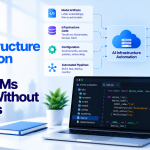
AI infrastructure automation addresses this complexity by making the provisioning, deployment, scaling, and operation of AI workloads repeatable. Instead of manually configuring every model deployment, engineering teams can use infrastructure as code, container orchestration, automated pipelines, policy enforcement, and model-serving platforms to manage the entire lifecycle.
The objective is not to automate every decision blindly. It is to build an infrastructure platform where AI workloads can be deployed consistently, scaled predictably, monitored continuously, and operated without creating unnecessary cost or operational risk.
Why AI Infrastructure Is Different From Traditional Infrastructure
Traditional application infrastructure usually centers on CPU and memory allocation, networking, storage, availability, and application scaling. AI workloads introduce additional variables.
An inference service may require a specific GPU architecture, substantial accelerator memory, model weights stored in a particular format, compatible drivers, and a runtime optimized for the model. Performance can depend on input length, output length, batching, concurrency, and the number of requests being processed simultaneously.
Training workloads introduce further requirements around distributed computation, checkpoint storage, data access, and long-running jobs.
This makes AI infrastructure harder to manage through generic deployment scripts alone.
A production environment needs to account for:
- GPU availability and accelerator memory.
- Model artifact versions and compatibility.
- Inference latency and throughput.
- Request queues and concurrency.
- Model loading and startup time.
- Scaling behavior under variable traffic.
- Hardware utilization and cost per workload.
- Security of model artifacts, datasets, and endpoints.
These requirements should be part of the infrastructure design rather than handled through manual intervention after deployment.
Build an Automated AI Infrastructure Stack
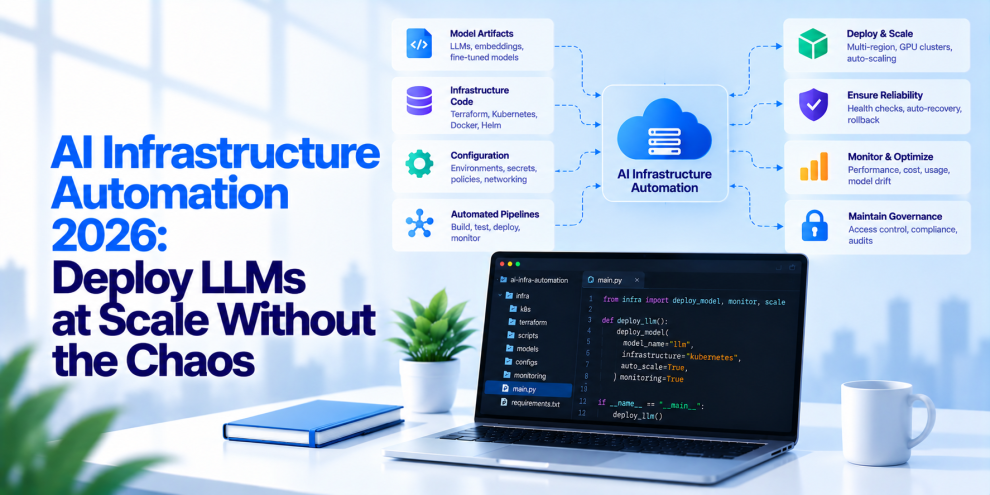
A scalable AI platform can be organized into several layers, each with a defined responsibility.
Infrastructure provisioning: Creates compute resources, networks, storage, identities, and supporting services through infrastructure as code.
Container and workload orchestration: Schedules model-serving workloads, manages deployment health, and coordinates resource allocation.
Model serving: Loads model artifacts and exposes inference endpoints through an appropriate serving runtime.
Deployment automation: Validates configurations, promotes approved artifacts, and manages releases across environments.
Observability and cost management: Tracks service health, inference performance, resource utilization, and infrastructure spending.
Security and governance: Enforces access controls, artifact verification, network restrictions, and operational policies.
These layers should work together through versioned configuration and automated workflows. The goal is to avoid a situation where infrastructure, model versions, deployment settings, and monitoring are managed independently.
Infrastructure as Code for AI Workloads
Manual infrastructure configuration becomes difficult to maintain when multiple models, teams, and environments are involved.
Infrastructure as code allows teams to define compute resources, networking, storage, permissions, and supporting infrastructure in version-controlled configuration.
Tools such as Terraform, OpenTofu, Pulumi, and cloud-native infrastructure templates can help provision the resources required by AI services. Configuration can then move through review, testing, and deployment pipelines in the same way as application code.
For example, an inference environment might require GPU-enabled compute, an isolated network, an artifact repository, a model-serving service, monitoring integrations, and a restricted service identity.
Rather than creating each component manually, the team can define the environment as a reusable module.
This improves consistency across development, staging, and production while making changes easier to review and reproduce.
However, infrastructure as code does not automatically make an environment safe. Teams still need to protect state files, manage secrets, review permissions, validate changes, and detect infrastructure drift.
Kubernetes Is Useful, but GPU Scheduling Needs Attention
Kubernetes is a common foundation for containerized AI infrastructure because it provides workload orchestration, service discovery, deployment management, and integration with cloud infrastructure.
For AI inference, Kubernetes can manage model-serving containers and schedule them onto nodes with the required accelerator resources. GPU support typically depends on the relevant device plugins, drivers, runtime configuration, and node setup.
The challenge is that GPU workloads do not behave exactly like ordinary stateless web services.
A pod may remain healthy from Kubernetes’ perspective while the inference service experiences long queues or poor response times. A model may require substantial memory before it can start accepting requests. Scaling the number of replicas may not help if the cluster has no available GPU capacity.
Teams should therefore define workload requirements explicitly, including accelerator type, memory needs, CPU allocation, storage, concurrency, and startup behavior.
Node pools can separate GPU workloads from general application workloads. Scheduling constraints can direct specific models to compatible hardware, while resource quotas can prevent one team from consuming all available capacity.
Kubernetes provides the orchestration foundation, but AI-aware capacity planning is still necessary.
Automate Model Deployment With CI/CD
AI infrastructure needs a delivery pipeline that manages more than container images.
A production release may involve application code, model weights, tokenizer files, inference runtime versions, serving configuration, prompt templates, and evaluation results. These components should be versioned and validated before they reach production.
A practical pipeline can follow this sequence:
Code and Model Changes → Automated Tests → Model Evaluation → Artifact Validation → Security Checks → Staging Deployment → Production Promotion
The exact steps depend on the workload, but the principle remains the same: production deployment should be based on verified artifacts and controlled configuration changes.
Model evaluation should be part of the release process when changes can affect output quality, latency, safety, or compatibility. Infrastructure validation should also confirm that the selected runtime and hardware can support the model.
Production releases should be traceable to the source revision, model version, serving configuration, and evaluation results that justified deployment.
This makes it easier to investigate regressions and roll back a release when necessary.
Model Versioning Must Include the Serving Environment
A model identifier alone is not enough to reproduce an AI deployment.
The same model weights can behave differently under different inference runtimes, quantization settings, tokenizer versions, batching policies, or hardware configurations.
Teams should track the complete deployment configuration, including:
- Model artifact and version.
- Container image and runtime version.
- Hardware requirements.
- Quantization and serving parameters.
- API and request schema versions.
- Evaluation results.
- Configuration and deployment revision.
When a new model version is released, the pipeline should verify that its dependencies and runtime settings remain compatible.
Immutable artifacts and explicit version references help prevent deployments from silently changing because a mutable image tag or model alias points to a different version.
This is particularly important when several teams share the same AI platform.
Autoscaling Must Understand AI Workloads
Autoscaling is essential when inference demand changes throughout the day. But scaling AI workloads based only on CPU utilization can produce poor results.
A GPU may be heavily utilized while requests remain within the required latency target. Conversely, a service may have moderate GPU utilization but unacceptable latency because requests are waiting in a queue or processing unusually long inputs.
AI-aware scaling can consider several signals:
- Request rate and concurrency.
- Queue depth and queue waiting time.
- Request latency percentiles.
- GPU utilization and accelerator memory.
- Active model instances.
- Tokens processed per second.
- Pending requests and rejected requests.
Kubernetes-based platforms can combine pod autoscaling with node provisioning mechanisms that add suitable compute when capacity is unavailable. The exact implementation depends on the serving stack and infrastructure provider.
Scaling policies should also account for model startup time. If loading a large model takes several minutes, reacting only after latency becomes unacceptable may be too late.
Pre-warmed capacity, queue management, admission controls, and workload-aware scaling can help maintain responsiveness.
Teams should set explicit scaling limits and monitor the cost of additional replicas. Otherwise, an autoscaler may respond to growing demand by creating expensive capacity without addressing the actual bottleneck.
Choose the Right Model-Serving Runtime
Infrastructure automation becomes more effective when the serving layer is designed for the workload.
Different serving systems optimize for different deployment patterns. vLLM is commonly used for high-throughput LLM serving, while NVIDIA Triton Inference Server supports a range of model-serving workloads. Hugging Face Text Generation Inference is another option for deploying language models.
The right choice depends on model compatibility, hardware, throughput requirements, operational maturity, and the features needed by the application.
For example, an application serving many concurrent LLM requests may benefit from continuous batching and efficient key-value cache management. A system hosting several types of models may prioritize a serving platform that supports multiple model formats and runtime configurations.
Infrastructure teams should benchmark candidate runtimes against representative workloads rather than relying solely on generic performance claims.
The serving runtime should also expose health checks, useful metrics, predictable startup behavior, and a clear upgrade path.
Treat GPU Capacity as a FinOps Problem
GPU infrastructure can become expensive when capacity is provisioned without a clear understanding of workload demand.
An idle GPU instance may continue generating costs even when no useful inference work is being performed. Oversized replicas, inefficient batching, excessive model copies, and poorly scheduled workloads can increase spending without improving the user experience.
AI infrastructure automation should therefore connect resource allocation with measurable workload requirements.
Useful cost metrics include:
- Cost per request or completed task.
- Cost per thousand generated tokens.
- GPU utilization and idle time.
- Throughput per accelerator.
- Cost of model loading and warm capacity.
- Failed or retried inference requests.
- Cost by model, team, and environment.
Teams can use these signals to compare deployment configurations and identify waste.
For development and evaluation workloads, scheduled shutdowns or temporary compute environments may reduce unnecessary spending. For production services, capacity decisions should balance cost with latency, availability, and recovery requirements.
The goal is not to maximize GPU utilization at all costs. A highly utilized system can still miss latency objectives. The objective is to deliver the required service level at a sustainable cost.
Secure the Entire AI Infrastructure Supply Chain
AI infrastructure introduces additional assets that need protection, including model weights, datasets, container images, serving runtimes, credentials, and inference endpoints.
A compromised artifact or overly privileged workload can expose sensitive data or affect multiple applications.
Security should be integrated into the deployment process.
Model and container artifacts should come from approved sources and be verified before deployment. Images should be scanned for vulnerabilities, dependencies should be tracked, and deployment identities should receive only the permissions they require.
Network policies can restrict communication between inference services and unrelated systems. Secrets should be supplied through controlled secret-management mechanisms rather than embedded in container images or configuration files.
Inference endpoints also need authentication, authorization, rate limiting, and abuse monitoring. Internal endpoints should not become publicly accessible simply because a service was deployed into a shared cluster.
For sensitive workloads, teams should consider tenant isolation, data retention controls, encryption, and restrictions on where model inputs and outputs can be logged.
Automation should enforce these controls consistently across environments rather than relying on each project team to configure them independently.
Observability Must Connect Infrastructure to Model Performance
Traditional infrastructure monitoring tells teams whether a node is available, a container is running, or a service is responding.
AI operations require additional visibility into what the model-serving system is doing.
A deployment can appear healthy while delivering poor inference performance or producing a high rate of failed requests. Monitoring only pod status and CPU usage will not explain these problems.
An AI observability strategy should combine infrastructure signals with application and inference metrics.
Infrastructure metrics include node availability, GPU utilization, accelerator memory, container restarts, network throughput, and storage performance.
Serving metrics include request rate, queue depth, time to first token, time per output token, throughput, and latency percentiles.
Operational metrics include model loading failures, timeout rates, rejected requests, deployment errors, and scaling events.
Quality metrics can include evaluation results, task success, and application-specific output checks, where these can be measured reliably.
Distributed traces can connect an incoming request to the inference endpoint and downstream dependencies. Model and configuration versions should also be associated with deployment telemetry so teams can compare behavior across releases.
Because prompts and outputs may contain sensitive information, observability systems should avoid collecting full payloads by default. Diagnostic metadata is often sufficient for investigating performance and reliability issues.
Make AI Infrastructure Recoverable
Automated deployments need a clear recovery strategy.
A model update may introduce latency regressions, incompatibilities, memory pressure, or lower task quality. A runtime upgrade may expose a bug. A configuration change may prevent a model from loading.
Teams should define what constitutes an unhealthy release and how the platform responds.
Depending on the application, the recovery process might include rolling back the serving image, restoring a previous model artifact, shifting traffic to a known-good deployment, or temporarily routing requests to an alternative model.
Canary releases and progressive traffic shifting help limit exposure while teams evaluate a new version. Automated rollback should use multiple meaningful signals rather than a single noisy metric.
For example, a release might be evaluated against error rates, latency, resource pressure, and a set of model-quality checks. A failure in a critical signal can pause promotion or trigger rollback.
Recovery procedures should be tested regularly. A rollback strategy that has never been exercised may fail precisely when the system needs it most.
Standardize AI Infrastructure Through Platform Engineering
When each product team builds its own model-serving infrastructure, organizations often end up with duplicated deployment scripts, inconsistent security settings, different monitoring approaches, and unpredictable GPU costs.
Platform engineering can reduce this fragmentation by providing reusable building blocks.
A central AI platform might offer approved model-serving templates, standardized CI/CD workflows, infrastructure modules, observability integrations, access policies, and documented deployment patterns.
Product teams can then deploy AI workloads through supported interfaces without having to become experts in every underlying infrastructure component.
The platform should still allow appropriate flexibility. A small classification model and a large generative model may require different hardware, scaling, and serving configurations.
The aim is to standardize common controls and operational practices while allowing workload-specific optimization where needed.
A Practical Roadmap for AI Infrastructure Automation
Organizations can introduce AI infrastructure automation in stages.
Stage 1: Inventory existing AI workloads. Identify models, runtimes, compute requirements, environments, dependencies, and current operational pain points.
Stage 2: Standardize provisioning. Move infrastructure configuration into version control and create reusable modules for networks, identities, compute, storage, and monitoring.
Stage 3: Automate deployment. Build CI/CD pipelines that validate model artifacts, container images, serving configuration, and evaluation results before promotion.
Stage 4: Introduce workload-aware scaling. Measure request behavior, latency, queueing, and accelerator utilization before configuring autoscaling and capacity limits.
Stage 5: Add security and governance policies. Enforce artifact verification, least privilege, secret management, endpoint protection, and environment separation.
Stage 6: Optimize cost and reliability. Establish service objectives, cost metrics, rollback procedures, and regular performance evaluations.
This staged approach helps teams build a repeatable foundation before introducing more advanced automation.
Where Engineering Teams Fit
Moving AI workloads into production requires coordination across cloud infrastructure, DevOps, backend engineering, model serving, security, and observability. Teams like GeekyAnts and Thoughtworks work across AI engineering and application architecture, making this broader engineering approach relevant for organizations that need to operationalize AI beyond isolated prototypes.
The objective is to build infrastructure that supports model deployment, scaling, monitoring, and governance as connected engineering capabilities rather than separate operational tasks.
Deploy AI at Scale Without Losing Control
AI infrastructure automation is becoming essential as organizations operate more models, serve more requests, and distribute AI workloads across different environments.
The challenge is not simply provisioning GPU instances or deploying a model container. It is coordinating infrastructure, model artifacts, serving runtimes, security, scaling, observability, and cost management throughout the deployment lifecycle.
The strongest platforms combine infrastructure as code, controlled CI/CD, suitable model-serving runtimes, workload-aware autoscaling, artifact verification, clear recovery procedures, and consistent operational policies.
Automation should make deployments more repeatable, but it should also make failures easier to detect, changes easier to audit, and infrastructure easier to recover.
In 2026, the objective is not to automate every infrastructure decision without oversight. It is to create an AI platform where models can be deployed and scaled efficiently while reliability, security, and cost remain under engineering control.
For more, visit our homepage!



Add Comment