





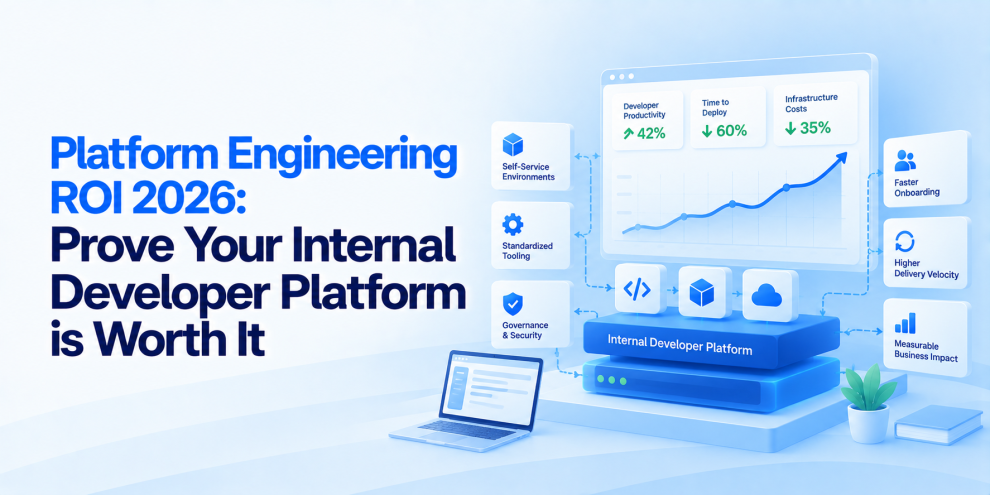

Platform engineering has become a major DevOps strategy for organizations managing hundreds or thousands of developers. Internal developer platforms promise faster delivery, fewer operational bottlenecks, more consistent infrastructure, and a better developer experience. But there is a problem that platform teams increasingly have to answer: What measurable value is the platform actually creating?
Building an internal developer platform can require significant investment. Engineering teams may spend months creating self-service workflows, infrastructure templates, deployment automation, observability integrations, security guardrails, and developer portals. If the platform is measured only by the number of features delivered, leadership may struggle to understand whether the investment is producing meaningful business value.
In 2026, platform engineering needs to move beyond “we built the platform.” The conversation needs to become “the platform improved these engineering and business outcomes.”
Why Platform Engineering ROI Is Difficult to Measure
Traditional DevOps investments can sometimes be connected to relatively direct outcomes. A deployment automation project might reduce deployment time. Infrastructure optimization might reduce cloud spending. Monitoring improvements might reduce incident resolution time.
Platform engineering is broader.
An internal developer platform can influence development workflows, infrastructure provisioning, security, deployment processes, compliance, onboarding, and operational reliability simultaneously.
That makes attribution difficult.
A developer portal may not directly generate revenue. A reusable deployment template may not appear as a line item in financial reports. Automated environment provisioning may save hours across dozens of teams rather than producing one obvious cost reduction.
The answer is not to avoid measurement. It is to measure the platform at the points where it changes engineering behavior and operational outcomes.
Start With Developer Time
One of the clearest platform engineering metrics is the amount of engineering effort removed from repetitive operational work.
Before a platform exists, developers may need to create infrastructure configuration, request cloud resources, configure CI/CD pipelines, set up monitoring, manage secrets, and coordinate with platform or infrastructure teams.
An internal platform can turn many of those activities into standardized self-service workflows.
The relevant question is not simply how many workflows exist.
It is:
How much engineering time does each workflow eliminate?
If a service environment previously required several hours of manual setup and the platform reduces that process to minutes, the organization has created measurable capacity.
That capacity can then be connected to developer productivity, delivery speed, or reduced operational workload.
Measure Time to First Deployment
Developer onboarding is another useful measurement area.
A new engineer or team may previously have needed to understand repositories, infrastructure, deployment systems, cloud permissions, monitoring configuration, and operational processes before shipping their first change.
A platform can provide standardized paths through those systems.
This makes time to first deployment a practical platform metric.
If a new service can move from repository creation to a production-ready deployment through a documented and automated workflow, the platform is reducing organizational friction.
The measurement should capture the process before and after platform adoption rather than relying on subjective claims that the developer experience “feels better.”
Track Deployment Frequency, But Add Context
Platform teams often track deployment frequency because delivery automation is one of the capabilities an internal platform provides.
But deployment frequency alone can be misleading.
A team might deploy frequently without improving customer outcomes. Another team may deploy less frequently because its application has different operational requirements.
Deployment frequency is therefore more useful when combined with other engineering performance indicators such as lead time for changes, change failure rate, and recovery time.
The objective is to determine whether the platform makes delivery faster without making production less reliable.
Measure Lead Time From Commit to Production
One of the strongest indicators of platform impact is the time between a code change and a successful production deployment.
A platform can reduce this time by standardizing CI/CD workflows, automated testing, infrastructure provisioning, security checks, artifact management, and deployment processes.
But the baseline matters.
If the median lead time was several hours before platform adoption and falls substantially afterward, the platform has a measurable operational impact.
This is more meaningful than reporting how many pipeline templates the platform team created.
Reliability Is Part of Platform ROI
Platform engineering should not optimize only for developer speed.
A platform that enables rapid deployments but increases production incidents is not necessarily creating value.
Reliability should therefore be part of the ROI model.
Useful measures include change failure rate, mean time to recovery, deployment rollback frequency, incident frequency, and the number of production issues caused by configuration inconsistencies.
Standardized platform workflows can reduce configuration drift and make reliable deployment patterns easier to reproduce.
The result is not simply faster engineering.
It is more predictable engineering.
Self-Service Adoption Is a Critical Metric
A platform only creates value when developers actually use it.
A sophisticated internal developer platform with low adoption is an expensive internal product that has not reached product-market fit.
Platform teams should measure adoption across teams, services, workflows, and environments.
Useful signals include the percentage of new services created through the platform, percentage of deployments using standardized workflows, active platform users, and the proportion of infrastructure requests completed through self-service.
Low adoption should trigger investigation rather than simply being reported as a negative metric.
Developers may avoid the platform because workflows are too restrictive, documentation is poor, onboarding is difficult, or the platform does not solve the problems they actually experience.
Measure the Cost of the Platform Itself
ROI calculations need to include platform costs.
That means accounting for engineering headcount, infrastructure, developer portal tooling, CI/CD infrastructure, observability, maintenance, support, training, and ongoing platform development.
A platform that saves developers time but requires an enormous amount of maintenance may have a weaker business case than expected.
Platform teams should therefore track the total cost of ownership alongside the benefits they generate.
The goal is not to minimize platform spending at all costs.
It is to understand whether the value generated is greater than the cost required to operate the platform.
Avoid Counting Automation Twice
One common measurement mistake is claiming the same efficiency gain across multiple metrics.
For example, if automated infrastructure provisioning saves engineering teams time, that benefit should not be counted again as a separate financial saving simply because deployment time also decreased.
Platform ROI should distinguish between related indicators and actual economic outcomes.
A useful model separates leading indicators from business outcomes.
Leading indicators might include platform adoption, self-service usage, workflow completion rates, and developer satisfaction.
Outcome indicators might include engineering hours saved, reduced operational costs, lower incident impact, faster product delivery, and improved reliability.
Developer Experience Needs Quantitative Evidence
Developer experience is often discussed as a qualitative concept, but parts of it can be measured.
Teams can track time spent waiting for environments, time spent troubleshooting CI/CD failures, infrastructure request turnaround time, onboarding duration, support tickets, and repeated manual tasks.
Developer surveys can provide additional context, but they should complement behavioral data rather than replace it.
If developers report that the platform is easier to use and telemetry shows that infrastructure requests have also decreased, the evidence becomes stronger.
Platform Golden Paths Should Have Business Metrics
Golden paths are a common platform engineering concept. They provide recommended workflows for building, deploying, and operating services.
But creating a golden path is not an achievement by itself.
The platform team should measure whether teams actually use it and whether using it produces better outcomes.
For example, a standardized service template might include CI/CD, security scanning, observability, secrets management, and deployment automation.
The relevant measurements could include adoption rate, setup time, deployment success rate, security-control coverage, and operational incidents compared with services that do not use the template.
The platform becomes measurable when its capabilities are connected to outcomes.
Cloud Cost Can Be Part of the ROI Equation
Internal platforms can also influence infrastructure efficiency.
Standardized infrastructure configurations can reduce unnecessary resource allocation. Automated environment lifecycle management can prevent idle environments from running indefinitely. Policies can help enforce tagging, resource limits, and approved infrastructure patterns.
However, platform teams should avoid claiming cloud savings simply because a platform exists.
Cloud cost reduction needs to be demonstrated through measurable changes in resource utilization, waste, environment lifecycle, or infrastructure efficiency.
Platform engineering can contribute to FinOps, but the relationship should be measured rather than assumed.
Security and Compliance Have Economic Value
Security controls are another area where platform ROI can be difficult to quantify.
An internal platform can automatically apply security scanning, secrets management, identity controls, policy enforcement, audit logging, and approved deployment configurations.
These capabilities may reduce the likelihood of security incidents and make compliance processes more efficient.
Not every security benefit can be converted into a precise financial figure.
However, teams can still measure control coverage, audit preparation time, policy violations, remediation effort, and the percentage of workloads meeting required security standards.
Reducing manual compliance work can itself represent meaningful operational value.
Platform Metrics Need a Baseline
The most important rule for measuring ROI is simple: measure before and after.
A platform team cannot demonstrate improvement without knowing what the process looked like before the platform changed it.
Before introducing a new capability, capture baseline measurements such as deployment lead time, environment provisioning time, infrastructure request volume, incident frequency, onboarding duration, and manual operational effort.
After adoption, compare the same measurements.
This makes the ROI conversation evidence-based rather than dependent on platform-team narratives.
Build a Platform ROI Scorecard
A practical scorecard can combine several categories.
Developer productivity: onboarding time, environment setup time, manual tasks eliminated, developer waiting time.
Delivery performance: deployment frequency, lead time for changes, deployment success rate, rollback rate.
Reliability: change failure rate, recovery time, incident frequency, configuration-related incidents.
Adoption: active users, platform usage, golden-path adoption, self-service completion.
Financial impact: platform operating cost, engineering hours saved, infrastructure savings, support effort reduced.
Security and compliance: policy coverage, security-control adoption, audit effort, policy violations.
No single metric should determine whether a platform is successful. The value comes from looking at the relationship between these indicators.
Do Not Optimize for Vanity Metrics
Platform teams can easily fall into the trap of measuring activity instead of outcomes.
The number of templates created, number of portal pages, number of APIs exposed, or number of platform features shipped may demonstrate that the team is busy.
They do not prove that developers are more productive.
A better question is whether engineers can complete common tasks with less waiting, fewer manual steps, fewer errors, and less operational coordination.
Platform engineering should be treated like an internal product organization.
Its users are developers.
Its success should therefore be measured by the outcomes those users achieve.
Where Engineering Partners Fit
Building an internal developer platform that produces measurable DevOps outcomes requires expertise across cloud infrastructure, CI/CD, Kubernetes, developer experience, observability, security, automation, and platform architecture. Engineering organizations such as GeekyAnts help teams design these capabilities around measurable engineering outcomes rather than simply adding another internal tooling layer.
The objective is to build a platform that developers choose because it makes their work easier while giving engineering leadership greater consistency, security, and operational visibility.
What DevOps Leaders Should Audit
Before expanding an internal developer platform, engineering leaders should ask: What problem is the platform solving? What was the baseline before adoption? Which teams are using it? How much developer time does each workflow save? Has deployment lead time improved? Has reliability changed? Are developers actually using the golden paths? What does the platform cost to operate? Are security and compliance controls being adopted? Can platform benefits be connected to measurable business outcomes?
If these questions cannot be answered, the platform may be growing faster than its business case.
Proving That the Platform Is Worth It
Platform engineering is not successful because a team built a developer portal, standardized Kubernetes templates, or created another deployment abstraction.
It is successful when those capabilities produce measurable improvements.
Developers spend less time waiting for infrastructure. Services reach production faster. Deployments become more consistent. Incidents become easier to recover from. Security controls become easier to apply. Infrastructure becomes easier to operate.
That is the real ROI of an internal developer platform.
In 2026, platform teams should stop measuring success by how much infrastructure they build and start measuring how much engineering friction they remove.
The strongest platform is not the one with the most features.
It is the one whose value can be demonstrated with evidence.
For more, visit our homepage!






Add Comment