



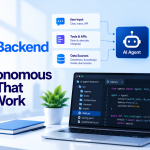

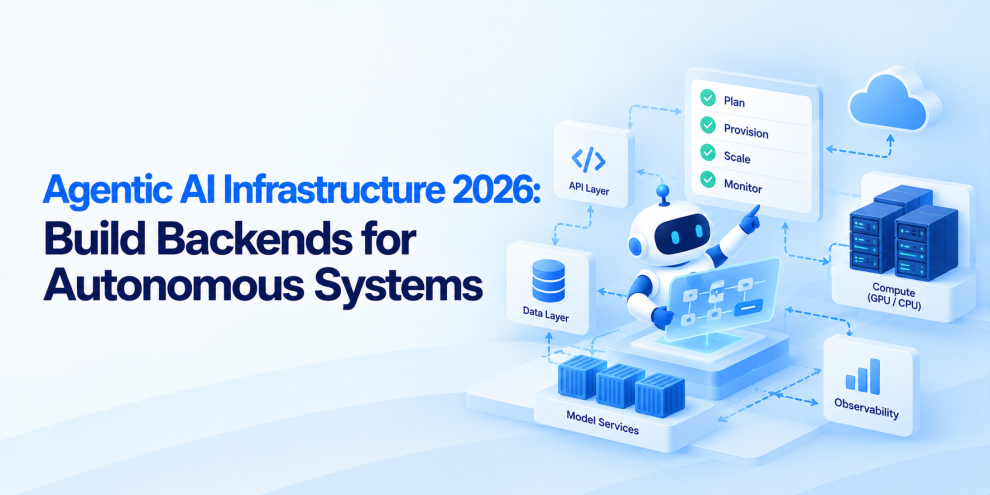

Agentic AI changes the backend problem. A traditional AI application usually receives a request, sends it to a model, gets a response, and returns it to the user. An autonomous system can interpret a goal, plan multiple steps, retrieve information, call tools, interact with enterprise systems, evaluate results, retry failed operations, and continue working without another user request.
For large enterprises, that difference is significant. One customer request could trigger several model calls, database queries, API requests, retrieval operations, and business workflows. The infrastructure therefore needs to support much more than model inference. It needs durable execution, identity, authorization, state management, queues, observability, security, and controls around autonomy.
For technology leaders, the key question in 2026 is no longer simply which AI model to deploy. It is whether the existing backend can safely support the workload an autonomous system creates.
Agentic AI Is a Backend Workload
It is easy to think of an agent as a chatbot with additional capabilities. In an enterprise environment, the reality is much closer to a distributed workflow.
A customer-service agent might retrieve account information, search internal documentation, check transaction history, create a support ticket, call another service, and summarize the outcome. One request can therefore become many backend operations.
This creates workflow amplification. The number of downstream operations can be significantly larger than the number of incoming user requests.
Infrastructure teams need to plan around that amplification. Capacity cannot be calculated only from API traffic. It must account for model calls, tool execution, database activity, queues, external APIs, and concurrent workflows.
Durable Execution Should Be a Core Capability
Agent workflows do not always finish within a normal API request. Some may take minutes or wait for external systems, approvals, or human intervention.
Keeping an HTTP request open throughout that process creates unnecessary reliability risks. A better architecture moves long-running execution into durable workflows, queues, workers, or event-driven systems.
Consider an agent processing an enterprise claim. It may retrieve documents, validate information, call an external service, wait for a response, and request additional review. If the worker fails halfway through the process, the system should know which steps were completed and where execution should resume.
Durable execution turns an agent workflow into a recoverable business process rather than a fragile chain of API calls.
Separate Agent State From Conversation History
Conversation history and execution state serve different purposes.
Conversation history records what the user and agent discussed. Execution state records what the agent is currently doing.
For an enterprise workflow, durable state may include completed actions, pending tasks, tool results, approvals, retries, errors, workflow stages, deadlines, and execution identifiers.
Keeping these concerns separate makes recovery, auditing, debugging, and scaling easier. It also prevents the conversation database from becoming the storage layer for every aspect of an autonomous workflow.
Give Agents Narrowly Scoped Tools
Agents need access to enterprise capabilities, but unrestricted access is a major architectural risk.
A generic SQL interface, arbitrary HTTP client, or shell environment gives an agent far more authority than most business workflows require.
Instead, tools should represent specific business operations such as retrieving an account, creating a support case, checking payment status, scheduling an appointment, or updating a customer preference.
Each tool should define its inputs, permissions, resource scope, validation rules, and potential side effects.
This creates a controlled boundary between probabilistic model behavior and deterministic enterprise systems.
Authorization Must Stay Outside the Model
An agent can decide that it wants to perform an action. It should never be the component that determines whether the action is authorized.
The backend must independently validate identity, permissions, resource ownership, tenant boundaries, and business policies.
For example, if an agent decides to retrieve a customer record, the backend should determine whether the requesting identity has permission to access that record. The fact that the model selected the operation is irrelevant to the authorization decision.
This separation becomes critical as enterprises connect agents to sensitive customer, financial, operational, and employee systems.
Agent Identity and Least Privilege
Autonomous agents need explicit identities.
A production platform should be able to determine which user initiated a workflow, which agent executed an operation, which service performed it, and which permissions were active at the time.
Agent permissions should also follow least privilege.
A customer-support agent may need to read account information and create tickets but should not have access to unrestricted customer databases. An infrastructure agent might restart selected workloads but should not automatically receive permissions to modify networking or delete production resources.
Permissions should be limited by agent, tool, environment, resource, and operation.
The more autonomy an agent receives, the more important this becomes.
Design Every Agent Action for Failure
Autonomous systems retry. Networks fail, workers restart, APIs time out, and queues can deliver the same task more than once.
This makes idempotency essential.
If an agent creates a ticket, submits a transaction, updates customer information, or provisions infrastructure, repeating the same operation should not unintentionally create a second action.
Idempotency keys, operation identifiers, transaction boundaries, and durable execution state can help the backend distinguish a new operation from a retry.
Agentic infrastructure should also expect partial failure. A workflow may successfully complete three steps and fail on the fourth. Recovery mechanisms should support checkpoints, retries, compensating actions, or human escalation rather than treating the entire workflow as a single atomic request.
Queues and Backpressure Protect Enterprise Systems
Queues provide an important separation between incoming requests and long-running agent execution.
They allow workloads to be distributed across workers, retried independently, prioritized, and controlled according to available capacity.
Backpressure is equally important. An agent can potentially generate work faster than a downstream database or API can handle it. Without limits, repeated retries or autonomous loops can create traffic spikes and affect unrelated applications.
Enterprise platforms should therefore enforce queue limits, concurrency limits, rate limits, retry budgets, timeouts, and circuit breakers.
When a downstream system is overloaded, the agent should slow down, defer work, or escalate rather than continuing indefinitely.
Put Hard Limits Around Autonomy
An agent can get stuck.
It may repeatedly call the same tool, alternate between two actions, or continue reasoning without reaching a useful result.
The backend should not depend on the model recognizing that it is stuck.
Execution boundaries can include maximum workflow duration, maximum tool calls, maximum retries, token budgets, and cost limits.
These controls create a practical definition of autonomy: the agent can operate independently, but only within boundaries established by the platform.
Model Routing Becomes Infrastructure
Large enterprises are unlikely to use one model for every agent task.
A lightweight model may handle classification or routing. A more capable model may handle complex planning. A specialized model may perform extraction or summarization. A private or local model may be appropriate for sensitive workloads.
The backend can route requests based on task complexity, latency requirements, cost, privacy, and availability.
This also improves resilience. If one provider becomes unavailable or experiences elevated latency, the platform can potentially fall back to another model or reduce functionality gracefully.
Model routing should therefore be treated as a shared platform capability rather than implemented independently inside every application.
Retrieval Must Respect Enterprise Data Boundaries
Agents become significantly more useful when they can access internal knowledge, but retrieval introduces another security boundary.
A retrieval system should not simply return the most relevant information. It needs to consider the user’s identity, role, tenant, resource ownership, and data sensitivity.
An agent should receive only the information its execution context is authorized to use.
This is especially important for large organizations with multiple business units and sensitive datasets. A retrieval mistake can expose information across organizational boundaries even when the model itself is behaving normally.
Authorization needs to happen before information reaches the model.
Observability Must Follow the Workflow
Traditional application monitoring can tell teams that a service is unhealthy. Agentic observability needs to explain what the agent actually did.
A useful trace should connect the original request with the agent execution, model calls, retrieval operations, tool invocations, queues, backend services, retries, failures, and final outcome.
Technology leaders should be able to determine which agent ran, which user initiated it, which tools were called, how many times they were called, where latency occurred, which authorization decisions were applied, and why the workflow ultimately succeeded or failed.
This is closer to distributed-systems observability than conventional chatbot monitoring.
Sensitive prompts, responses, credentials, and customer information should also be protected from unnecessary collection in telemetry.
Cost Is an Infrastructure Constraint
Autonomous systems can continue generating work without another explicit user request.
That makes cost control part of infrastructure design.
Teams should monitor model usage, token consumption, tool executions, compute time, external API usage, and workflow costs. Budgets can be established at the agent, workflow, tenant, or environment level.
Cost limits are not simply financial controls. They can prevent runaway workflows from consuming infrastructure resources and affecting other workloads.
An agent that can continue spending indefinitely is an operational risk.
Build a Control Plane Around Autonomous Actions
The safest architecture separates intelligence from execution authority.
The model can reason about what should happen. A deterministic control layer should decide whether the proposed action is allowed.
A practical architecture is:
User Request → Agent Runtime → Policy Evaluation → Tool Authorization → Execution → Verification
The policy layer can evaluate permissions, risk, resource scope, environment, cost, and reversibility.
Low-risk actions may execute automatically. Higher-risk operations can require additional validation or human approval.
This allows enterprises to increase autonomy without giving the model unrestricted control over critical systems.
Risk-Based Human Approval
Not every agent action requires human intervention.
A read-only search can usually be autonomous. Creating a support ticket may also be automated. Changing sensitive financial information may require additional verification. Deleting production data or changing critical infrastructure should receive much stronger controls.
The objective is to automate low-risk work while preserving human judgment for actions with significant business, security, financial, or operational consequences.
For large enterprises, defining these risk tiers should be a platform governance exercise rather than an application-by-application decision.
Test Agents Like Distributed Systems
Traditional unit tests are insufficient for autonomous workflows.
Agent behavior can change based on model output, retrieved information, tool responses, timing, service failures, and changing context.
Testing should therefore include failure scenarios.
What happens when a tool times out? What happens when the model produces an invalid parameter? What happens when permissions change during execution? What happens when a queue redelivers a task? What happens when the agent reaches its maximum execution limit?
Enterprise testing should also cover tenant isolation, authorization boundaries, model fallback, downstream service failures, disaster recovery, and recovery from partially completed workflows.
The goal is to understand not only whether the agent works, but how the platform behaves when the agent or its dependencies do not.
Scale Infrastructure Around Workflow Amplification
Traditional capacity planning often starts with requests per second.
Agentic systems require another metric: how much downstream work does one request generate?
If one agent request triggers eight tool calls and several model operations, 10,000 incoming requests can translate into a much larger volume of internal activity.
Infrastructure planning should therefore account for workflow amplification, concurrency, queue depth, database load, model throughput, downstream service limits, and external API quotas.
The backend needs to scale around the actual work generated by the agent.
Where Engineering Partners Fit
Building production-grade agentic infrastructure requires expertise across backend engineering, distributed systems, cloud infrastructure, AI engineering, security, observability, and DevOps.
Engineering organizations such as GeekyAnts help enterprises bring these capabilities together, from agent-aware backend architecture and controlled tool execution to workflow infrastructure, observability, and production security.
The objective is not simply to make agents capable of performing more actions. It is to create an infrastructure foundation where increased autonomy does not compromise reliability, governance, security, or operational control.
What Technology Leaders Should Audit
Before deploying autonomous AI at enterprise scale, leaders should ask whether long-running workflows can recover from failures, whether agent state is durable, whether tools are narrowly scoped, whether authorization remains independent of the model, and whether every agent has an explicit identity.
They should also examine whether tool calls are idempotent, whether queues have backpressure, whether retries and execution limits are enforced, whether retrieval respects tenant and role boundaries, whether model routing is centrally managed, and whether engineers can reconstruct an entire agent workflow through observability data.
Finally, organizations should determine which actions require human approval and whether agent permissions can be revoked quickly during an incident.
These questions distinguish an autonomous platform from an LLM that has simply been connected to production APIs.
The Infrastructure Layer Will Define Agentic AI
The model may be the visible part of an agentic application, but the infrastructure determines whether that application can operate safely at enterprise scale.
As agents become capable of interacting with more systems, the backend must provide durable execution, narrowly scoped tools, explicit authorization, resilient state management, queues, backpressure, observability, cost controls, and policy enforcement.
For large organizations, the strategic opportunity is not simply deploying more capable agents. It is creating a common infrastructure layer that allows those agents to operate across existing digital platforms without weakening the controls that keep those platforms reliable.
The goal is not an AI system that can do everything.
It is an AI system that can do the right things reliably, within clearly defined boundaries, even when the environment around it fails.
That is the real infrastructure challenge of agentic AI in 2026.
For more, visit our homepage!


Add Comment