



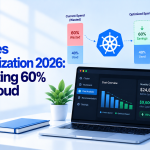


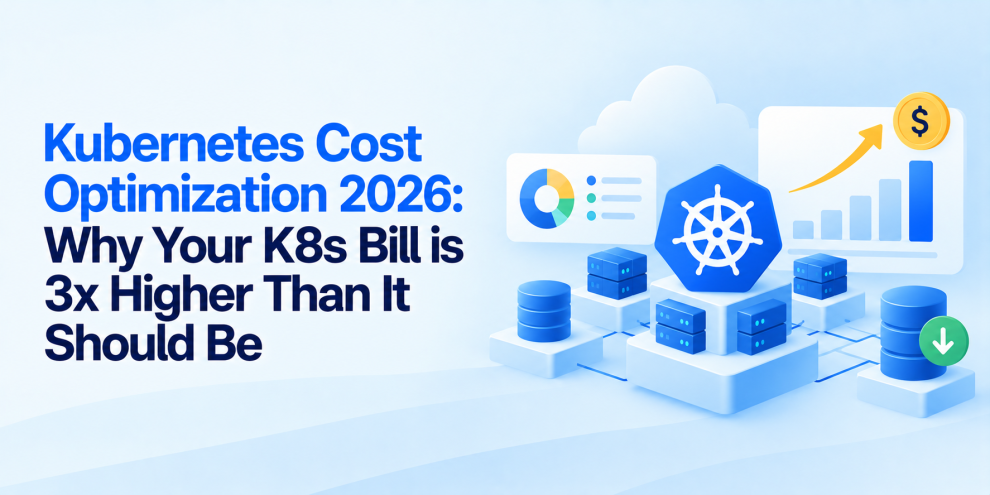

Kubernetes makes it possible to run complex applications across flexible infrastructure, but that flexibility comes with a cost. A cluster can scale quickly, provision new nodes automatically, and support dozens or thousands of workloads without requiring teams to manually manage every server. The same capabilities can also make it surprisingly easy to pay for infrastructure that delivers very little value.
A Kubernetes bill that appears reasonable at first can grow through oversized resource requests, idle nodes, inefficient autoscaling, unused persistent volumes, overprovisioned workloads, excessive observability data, and development environments that run continuously.
The problem is rarely Kubernetes itself. The bigger problem is treating Kubernetes capacity as an unlimited pool of infrastructure rather than a resource that needs to be engineered.
In 2026, Kubernetes cost optimization is becoming a core DevOps and platform engineering responsibility. The goal is not simply to reduce the cloud bill. It is to make sure every unit of compute, memory, storage, and network capacity is aligned with actual workload requirements.
Kubernetes Costs Start With Resource Requests
One of the most common sources of Kubernetes waste is incorrect resource configuration.
A deployment may request 2 CPUs and 4 GB of memory because that seemed like a safe starting point. The application may actually use a fraction of those resources during normal operation. Kubernetes schedules workloads based on requests, meaning inflated values can force the cluster to provision additional capacity even when the applications are not consuming it.
This creates an important distinction between requested capacity and actual utilization.
If workloads consistently request more CPU and memory than they use, the cluster may need additional nodes simply to satisfy scheduling requirements.
Resource requests should therefore be based on observed workload behavior rather than arbitrary safety margins.
CPU and Memory Limits Can Also Create Problems
Resource limits provide useful protection, but blindly applying large limits does not automatically improve reliability.
A workload with a very high memory limit can make capacity planning more difficult. CPU limits can also influence application behavior depending on the workload and configuration.
DevOps teams should evaluate requests and limits together with actual utilization, application performance, restart behavior, throttling, and memory pressure.
The objective is not to make limits as small as possible. It is to establish values that protect the application without reserving unnecessary capacity.
Idle Nodes Are Expensive
Kubernetes clusters often contain nodes that are technically available but poorly utilized.
A node might have enough capacity for several workloads while only a small portion is actually being consumed. If workloads cannot be packed efficiently because of resource requests, taints, affinity rules, topology constraints, or workload fragmentation, the cluster may need more nodes than necessary.
This is where bin packing becomes important.
A well-designed cluster attempts to place workloads efficiently so that available node capacity is used effectively.
Poor scheduling efficiency can turn unused CPU and memory into real cloud expenditure.
Autoscaling Does Not Automatically Reduce Costs
Autoscaling is often presented as a cost optimization mechanism, but scaling in the wrong direction can increase spending.
Horizontal Pod Autoscaling can increase replicas when CPU or other metrics rise. Cluster autoscaling can then add nodes to accommodate those replicas.
If application behavior, requests, or scaling thresholds are poorly configured, this can produce unnecessary expansion.
For example, an application may briefly experience increased CPU usage and scale from 10 replicas to 40. If the workload returns to normal quickly but scale-down behavior is slow, the cluster may continue paying for excess capacity.
Autoscaling should therefore be evaluated as a feedback system rather than simply turned on.
HPA and Cluster Autoscaling Need to Work Together
Application-level and infrastructure-level autoscaling should have compatible objectives.
HPA determines how many application replicas are required. Cluster autoscaling determines how much infrastructure is required to schedule those workloads.
If HPA aggressively scales while cluster autoscaling responds slowly, the system can temporarily create scheduling pressure.
If scale-down policies are too conservative, unused capacity can remain active for extended periods.
DevOps teams should examine scale-up speed, scale-down delay, stabilization windows, minimum replicas, maximum replicas, workload startup time, and actual traffic patterns.
The objective is controlled elasticity rather than constant expansion.
Overprovisioning for Peak Traffic Can Be Expensive
Many Kubernetes environments are designed around worst-case traffic.
A team may provision enough infrastructure to handle the largest expected workload even though that traffic occurs only occasionally.
This creates a large amount of idle capacity during normal periods.
Autoscaling can reduce this gap, but not every workload scales equally well. Stateful services, databases, latency-sensitive workloads, and applications with slow startup times may require additional capacity.
For these systems, DevOps teams should evaluate whether the cost of permanent headroom is justified by the required availability and performance objectives.
Spot and Preemptible Capacity Can Reduce Compute Costs
Workloads that tolerate interruption can often use lower-cost compute capacity such as spot or preemptible instances.
These resources can be useful for batch processing, CI/CD runners, development environments, data processing, and workloads designed to recover automatically.
They are not appropriate for every workload.
The key is workload classification. Stateless and fault-tolerant workloads can often tolerate interruption more easily than critical stateful services.
Kubernetes makes it possible to create different node pools and scheduling policies so that suitable workloads can use lower-cost infrastructure without forcing critical workloads onto the same capacity.
Node Pools Should Reflect Workload Characteristics
A single node type rarely provides the best cost profile for every workload.
CPU-intensive services may benefit from compute-optimized nodes. Memory-heavy workloads may require memory-optimized capacity. Batch workloads may use lower-cost interruptible instances. Specialized workloads may require specific hardware.
Separating workloads into appropriate node pools allows the cluster to match infrastructure characteristics to application requirements.
But excessive fragmentation can create the opposite problem. Too many node types and scheduling constraints can make bin packing harder and leave capacity unused.
The objective should be deliberate specialization rather than unnecessary complexity.
Kubernetes Storage Can Become a Hidden Cost
Compute is usually the most visible Kubernetes expense, but storage can quietly accumulate.
Persistent volumes may remain allocated after workloads are deleted. Snapshots may accumulate. Development environments may create databases and disks that are rarely used.
Storage costs can become particularly difficult to track when teams create resources dynamically and do not have clear ownership.
DevOps teams should periodically identify unused volumes, old snapshots, unattached disks, oversized storage allocations, and unnecessary replicas.
Storage lifecycle policies should be part of the platform rather than an afterthought.
Network Costs Matter Too
Kubernetes workloads can generate substantial network traffic.
Cross-zone traffic, cross-region communication, NAT gateways, load balancers, service meshes, and external API calls can all contribute to infrastructure costs.
A workload architecture that looks efficient from a CPU perspective can still be expensive because of network behavior.
Teams should therefore examine where traffic flows.
If services communicate constantly across availability zones, the network bill may become significant. If a service mesh introduces additional traffic or processing overhead, that cost should also be measured.
Cost optimization requires looking beyond compute.
Observability Can Become a Major Kubernetes Expense
Modern Kubernetes environments generate large volumes of logs, metrics, traces, and events.
Observability is essential, but collecting everything indefinitely can create unnecessary storage and ingestion costs.
High-cardinality metrics can increase monitoring costs significantly. Detailed application logs may also generate large amounts of data with limited operational value.
The answer is not to reduce observability blindly.
Instead, teams should classify telemetry by operational importance. Critical signals may require long retention and high resolution, while lower-value data can be sampled, aggregated, filtered, or retained for shorter periods.
An observability strategy should therefore have a cost model.
Development and Staging Clusters Are Frequent Sources of Waste
Production receives most of the attention, but non-production environments can consume substantial infrastructure.
A development cluster that runs continuously can accumulate significant costs even when engineers use it only during working hours.
The same applies to staging environments, preview environments, temporary test clusters, and abandoned workloads.
Automated schedules can scale non-production environments down during inactive periods. Ephemeral environments can also be deleted automatically after their intended lifecycle.
The easiest Kubernetes cost to eliminate is often the capacity nobody is using.
Namespace-Level Cost Visibility Matters
A Kubernetes bill becomes much easier to optimize when teams know which workloads are responsible for it.
Cloud billing alone may show the total cluster cost without explaining which team, namespace, application, or service consumed the underlying resources.
Cost allocation tools and Kubernetes-aware observability can provide more detailed visibility.
Teams should be able to answer questions such as: Which namespace consumes the most CPU? Which application requests the most memory? Which team owns the largest node pool? Which workloads are consistently underutilized?
Without ownership visibility, cost optimization becomes a platform team’s problem instead of an engineering-wide responsibility.
AI Workloads Change Kubernetes Cost Optimization
AI workloads introduce another layer of complexity.
GPU-backed Kubernetes clusters can become extremely expensive when accelerators remain idle. A model-serving workload may require significant memory even when request volume is low. Batch inference can create temporary spikes that require a different scheduling strategy from real-time inference.
AI workloads therefore need their own cost controls.
Teams should monitor GPU utilization, model-serving throughput, memory consumption, inference latency, accelerator allocation, and idle time.
A GPU that is technically assigned to a workload but spends most of its time idle represents a significant optimization opportunity.
Cost Optimization Should Not Break Reliability
The biggest mistake in Kubernetes cost reduction is optimizing the bill without considering the service-level objectives.
Reducing replicas may lower costs but increase latency or reduce availability. Lowering resource requests may increase CPU contention. Aggressive scale-down policies may cause cold-start delays. Moving workloads to cheaper infrastructure may introduce interruption risk.
Cost should therefore be treated as one dimension of the engineering objective.
A practical model is:
Cost + Reliability + Performance + Security
Optimization is successful only when the reduction does not violate the application’s operational requirements.
Use Rightsizing Instead of Guesswork
Kubernetes rightsizing should be driven by production data.
Teams should examine CPU utilization, memory utilization, request rates, latency, restarts, throttling, garbage collection, queue depth, and application-specific metrics.
A workload that uses 200 MB of memory most of the time but occasionally requires 800 MB needs a different configuration from one that consistently uses 3 GB.
Rightsizing should account for both typical and exceptional behavior.
Automated recommendations can help identify inefficient workloads, but engineering teams should validate changes against application behavior before applying them broadly.
Build Cost Controls Into the Platform
Cost optimization becomes much harder when every application team has to solve it independently.
Platform teams can provide standardized mechanisms for resource requests, autoscaling, workload scheduling, cost visibility, environment shutdown, and policy enforcement.
Templates can establish reasonable defaults. Policy engines can flag workloads with missing requests or excessive limits. Dashboards can show cost and utilization together.
This creates a platform where efficient behavior becomes the default rather than something engineers have to remember manually.
Kubernetes Cost Optimization Needs Continuous Monitoring
Cloud costs change as workloads change.
A configuration that was efficient six months ago may become expensive after traffic grows, an application changes its architecture, or a new dependency is introduced.
Teams should therefore monitor cost alongside operational metrics.
Useful indicators include cost per service, cost per request, cost per customer, node utilization, requested versus used resources, idle capacity, autoscaling activity, storage growth, network expenditure, and GPU utilization.
Cost per business transaction can be particularly useful because it connects infrastructure spending to actual product activity.
Where Platform Engineering Fits
Engineering organizations such as GeekyAnts work across Kubernetes, cloud infrastructure, Terraform, Crossplane, CI/CD, platform engineering, and application architecture. That combination is relevant when Kubernetes cost optimization involves more than changing cloud instance types and requires coordinated improvements across infrastructure, workload configuration, automation, and platform governance.
What DevOps Teams Should Audit
Before attempting a major Kubernetes cost reduction, teams should review the entire resource lifecycle. Are CPU and memory requests based on actual usage? Are workloads consistently overprovisioned? Are nodes efficiently packed? Are autoscaling policies producing unnecessary capacity? Are development clusters running outside working hours? Are unused volumes and snapshots being removed? Are network costs being monitored? Is observability generating excessive telemetry? Are expensive workloads using the appropriate node pools? Are GPU resources sitting idle? Can teams identify which applications and departments own infrastructure costs?
These questions provide a practical starting point for identifying waste without compromising reliability.
The Future of Kubernetes Cost Optimization
Kubernetes cost optimization is becoming less about finding the cheapest virtual machine and more about engineering efficient systems.
The strongest teams will combine workload rightsizing, intelligent scheduling, autoscaling, workload-aware node pools, storage lifecycle management, network optimization, observability controls, and clear cost ownership.
FinOps and platform engineering will increasingly overlap. Infrastructure teams need to understand application behavior, while application teams need visibility into the infrastructure costs created by their workloads.
AI will make this relationship even more important as GPU infrastructure, model serving, inference workloads, and agentic systems become part of Kubernetes environments.
The objective is not to make Kubernetes as cheap as possible.
It is to make Kubernetes efficient enough that every unit of infrastructure has a clear engineering purpose.
A lower cloud bill is useful. A predictable, observable, rightsized Kubernetes platform is better.
For more, visit our homepage!



Add Comment