








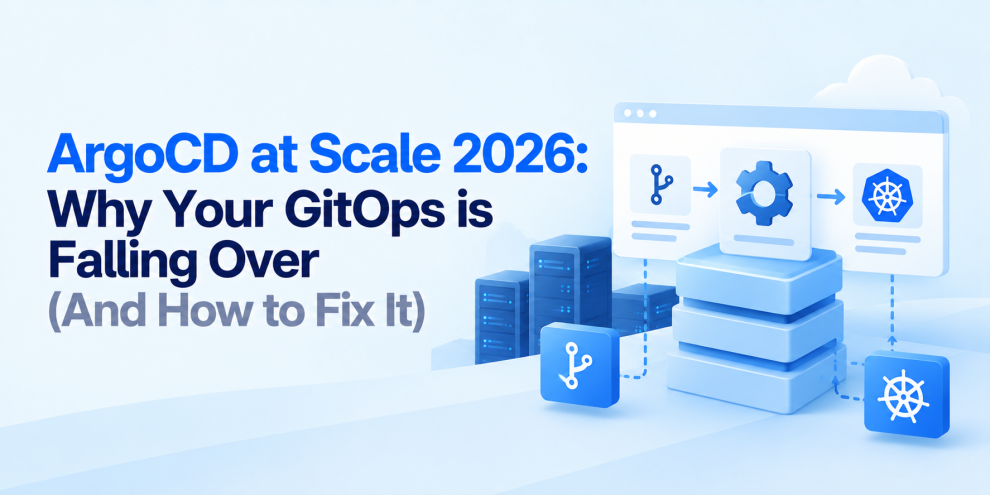

GitOps looks simple on a whiteboard. Developers commit changes to Git, ArgoCD detects the desired state, Kubernetes receives the configuration, and the platform continuously reconciles the environment. That model works extremely well when the number of applications, clusters, environments, and teams is manageable. At enterprise scale, however, GitOps introduces a different class of operational problems. Thousands of applications can generate constant reconciliation activity, repository changes can trigger large waves of deployments, clusters can become difficult to manage, and ArgoCD itself can become another platform that engineers need to operate. The problem is not necessarily ArgoCD. The problem is scale. A GitOps architecture designed for dozens of applications may behave very differently when it manages thousands of workloads across multiple clusters and regions. At that point, platform teams need to think about application discovery, repository structure, reconciliation frequency, controller capacity, API-server load, secrets, multi-tenancy, deployment waves, observability, and failure recovery.
GitOps Changes When You Reach Enterprise Scale
A small Kubernetes environment might have a handful of applications, one cluster, and a single ArgoCD installation. Developers can understand most of the system without needing elaborate platform abstractions. At scale, the architecture changes. An organization may operate hundreds of clusters across development, staging, production, and regional environments. Each cluster can contain hundreds of workloads. Multiple teams may share the same ArgoCD platform while maintaining different repositories, ownership models, deployment policies, and release schedules. Every one of those resources becomes part of the reconciliation system. GitOps is still declarative, but the control plane now has significantly more work to perform.
The Reconciliation Problem
ArgoCD continuously compares the desired state stored in Git with the state running inside Kubernetes. That reconciliation loop is the foundation of GitOps. The challenge appears when the number of applications increases dramatically. More applications mean more Kubernetes resources to monitor. More clusters mean more API-server communication. More repository changes mean more events that can trigger synchronization. More frequent deployments increase the amount of work the controllers need to process. If the platform is not designed for this workload, synchronization delays can increase and operational visibility can become difficult. The answer is not simply increasing CPU and memory. Platform teams need to understand what is generating reconciliation work and where the bottlenecks actually exist.
Application Count Is Not the Only Scaling Factor
Two organizations can run the same number of applications while placing completely different loads on ArgoCD. An application with a few Kubernetes resources is very different from an application managing hundreds of objects, complex Helm templates, multiple sources, external dependencies, and frequent changes. Scaling therefore needs to account for factors such as application count, resource count, cluster count, repository size, manifest generation complexity, synchronization frequency, deployment frequency, and API-server activity. A platform team that measures only the number of ArgoCD applications may miss the real source of pressure.
Repository Design Can Become a Bottleneck
Git is the source of truth in a GitOps architecture, but repository structure affects operational behavior. A large monorepo containing deployment configuration for hundreds of services can create unnecessary processing when relatively small changes occur. At the other extreme, creating an individual repository for every tiny configuration component can create management overhead. The right structure depends on application ownership, release independence, security boundaries, team organization, and deployment frequency. The important point is that Git repository architecture should be treated as part of the platform design rather than an afterthought.
Stop Treating Every Deployment the Same
Not every application needs to synchronize immediately. A production payment service, a development environment, and an internal test application can have completely different operational requirements. Platform teams can use deployment policies and synchronization strategies that reflect those differences. Critical workloads may require controlled rollout processes and additional validation. Development workloads may prioritize speed. Low-priority applications may tolerate delayed reconciliation. The objective is to avoid building a platform where every application competes equally for control-plane resources.
ApplicationSets Help, But They Are Not a Scaling Strategy by Themselves
ApplicationSets can make it easier to generate and manage large numbers of ArgoCD applications using templates and generators. That can significantly reduce repetitive configuration. But automation also makes it easier to create large numbers of applications very quickly. A poorly designed generator can produce unnecessary resources, duplicate configuration, or large synchronization workloads. ApplicationSet design therefore needs governance. Templates should be reusable, predictable, versioned, and aligned with platform ownership boundaries. Automation should reduce operational complexity rather than hide it.
Kubernetes API Pressure Matters
ArgoCD does not operate in isolation. It communicates with Kubernetes. At scale, excessive reconciliation and synchronization activity can contribute to pressure on Kubernetes API servers and other control-plane components. This becomes particularly important when many applications attempt to synchronize simultaneously. Platform teams should monitor Kubernetes API-server latency, request rates, throttling, controller activity, and resource consumption alongside ArgoCD metrics. A slow GitOps control plane can sometimes be a symptom of a wider Kubernetes scaling problem.
Helm and Manifest Generation Can Become Expensive
Generating Kubernetes manifests is another part of the deployment pipeline that can become expensive at scale. Large Helm charts, complex templates, multiple values files, plugins, or custom configuration logic can increase manifest-generation time. When hundreds or thousands of applications rely on expensive rendering operations, the cost can become visible in synchronization latency. Platform teams should keep deployment configuration predictable and avoid unnecessary complexity in the manifest-generation path. The goal is not to eliminate Helm or other configuration tools. It is to make their execution characteristics understood and manageable.
Multi-Cluster GitOps Needs a Clear Model
Managing multiple Kubernetes clusters introduces another architectural challenge. Should one ArgoCD installation manage every cluster? Should regions have separate ArgoCD instances? Should production environments have isolated control planes? Should development and production share the same installation? There is no universal answer. Centralized management can simplify administration and provide a unified operational view. Distributed ArgoCD installations can provide stronger isolation and reduce the blast radius of a control-plane failure. The decision should consider cluster count, geography, compliance requirements, team boundaries, network connectivity, availability requirements, and operational ownership.
Multi-Tenancy Needs More Than Namespaces
Sharing ArgoCD between multiple teams requires carefully designed boundaries. Teams need appropriate access to applications, projects, repositories, clusters, and deployment destinations. A developer working on one service should not automatically gain access to unrelated production environments. Platform teams should define clear ownership and authorization boundaries. This becomes even more important when GitOps controls production infrastructure. A misconfigured permission can potentially allow unauthorized deployment changes. GitOps does not eliminate the need for identity and authorization. It makes those controls part of the delivery architecture.
Secrets Should Not Become GitOps’ Weakest Link
Git is designed for version-controlled configuration, but sensitive credentials should not simply be committed alongside application manifests. Production environments require controlled secret-management approaches that integrate with the GitOps workflow without turning Git repositories into credential stores. Organizations can use external secret-management systems and Kubernetes integrations so that ArgoCD manages the desired configuration while sensitive values remain under appropriate security controls. The broader principle is straightforward: Git can define what should exist without necessarily storing every secret required to create it.
Deployment Waves Need Deliberate Control
Large environments can experience deployment storms. A change to a shared configuration or base template can cause a large number of applications to become out of sync at the same time. If every application immediately attempts to reconcile, the resulting workload can put pressure on ArgoCD, Kubernetes, registries, databases, and dependent services. Progressive deployment strategies can reduce this risk. Applications can be synchronized in controlled groups, with health checks and verification between stages. This turns a potentially massive deployment event into a sequence of smaller changes.
GitOps Does Not Automatically Mean Safe Deployments
GitOps provides traceability and declarative configuration, but it does not guarantee that every change is safe. A configuration can be syntactically valid while still causing an outage. A deployment can successfully synchronize while introducing an incompatible database change. A Kubernetes resource can become healthy while its downstream dependency fails. Production GitOps therefore needs validation beyond successful synchronization. Policy checks, automated testing, health verification, progressive delivery, rollback strategies, and application-level monitoring should work together. The important distinction is between “the desired state was applied” and “the application is actually healthy.”
Observability Must Include the GitOps Control Plane
Platform teams should monitor ArgoCD itself as a production system. Useful signals include synchronization duration, application health, reconciliation failures, manifest-generation latency, repository errors, API-server errors, controller resource usage, queue behavior, deployment frequency, and failed synchronizations. Teams should also connect Git changes with deployment events. When an incident occurs, engineers should be able to determine which commit changed the desired state, which application synchronized it, which cluster received the change, and what happened afterward. This makes GitOps telemetry part of the broader DevOps observability strategy.
Build Guardrails Before Adding More Automation
At scale, automation without guardrails can amplify mistakes. A change to a shared deployment template could affect hundreds of applications. A repository permission mistake could expose production configuration. An incorrectly configured ApplicationSet could generate unexpected workloads across multiple clusters. Platform teams should therefore establish policy controls around repositories, projects, deployment destinations, production environments, resource limits, synchronization behavior, and privileged operations. The more applications a platform controls, the more important centralized guardrails become.
GitOps Platforms Need Capacity Planning Too
One common mistake is treating ArgoCD as a tool that can simply be installed and left alone. A production GitOps platform needs capacity planning. Teams should understand expected application growth, cluster growth, deployment frequency, repository activity, resource counts, and synchronization patterns. Capacity should be reviewed as the organization grows rather than after the platform begins experiencing delays. The same principle applies to the surrounding infrastructure. ArgoCD depends on Kubernetes, Git repositories, container registries, networking, authentication systems, and observability infrastructure. A bottleneck in any of these systems can affect deployment reliability.
When Multiple ArgoCD Instances Make Sense
There is a point where separating ArgoCD installations may become operationally useful. Organizations with strong environment boundaries, multiple regions, regulatory requirements, or independent platform teams may benefit from separate control planes. This can reduce blast radius and allow teams to scale or upgrade environments independently. However, multiple installations also increase operational overhead. Teams now need to manage upgrades, configuration, monitoring, access controls, and backup strategies across several ArgoCD environments. The decision should therefore be based on isolation and operational requirements rather than simply assuming that more instances are better.
Where Platform Engineering Fits
Large-scale GitOps requires more than Kubernetes knowledge. It combines infrastructure architecture, CI/CD, identity, security, observability, automation, and developer experience. Engineering organizations such as GeekyAnts work across platform engineering, Kubernetes, Terraform, Crossplane, CI/CD, GitOps-oriented tooling, cloud infrastructure, and application engineering. That combination is relevant when GitOps becomes a platform capability supporting many development teams rather than simply a deployment tool used by individual projects. The goal is to create a delivery platform that developers can use consistently while infrastructure teams retain control over reliability and security.
What DevOps Leaders Should Audit
Before scaling an ArgoCD environment further, platform teams should ask: How many applications and resources are being reconciled? How often do deployments occur? Which applications generate the most synchronization activity? Is manifest generation becoming a bottleneck? Are Kubernetes API servers experiencing pressure? Are repositories structured for independent releases? Are production environments properly isolated? Are permissions scoped by team and environment? Are deployment waves controlled? Can the team trace every production deployment back to a Git commit? These questions reveal scaling problems before they become production incidents.
The Future of GitOps at Scale
GitOps remains valuable because it creates a declarative, version-controlled approach to application delivery. But enterprise GitOps requires a different mindset from small-scale Kubernetes deployment. The platform needs capacity planning, clear repository architecture, controlled synchronization, multi-cluster strategy, strong authorization, secret management, deployment policies, progressive delivery, and deep observability.
ArgoCD can remain an important part of that architecture, but it should be treated as a production control plane rather than simply another Kubernetes tool. The biggest GitOps mistake at scale is assuming that more automation automatically creates more reliability. It does not.
Reliable GitOps comes from controlled reconciliation, predictable platform behavior, clear ownership, and carefully designed boundaries. When those principles are in place, ArgoCD can scale with the organization instead of becoming another bottleneck inside the delivery platform.
For more, visit our homepage!




Add Comment