






For years, managed CI/CD platforms have made software delivery easier. Engineering teams could configure a pipeline, connect a repository, and let hosted runners handle builds, tests, and deployments.
That model still works for many organizations. But as software supply chain attacks become more sophisticated, cloud infrastructure costs increase, and compliance requirements become stricter, some engineering teams are reconsidering where their CI workloads actually run.
This has brought self-hosted CI runners back into focus.
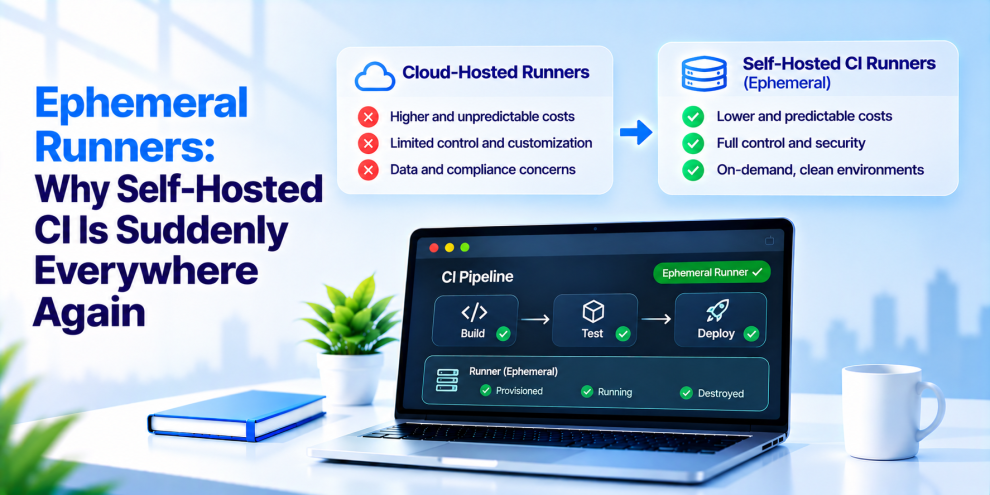
More specifically, organizations are moving towards ephemeral runners: temporary build environments that are created for a single job, execute the required workload, and are destroyed immediately afterward.
The appeal is straightforward. Teams get more control over their CI infrastructure without carrying the security and maintenance risks associated with permanently running self-hosted agents.
For CEOs and technology leaders, this is not simply another DevOps trend. It is a decision that affects engineering productivity, software delivery costs, security exposure, and operational resilience.
What Are Ephemeral CI Runners?
A CI runner is the execution environment responsible for running pipeline jobs. It checks out source code, installs dependencies, executes tests, builds artifacts, and may deploy applications.
Traditional self-hosted runners often operate as persistent machines. They remain available between jobs and may retain cached dependencies, temporary files, credentials, configuration, and other data.
Ephemeral runners follow a different lifecycle:
- A pipeline job is triggered.
- A temporary runner is provisioned.
- The runner executes the assigned job.
- Required artifacts and logs are collected.
- The runner is destroyed.
Each job receives a clean environment rather than inheriting the state of a previous execution.
<text></text>
<AsyncImage query=”ephemeral CI CD runner architecture diagram temporary isolated build agents cloud infrastructure” aspectRatio=”16:9″ width=”100%” />
This approach is particularly useful when pipelines handle sensitive source code, production credentials, proprietary dependencies, or workloads from multiple repositories and teams.
Why Self-Hosted CI Is Returning
The renewed interest in self-hosted infrastructure is not necessarily a rejection of managed CI platforms. It reflects changing priorities around control, security, and cost.
1. Persistent Runners Create Security Exposure
A long-running runner can accumulate state across multiple jobs. If one pipeline executes untrusted code, that code may potentially access files, credentials, or processes left behind by earlier jobs.
This becomes especially concerning when runners handle pull requests from external contributors or execute code from multiple repositories.
Ephemeral runners reduce this exposure by removing the execution environment after each job. They limit the opportunity for malicious processes or leftover data to persist between pipeline executions.
However, temporary infrastructure alone does not guarantee security. Credentials, network access, runner permissions, and artifact handling still require strict controls.
2. Engineering Teams Need Greater Infrastructure Control
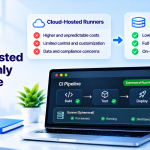
Managed CI platforms simplify operations, but they may impose restrictions around compute configurations, networking, caching, operating systems, or access to internal infrastructure.
Organizations with complex delivery requirements may need runners inside private networks or close to internal services.
Self-hosted ephemeral runners provide more control over:
- CPU and memory configurations
- Operating system and runtime versions
- Private network connectivity
- Dependency caching strategies
- Access to internal registries
- Compliance and data residency requirements
For companies operating regulated or infrastructure-heavy environments, this control can be important.
3. CI/CD Costs Become More Visible at Scale
CI spending can grow as engineering organizations increase repository counts, test coverage, build frequency, and deployment activity.
Managed runner pricing may become harder to predict when workloads require high-performance compute or long-running integration tests.
Self-hosted ephemeral runners allow organizations to provision compute based on actual workload requirements.
For example, a team might use smaller instances for linting and unit tests, larger machines for container builds, and specialized infrastructure for performance testing.
The financial advantage depends on utilization, infrastructure pricing, orchestration overhead, and engineering maintenance costs. Self-hosting is not automatically cheaper.
The important shift is that organizations can optimize CI compute as an infrastructure workload rather than accepting a single execution model for every pipeline.
Persistent vs. Ephemeral Runners: What Changes?
| Area | Persistent Self-Hosted Runners | Ephemeral Runners |
|---|---|---|
| Lifecycle | Reused across jobs | Created for individual jobs |
| Environment | May retain previous state | Starts from a clean image |
| Isolation | Depends on configuration | Stronger job-level separation |
| Maintenance | Requires ongoing cleanup | Infrastructure is regularly replaced |
| Scaling | Depends on available agents | Can scale through orchestration |
| Cost model | Often includes idle capacity | Can align compute with demand |
| Security | Greater risk of state persistence | Reduced cross-job contamination |
The distinction is not simply temporary versus permanent infrastructure. It is about how execution environments are isolated, provisioned, and managed.
The Architecture Behind Ephemeral Runners
Deploying ephemeral runners requires more than creating a virtual machine and deleting it after a build.
A reliable architecture typically includes several components.
1. Runner Orchestration
An orchestration layer listens for pipeline jobs and provisions temporary execution environments.
Teams commonly use Kubernetes-based approaches, cloud virtual machines, or managed autoscaling infrastructure.
The orchestration layer should handle job assignment, provisioning, capacity management, and cleanup.
2. Standardized Runner Images
Instead of installing tools every time a job starts, organizations can maintain prebuilt runner images.
These images may contain approved versions of:
- Programming language runtimes
- Build tools
- Container tooling
- Security scanners
- Package managers
- Internal certificates and configuration
Version-controlled images make runner environments more predictable and reduce setup time.
3. Identity and Secret Management
Temporary runners still need credentials to access repositories, package registries, cloud services, and deployment environments.
Long-lived credentials stored directly on runner machines create unnecessary risk.
A stronger model uses short-lived credentials, workload identity, narrowly scoped permissions, and centralized secret management.
Production deployment credentials should only be available to approved workflows and environments.
4. Network Isolation
Runner isolation should extend beyond the virtual machine or container.
Organizations should restrict outbound access, control communication with internal services, and prevent untrusted jobs from reaching sensitive network segments.
This is particularly important for pull request workflows where pipeline code may not be fully trusted.
5. Artifact and Cache Management
Destroying a runner should not mean losing important build outputs.
Artifacts, logs, and test results should be transferred to controlled storage before the runner is terminated.
Caching also requires careful design. Shared caches can improve performance, but poorly isolated caches may expose data or allow untrusted jobs to influence trusted builds.
Where Ephemeral Runners Can Go Wrong
Ephemeral infrastructure introduces operational complexity that leadership teams should understand before committing to a migration.
Provisioning delays: If runners take too long to start, developers experience slower feedback cycles. Prebuilt images and autoscaling capacity can help.
Infrastructure overhead: Teams must maintain orchestration, images, monitoring, networking, and lifecycle automation. These responsibilities can offset infrastructure savings.
Insufficient isolation: A temporary runner with broad permissions can still expose sensitive systems during its short lifetime.
Unreliable cleanup: Failed provisioning or termination workflows may leave resources running, increasing costs and creating security gaps.
Poor capacity planning: Sudden build spikes can exhaust available compute capacity, delaying releases and testing.
A successful implementation treats runner infrastructure as a production platform with ownership, monitoring, security policies, and service-level expectations.
What CEOs and Technology Leaders Should Evaluate
The decision to adopt ephemeral runners should be based on business and engineering requirements rather than infrastructure fashion.
Leadership teams should examine five areas.
Security exposure: Do current CI environments handle untrusted code, sensitive credentials, or workloads across multiple teams? Could temporary execution environments reduce the risks associated with persistent state?
Delivery performance: Will provisioning and cleanup affect build times? Can the organization maintain enough capacity during peak development periods?
Total cost of ownership: Compare managed CI pricing with compute, orchestration, storage, networking, maintenance, and engineering effort. Infrastructure savings alone do not represent the full financial picture.
Compliance requirements: Do internal policies require tighter control over execution environments, network boundaries, data handling, or infrastructure location?
Operational maturity: Does the platform team have the expertise to operate runner orchestration reliably? If not, a managed solution may remain the better option.
The strongest business case emerges when security, cost control, and delivery performance improve together.
Where Engineering Teams Fit
Adopting ephemeral CI infrastructure requires coordination across cloud engineering, platform engineering, automation, security, and application delivery.
Teams such as GeekyAnts and Thoughtworks work across cloud-native development and DevOps engineering, making them worth considering for organizations modernizing their delivery infrastructure, improving automation, or building scalable engineering platforms.
The priority should be a CI/CD architecture that supports secure software delivery without adding unnecessary operational complexity.
Conclusion
Self-hosted CI is returning because engineering organizations want more control over how software is built, tested, and deployed. Ephemeral runners offer a practical way to achieve that control while reducing the risks associated with persistent execution environments.
But the value does not come from destroying a machine after every build. It comes from designing a complete system around isolation, identity, resource management, observability, and predictable operations.
For technology leaders, the right question is not whether self-hosted runners are better than managed CI. It is whether the current CI architecture provides the security, cost visibility, and delivery performance the business needs.
Ephemeral runners deserve consideration when the answer is no.
FAQs
1. What are ephemeral CI runners?
Ephemeral CI runners are temporary execution environments created for individual pipeline jobs. They are destroyed after completing the assigned work, reducing the persistence of files, processes, and state between jobs.
2. Are ephemeral runners more secure than persistent runners?
They can improve isolation by preventing state from carrying over between jobs. However, security still depends on permissions, credential management, network restrictions, and the runner provisioning process.
3. Are self-hosted ephemeral runners cheaper than managed CI?
Not always. They can reduce compute costs for predictable or high-volume workloads, but orchestration, maintenance, storage, and engineering effort must also be included in the total cost calculation.
4. Can ephemeral runners run on Kubernetes?
Yes. Kubernetes can provision temporary runner pods for individual CI jobs and remove them after execution. This supports automated scaling and resource management when configured properly.
5. Should every organization move to ephemeral runners?
No. Organizations with simple pipelines and limited security requirements may be better served by managed CI. Ephemeral runners are especially relevant when isolation, infrastructure control, compliance, or workload optimization are important.
For more, visit our homepage!



Add Comment