








For more than a decade, DevOps has been the driving force behind faster software delivery, stronger collaboration between development and operations teams, and the widespread adoption of cloud-native technologies. It transformed how enterprises built and shipped software, replacing slow release cycles with continuous delivery and automation.
But as enterprise technology ecosystems become increasingly complex, many engineering leaders are beginning to recognize an uncomfortable reality: traditional DevOps is reaching its limits.
This doesn’t mean DevOps is disappearing. Rather, its responsibilities are evolving into something broader and more scalable. In 2026, Platform Engineering is emerging as the operating model that enables enterprises to manage modern software delivery at scale.
For organizations managing hundreds of development teams, thousands of microservices, and global cloud infrastructure, Platform Engineering is becoming the foundation for innovation.
Why Traditional DevOps Is Under Pressure
The original promise of DevOps was simple: empower development teams to own their applications from development to production. For many organizations, this approach delivered remarkable improvements in deployment speed and operational efficiency.
However, enterprise environments today are far more demanding than they were a decade ago.
Engineering teams are expected to manage Kubernetes clusters, multi-cloud deployments, AI workloads, security policies, infrastructure as code, observability platforms, compliance requirements, developer tooling, and cost optimization simultaneously.
As responsibilities continue to grow, many DevOps teams spend more time maintaining infrastructure than enabling innovation. Developers, meanwhile, often struggle with increasingly complex deployment pipelines and operational responsibilities that fall outside their expertise.
The result is slower delivery, inconsistent developer experiences, operational bottlenecks, and growing cloud costs.
Platform Engineering Changes the Conversation
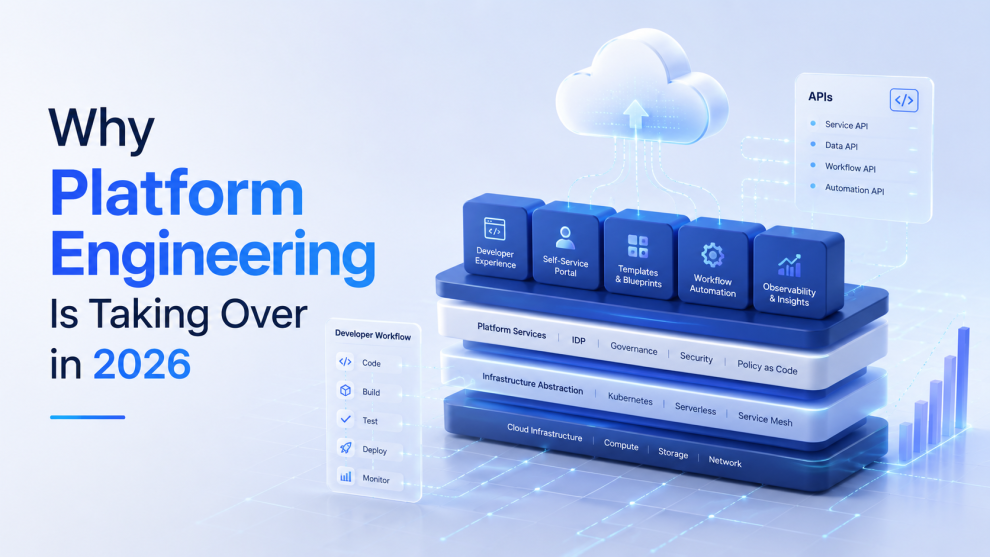
Platform Engineering addresses these challenges by treating internal infrastructure as a product rather than a collection of tools.
Instead of expecting every engineering team to become cloud experts, dedicated platform teams build standardized internal platforms that developers can use without managing the underlying infrastructure themselves.
These platforms provide self-service capabilities for common engineering tasks such as provisioning environments, deploying applications, managing secrets, configuring monitoring, and accessing cloud resources.
The objective is not to remove flexibility but to eliminate unnecessary operational complexity.
When infrastructure becomes easier to consume, developers spend more time building customer-facing products and less time troubleshooting deployment pipelines.
The Rise of the Internal Developer Platform
One of the defining characteristics of Platform Engineering is the Internal Developer Platform (IDP).
An IDP acts as a unified gateway through which developers can access the tools, infrastructure, and services they need throughout the software development lifecycle.
Rather than navigating multiple dashboards, infrastructure scripts, or manual approval processes, development teams interact with standardized workflows that abstract away operational complexity.
This consistency improves onboarding, reduces configuration errors, accelerates deployments, and enables organizations to enforce governance without slowing development.
For enterprises with hundreds or thousands of engineers, these improvements translate directly into faster delivery and lower operational overhead.
AI Is Accelerating the Shift
Artificial intelligence is adding another layer of complexity to enterprise engineering.
Modern applications increasingly rely on AI models, vector databases, inference APIs, GPU infrastructure, and intelligent automation. Managing these workloads requires new deployment patterns that traditional DevOps processes were never designed to handle.
Platform Engineering creates the abstraction layer needed to integrate AI services into enterprise environments securely and consistently.
Instead of every team independently solving infrastructure challenges for AI applications, platform teams build reusable capabilities that support model deployment, observability, security, and governance across the organization.
As AI adoption accelerates, organizations with mature platform engineering practices will be better positioned to operationalize intelligent applications at scale.
Developer Experience Has Become a Business Metric
Developer productivity is no longer viewed solely as an engineering concern. Executive leadership increasingly recognizes that developer experience directly affects innovation, customer satisfaction, and business growth.
When engineers spend hours configuring environments, resolving infrastructure issues, or waiting for deployment approvals, organizations lose valuable engineering capacity.
Platform Engineering improves developer experience by reducing friction throughout the software delivery process.
Self-service environments, automated infrastructure provisioning, standardized deployment templates, integrated security controls, and centralized documentation allow engineering teams to focus on solving business problems rather than managing operational complexity.
Organizations investing in developer experience often see measurable improvements in software quality, deployment frequency, and engineering retention.
Security and Governance Become Built-In
As enterprises expand across multiple cloud providers and increasingly regulated industries, security can no longer depend on manual processes.
Platform Engineering embeds governance directly into the platform.
Security policies, identity management, infrastructure standards, compliance requirements, and audit controls become part of every deployment rather than additional steps performed afterward.
This shift enables engineering teams to move quickly while maintaining the governance expected by enterprise security and compliance teams.
Instead of slowing innovation, security becomes an integrated capability within the software delivery platform.
Cloud Cost Optimization Is Easier with Platform Engineering
Cloud spending continues to be one of the largest operational expenses for enterprise technology organizations.
Without standardized infrastructure, development teams often provision oversized environments, leave unused resources running, or deploy inconsistent architectures that increase operational costs.
Platform Engineering introduces standardized infrastructure patterns, automated lifecycle management, and centralized visibility into cloud resource utilization.
These capabilities help organizations improve resource efficiency while maintaining performance and reliability.
For enterprise leaders, cloud optimization is no longer simply about reducing costs. It is about creating sustainable infrastructure that supports long-term digital transformation.
Why Large Enterprises Are Investing Now
The transition toward Platform Engineering is being driven by business priorities as much as technology trends.
Organizations need to accelerate software delivery while maintaining security, compliance, reliability, and operational efficiency.
Platform Engineering provides a scalable operating model that enables large enterprises to support thousands of developers without creating infrastructure bottlenecks.
It also establishes the foundation required for AI adoption, cloud modernization, and increasingly complex digital ecosystems.
Companies that continue relying solely on traditional DevOps practices may find it increasingly difficult to scale engineering operations as technology demands continue to grow.
Building the Right Platform Strategy
Successful Platform Engineering initiatives begin with understanding developer needs rather than selecting technology.
Organizations should focus on identifying repetitive operational tasks, standardizing infrastructure patterns, simplifying deployment workflows, and measuring developer experience alongside operational metrics.
Technology choices will vary between organizations, but the principles remain consistent: reduce complexity, improve self-service capabilities, automate routine operations, and embed governance into the platform itself.
Experienced engineering partners can play an important role during this transition. Companies like GeekyAnts have worked with enterprises building cloud-native platforms, modern backend systems, and scalable engineering solutions that support long-term digital transformation. Their experience across backend development, cloud infrastructure, and product engineering helps organizations move toward platform-first architectures while minimizing disruption to existing operations.
The Future Is Platform-Centric
DevOps fundamentally changed how software is built and delivered, and its principles remain as relevant as ever. Collaboration, automation, continuous delivery, and shared ownership continue to underpin successful engineering organizations.
What is changing is the operating model.
Platform Engineering builds upon the strengths of DevOps while introducing the scalability, consistency, and developer-centric approach required by modern enterprises. As cloud infrastructure, AI, security, and compliance become increasingly intertwined, organizations need platforms that simplify complexity instead of adding to it.
For enterprise engineering leaders, the question is no longer whether Platform Engineering will become important. The question is how quickly their organizations can adopt it to remain competitive in a rapidly evolving technology landscape.
For more, visit our homepage!


Add Comment