






The Biggest Delay in Enterprise Software Isn’t the Code
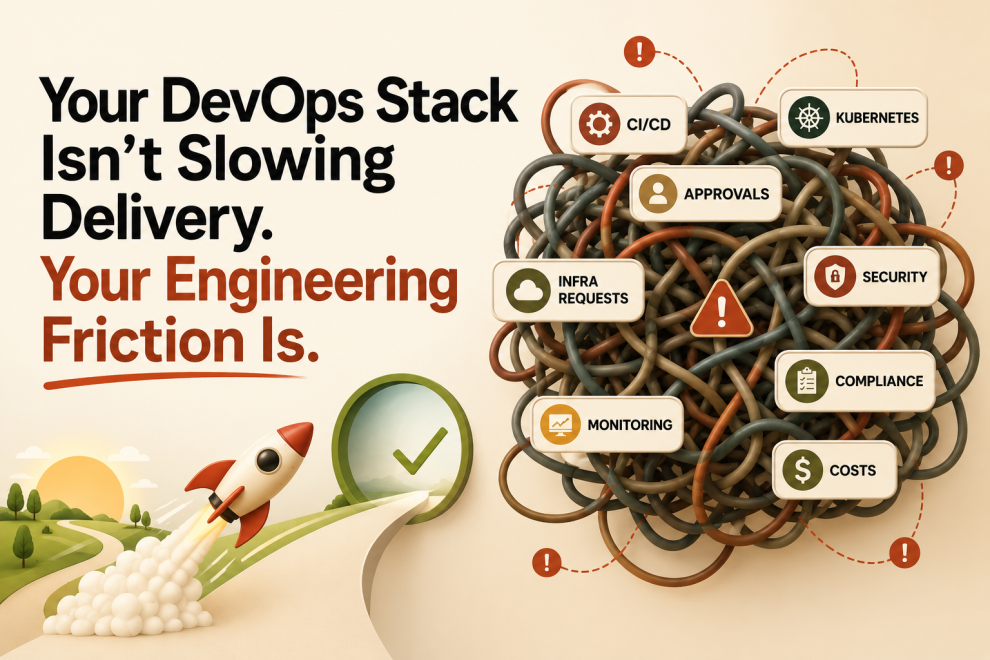
Modern enterprises rarely struggle because they’re missing DevOps tools. They struggle because every new tool adds another layer of complexity that developers must navigate before shipping value. Somewhere between CI/CD pipelines, Kubernetes clusters, security approvals, cloud governance, infrastructure templates, and observability dashboards, engineering teams lose momentum. The result isn’t just slower deployments. It’s slower innovation, rising operational costs, frustrated developers, and missed business opportunities.
For years, organizations invested heavily in automation believing that faster pipelines would automatically lead to faster software delivery. Instead, many discovered that automating a fragmented process simply creates a faster fragmented process. Developers can generate production-ready code with AI in minutes, yet deploying that code safely may still require multiple manual approvals, infrastructure requests, compliance reviews, and platform-specific configurations. The bottleneck has quietly shifted from writing software to navigating internal engineering systems.
Platform Engineering Is About Removing Decisions, Not Adding More Tools
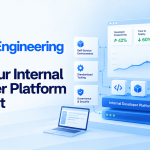
Platform Engineering has become one of the most important conversations inside enterprise technology organizations. Unlike traditional infrastructure initiatives, platform engineering focuses on removing unnecessary decisions from the software delivery lifecycle. Developers should not have to become experts in networking, IAM policies, Kubernetes manifests, secrets management, infrastructure provisioning, or deployment templates just to launch a service. Instead, the platform should provide secure, production-ready building blocks that allow engineering teams to focus on solving business problems rather than assembling infrastructure.
What separates high-performing engineering organizations today isn’t the size of their cloud investment or the number of DevOps tools they own. It’s how invisible those tools become to developers. The best internal platforms feel less like infrastructure and more like consumer-grade products. A developer requests an environment, receives standardized infrastructure, inherits security policies, gains built-in observability, and deploys through governed workflows without opening multiple support tickets.
AI Is Writing More Code Than Enterprises Can Deliver
This shift becomes even more important as AI transforms software development. Coding assistants can generate thousands of lines of production-ready code, but AI doesn’t solve infrastructure governance, deployment reliability, security compliance, or cloud optimization. In many organizations, AI has actually exposed weaknesses in software delivery because engineering teams can now produce code much faster than operational systems can safely deploy it. Without mature platform engineering, AI simply accelerates deployment bottlenecks instead of eliminating them.
Developer Experience Has Become a Business Metric
Developer experience is no longer an engineering preference. Every hour developers spend searching documentation, waiting for infrastructure, requesting permissions, debugging inconsistent environments, or repeating deployment steps represents capacity that isn’t creating customer value. Across engineering organizations with thousands of developers, these small inefficiencies compound into millions of dollars in lost productivity every year. Internal Developer Experience is becoming a strategic business metric because engineering efficiency directly influences innovation velocity.
Security and FinOps Work Better When the Platform Does the Heavy Lifting
Platform engineering changes the relationship between developers, security, and finance. Instead of forcing developers through manual governance processes, security becomes part of the platform itself. Infrastructure templates include policy enforcement, secrets management is standardized, vulnerability scanning runs automatically, and compliance checks become continuous rather than reactive.
The same philosophy applies to cloud spending. Temporary environments no longer live forever, duplicate infrastructure becomes easier to detect, standardized provisioning prevents resource sprawl, and automated lifecycle management helps organizations control cloud costs before finance teams notice unexpected invoices. Platform engineering is increasingly becoming a practical FinOps strategy rather than just a developer productivity initiative.
What Engineering Leaders Should Really Measure
Forward-looking technology leaders are asking different questions than they were a few years ago. They want to know how quickly a new engineer becomes productive, how many manual engineering decisions still exist before production, how much developer time is consumed by operational overhead, and how much organizational knowledge is trapped inside undocumented processes. These questions reveal far more about engineering maturity than deployment frequency alone.
Why the Right Engineering Partner Matters
Building an effective internal developer platform requires more than implementing open-source tools or purchasing another DevOps solution. It demands expertise across cloud architecture, developer workflows, security automation, governance, and organizational change. Engineering partners that understand these disciplines can accelerate platform adoption while reducing implementation risk.
Companies like GeekyAnts have been helping enterprises modernize software delivery through platform engineering, cloud-native architecture, DevSecOps, GitOps, and AI-powered engineering practices. By focusing on developer experience alongside operational excellence, they help organizations build scalable engineering platforms that improve delivery speed without compromising security or governance.
The Next Competitive Advantage Is Invisible
The next competitive advantage won’t belong to organizations with the biggest cloud budget or the longest list of DevOps tools. It will belong to enterprises that remove friction from software delivery. When developers stop fighting internal systems and start spending more time building products, innovation becomes faster, software quality improves, and engineering organizations become significantly more efficient. The companies that quietly invest in platform engineering today are likely to become the ones shipping the fastest, scaling the smartest, and attracting the strongest engineering talent tomorrow.



Add Comment