








DevOps Was the Beginning. Platform Engineering Is the Next Enterprise Shift.
For large enterprises, DevOps has already delivered significant improvements in software delivery speed, collaboration, and automation. But as organizations scale across multiple products, teams, cloud environments, and customer experiences, traditional DevOps approaches are reaching their limits.
The challenge today is no longer simply deploying software faster.
Enterprise technology leaders are asking more complex questions:
How can engineering teams increase delivery velocity without increasing operational complexity?
How can organizations standardize cloud infrastructure while allowing product teams to innovate independently?
How can businesses improve developer productivity while maintaining security, governance, and reliability?
These questions are driving the rise of platform engineering.
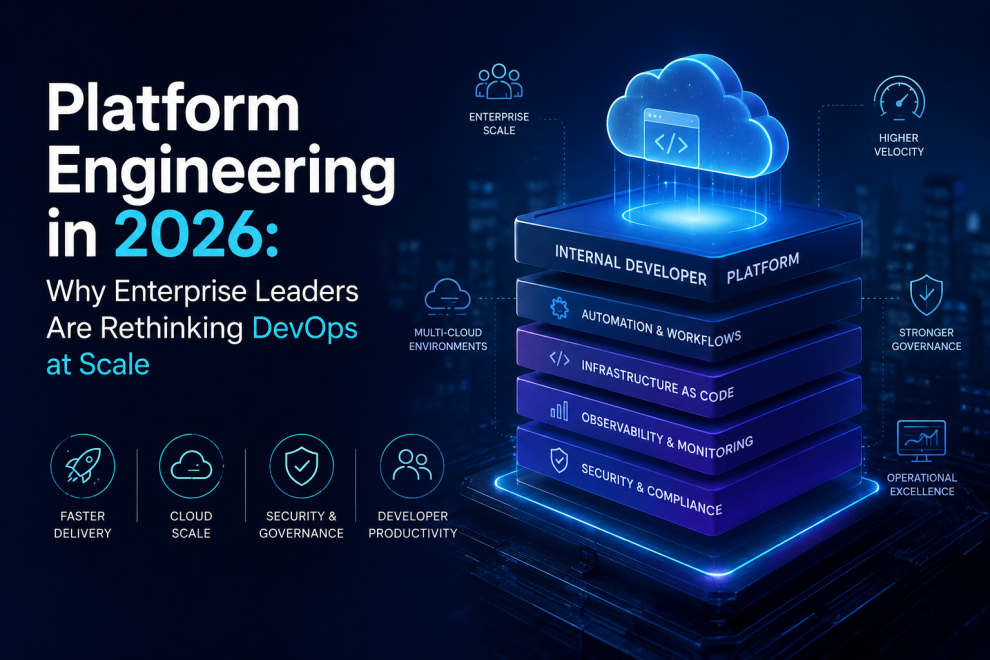
Platform engineering is becoming a strategic priority for organizations looking to build scalable technology ecosystems. Instead of expecting every engineering team to manage infrastructure complexity independently, companies are creating internal platforms that provide reusable capabilities, automated workflows, and self-service experiences for developers.
For enterprises operating at scale, this represents a major evolution in how technology teams deliver digital products.
Why Enterprise DevOps Models Are Becoming More Complex
Large organizations today operate in environments that are significantly different from when DevOps first became mainstream.
Engineering teams are managing:
- Multi-cloud architectures
- Kubernetes and containerized workloads
- AI-powered applications
- Distributed systems
- Global customer platforms
- Increasing security and compliance requirements
At smaller scales, teams can often manage these complexities through direct collaboration between developers and infrastructure teams.
However, at enterprise scale, this model creates friction.
Development teams spend valuable engineering time handling environment configurations, deployment processes, infrastructure dependencies, and operational workflows.
Meanwhile, platform and cloud infrastructure teams often become bottlenecks because every product team depends on them for similar requests.
Platform engineering addresses this gap by creating a shared foundation that enables teams to move faster while maintaining enterprise standards.
Platform Engineering as a Strategic Technology Investment
For technology leaders, platform engineering is not just another tooling initiative.
It represents a shift in how organizations think about engineering productivity.
A well-designed internal developer platform creates a consistent experience where developers can access the resources they need without unnecessary operational overhead.
This allows engineering teams to focus more on building customer-facing capabilities and less on managing repetitive infrastructure tasks.
For enterprises, the benefits extend beyond developer convenience.
Platform engineering can help improve:
- Software delivery consistency
- Engineering efficiency
- Infrastructure governance
- Cloud resource management
- Security alignment
- Product team autonomy
The result is a technology organization that can scale without adding proportional operational complexity.
The Role of Internal Developer Platforms in Enterprise Transformation
Internal developer platforms are becoming an important component of modern digital transformation strategies.
Instead of every business unit creating its own approach to application delivery, enterprises can establish common engineering capabilities that support multiple teams.
These platforms typically combine cloud infrastructure automation, deployment workflows, observability practices, security controls, and developer tooling into a unified experience.
The objective is not to restrict engineering teams.
The objective is to remove unnecessary complexity.
The best platform engineering strategies create a balance between standardization and flexibility, allowing teams to innovate while operating within reliable architectural boundaries.
AI Is Accelerating the Evolution of DevOps
Artificial intelligence is adding another layer of transformation to modern DevOps practices.
Enterprise teams are exploring AI-powered capabilities for:
- Application monitoring
- Incident analysis
- Infrastructure optimization
- Deployment recommendations
- Operational intelligence
However, AI adoption also introduces new challenges.
Organizations need strong governance, observability, security practices, and engineering foundations to ensure AI-driven systems operate reliably in production environments.
The future of DevOps will not be defined by automation alone. It will be defined by how effectively organizations combine automation with engineering discipline.
The Enterprise Challenge: Building Platforms That Actually Scale
Many organizations understand the value of platform engineering but struggle with implementation.
A successful platform requires more than selecting tools.
It requires understanding:
- Developer workflows
- Application architecture
- Cloud strategy
- Security requirements
- Business objectives
Poorly designed platforms can create additional complexity instead of reducing it.
Enterprise technology leaders need to approach platform engineering as a product development effort, where the platform continuously evolves based on the needs of internal users.
Why Engineering Expertise Matters in Modern Platform Engineering
Building scalable engineering platforms requires expertise across application development, cloud infrastructure, automation, and architecture.
Organizations often work with engineering partners that can help bridge these capabilities while accelerating modernization initiatives.
Companies like GeekyAnts bring experience across product engineering, cloud-native development, and scalable application architecture, helping businesses build modern technology platforms designed for long-term growth.
The key advantage is combining software engineering expertise with operational understanding, allowing enterprises to create systems that are not only faster to deploy but also reliable, secure, and maintainable.
The Future of DevOps Is Platform-Driven
As enterprises continue expanding their digital products, customer experiences, and AI initiatives, the need for scalable engineering systems will continue to grow.
Platform engineering represents the next stage of DevOps maturity.
The organizations that succeed will not simply automate more processes. They will create engineering ecosystems where teams can deliver innovation faster while maintaining enterprise-level reliability.
For technology leaders, the question is no longer whether platform engineering will influence DevOps.
The question is how quickly their organizations can adopt it effectively.
For more, visit our homepage!



Add Comment