





AI agents are changing how DevOps teams build, deploy, monitor, and operate software. Instead of relying exclusively on predefined scripts and alert rules, engineering teams can use AI agents to investigate incidents, analyze infrastructure telemetry, propose configuration changes, troubleshoot deployment failures, and coordinate operational workflows.
But giving an AI agent access to production infrastructure introduces a different class of engineering risk. An agent that misinterprets an alert could restart a healthy service, scale a workload beyond its limits, modify a network policy, or trigger a rollback that breaks dependent applications. When autonomous systems interact with Kubernetes clusters, CI/CD pipelines, cloud accounts, and deployment platforms, even a small reasoning error can have consequences beyond the original task.
In 2026, the challenge for DevOps engineers is not simply making AI agents capable of executing commands. It is designing the operational architecture that allows them to act within defined boundaries, recover from failures, and improve engineering workflows without compromising production reliability.
Why DevOps Needs a Different AI Agent Architecture
Traditional DevOps automation generally follows explicit rules. A monitoring system detects a threshold violation, a script executes a remediation, and the platform checks whether the service has recovered. The behavior is predictable because the execution path is defined in advance.
AI agents introduce more flexible decision-making. An agent can analyze logs, inspect deployment history, correlate metrics, query traces, and choose which diagnostic tool to use next. It can adapt its investigation based on the results rather than following one fixed sequence.
For example, an agent investigating increased API latency might inspect recent deployments, examine Kubernetes events, review database metrics, and compare traces before identifying a likely bottleneck.
This flexibility can reduce manual investigation, but it also makes execution less predictable. The agent may select an incorrect hypothesis, repeat an ineffective action, or overlook a dependency that changes the consequences of a proposed fix.
A production-grade DevOps agent therefore needs more than an LLM and a collection of infrastructure APIs. It needs controlled execution, explicit permissions, durable state, resource limits, observability, and reliable recovery mechanisms.
The objective is to make operational decisions more intelligent without making infrastructure control less predictable.
Build an Agent Orchestration Layer
A common mistake is connecting an AI model directly to shell access, Kubernetes credentials, or cloud administration APIs. This creates a tightly coupled system in which the model’s decisions can immediately affect production.
A safer architecture separates reasoning from execution.
A typical design looks like this:
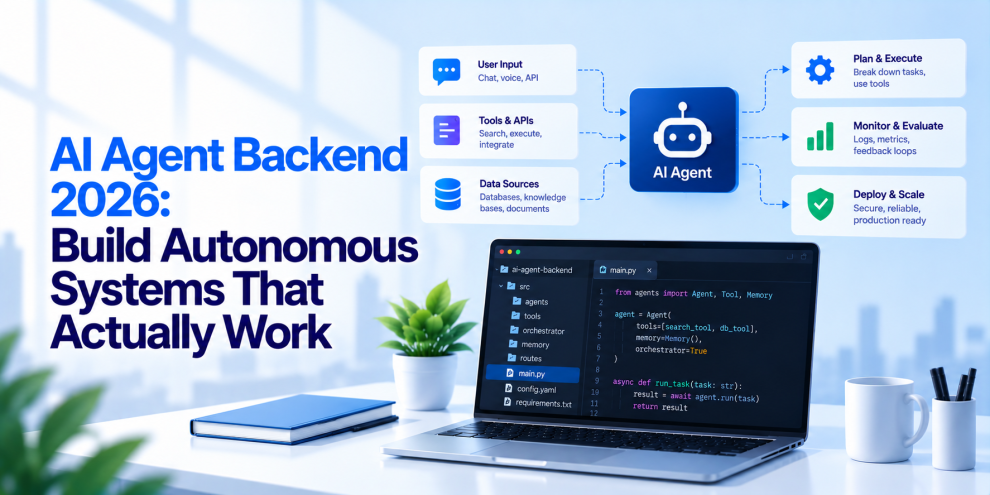
Monitoring and Telemetry → Agent Orchestrator → Policy and Approval Layer → Controlled Tools → Infrastructure and CI/CD Systems → Verification
The monitoring layer provides signals from metrics, logs, traces, deployment events, and infrastructure health checks. The orchestrator manages the agent’s execution lifecycle, including task state, step limits, deadlines, and tool selection.
The policy layer determines whether a proposed operation is allowed. Controlled tools expose narrowly defined capabilities, such as inspecting pod health, retrieving deployment history, or restarting an approved workload. The verification layer checks whether the action produced the intended result.
These components do not need to be separate microservices. They can be implemented within an existing platform architecture as long as their responsibilities and trust boundaries remain explicit.
The key design decision is to prevent the model from becoming the unrestricted control plane for production infrastructure.
Give AI Agents Limited Infrastructure Tools
DevOps agents often need access to sensitive systems, including Kubernetes clusters, cloud platforms, CI/CD pipelines, container registries, and observability services.
Granting unrestricted shell access or cluster-admin permissions is rarely justified for routine operational tasks.
Instead, expose specific tools with defined inputs, permissions, and side effects.
For example, a read-only troubleshooting agent might be allowed to retrieve pod status, inspect recent events, query metrics, and summarize deployment history. A remediation agent might additionally restart a particular class of stateless workloads within an approved namespace.
It should not automatically receive permission to delete persistent volumes, modify cluster-wide security policies, rotate production credentials, or change networking rules.
Each tool should validate its parameters and enforce authorization independently of the model’s reasoning. A generated command must never be treated as safe simply because an AI agent proposed it.
This approach follows the principle of least privilege and makes it easier to understand exactly what an agent can do when something goes wrong.
Separate Diagnosis From Remediation
One of the most useful architectural patterns is to separate identifying a problem from changing the system.
An agent can analyze an incident and recommend a remediation without having immediate permission to execute it. A policy engine or operational controller can then evaluate the proposed action against explicit constraints.
For example, an agent may conclude that a recent deployment is responsible for rising error rates. Before allowing a rollback, the system can check:
- Whether the previous version is compatible with current database schemas and downstream services.
- Whether a rollback is permitted for that environment.
- Whether the proposed change affects shared services.
- Whether a deployment freeze or change-management policy applies.
- Whether the action is reversible and within its approved risk category.
If the conditions are satisfied, the system can execute the remediation. If not, it can request human approval or continue gathering diagnostic evidence.
This design preserves the benefits of AI-assisted investigation while keeping operational authority within deterministic controls.
Make Autonomous Actions Safe to Retry
DevOps workflows frequently interact with distributed systems where timeouts and partial failures are normal.
An agent might trigger a deployment and receive no response because the CI/CD platform becomes temporarily unavailable. If it assumes the deployment failed and triggers another one, it may create duplicate runs or competing changes.
The same problem can occur when restarting services, modifying cloud resources, creating infrastructure, or updating configuration.
Reliable automation should track operations using execution IDs or other stable identifiers. Before retrying, it should determine whether the original operation completed, remains in progress, or failed before making changes.
Where supported, use idempotent APIs, bounded retries, exponential backoff, and explicit execution deadlines. Side-effecting operations should also have clear success criteria and recovery procedures.
The agent’s conversational context is not a substitute for durable operational state. The platform must be able to determine what actually happened, even if the worker crashes or the model loses context.
Prevent Runaway Remediation and Scaling
An AI agent optimizing for one metric can unintentionally damage the wider system.
Imagine an agent that observes increasing API latency and responds by increasing Kubernetes replicas. More replicas increase database connections, creating pressure on the database. The agent detects the new latency and scales the workload again.
Without constraints, the system can enter a feedback loop in which every remediation creates another problem.
Production platforms should enforce hard limits around replica counts, resource consumption, scaling frequency, infrastructure spending, and concurrent remediation tasks.
Circuit breakers can stop further actions when error rates or resource pressure exceed defined thresholds. Cooldown periods can prevent repeated scaling decisions from being executed before the effects of the previous action are visible.
Progressive remediation is also safer than making large changes immediately. An agent can apply a limited adjustment, observe the outcome, and proceed only when predefined health conditions are satisfied.
When the agent reaches a limit, it should stop and escalate rather than attempting to overcome the restriction.
Integrate Agents With Kubernetes and CI/CD
Kubernetes and CI/CD platforms provide natural integration points for DevOps agents, but both require careful permission design.
In Kubernetes, agents can begin with read-only access to approved resources. They can inspect pod states, events, deployment revisions, resource usage, and application health without modifying workloads.
If remediation is enabled, permissions should be restricted to specific resources and operations. Kubernetes RBAC, namespace boundaries, admission policies, and resource quotas can help enforce those limits.
For CI/CD systems, an agent may inspect failed builds, summarize test failures, identify relevant commits, or prepare a pull request with a proposed fix. Triggering a production deployment or changing privileged pipeline configuration should require stronger controls.
Production credentials should not be exposed to arbitrary model-generated commands. Instead, tools should execute approved operations through established identities and controlled workflows.
The goal is to integrate AI into existing DevOps systems without creating an alternative route around their security controls.
Treat Infrastructure Changes as Reviewed Software Changes
AI agents can generate Terraform configurations, Kubernetes manifests, Helm chart updates, pipeline definitions, and deployment scripts. These capabilities can accelerate infrastructure engineering, but generated configurations may still contain insecure permissions, incorrect resource settings, or assumptions that do not match the target environment.
AI-generated infrastructure changes should pass through the same validation process as human-written changes.
A practical workflow includes configuration validation, static security scanning, policy checks, infrastructure plan review, required approvals, and controlled deployment.
For example, an agent might identify an oversized compute configuration and propose a Terraform change. The pipeline can validate the configuration, estimate the resource changes, evaluate security policies, and present the plan for review before applying it.
This approach makes AI a contributor to the engineering workflow rather than an exception to it.
Use Observability to Understand Agent Decisions
Traditional DevOps observability answers questions about system behavior: what failed, when latency increased, which deployment changed, and which dependency became unhealthy.
Autonomous operations introduce another requirement: understanding what the agent did and why.
Each execution should have an audit trail containing the triggering event, relevant telemetry references, agent and workflow versions, proposed actions, policy decisions, authorization results, commands or operations executed, and post-action verification.
Distributed traces can connect the initial alert to the agent’s investigation, tool calls, infrastructure changes, and resulting system behavior.
Useful metrics include:
- Incident investigation time and remediation time.
- Agent task completion and escalation rates.
- Tool-call failures and repeated operations.
- Remediation success and rollback frequency.
- Unauthorized action attempts.
- Infrastructure resource consumption and cost.
- Human approval and intervention rates.
Raw logs, prompts, and command output can contain credentials or sensitive operational details. Telemetry should therefore minimize sensitive content and apply appropriate access controls, redaction, and retention policies.
Without this visibility, the agent becomes another opaque component inside an already complex production environment.
Test AI Agents Against Realistic Failure Scenarios
An AI agent that works during a demonstration may behave differently under production conditions. Telemetry can be incomplete, infrastructure dependencies can fail, and several incidents may occur simultaneously.
Testing should cover both the agent’s reasoning and the reliability of the surrounding execution system.
Unit tests can validate tool schemas, permissions, and policy rules. Integration tests can simulate unavailable APIs, Kubernetes failures, CI/CD timeouts, and duplicate execution requests. Scenario tests can evaluate whether the agent identifies the correct service dependency and avoids unsafe remediation.
Security testing should include attempts to invoke unauthorized tools, access restricted namespaces, expose secrets, bypass approvals, or execute commands outside the approved scope.
Teams should also test recovery behavior. What happens if the agent worker crashes after initiating a deployment? What happens when a remediation worsens the incident? Can operators immediately revoke access? Can the system stop all autonomous changes during an emergency?
These tests should be performed in isolated environments before an agent receives production permissions.
Keep Humans in the Loop Where Risk Requires It
Not every DevOps operation needs human approval. Requiring approval for every diagnostic query or routine low-risk action would undermine the value of automation.
A better approach classifies operations according to their potential impact and reversibility.
Read-only diagnostics can usually be automated. Restarting an isolated, stateless workload may be automated when predefined health checks and limits are satisfied. Changing production networking, deleting persistent data, modifying identity policies, or rolling back a shared service may require explicit approval.
Approval rules should be based on the action’s risk, not merely on the model’s confidence in its recommendation.
The system should also provide a clear escalation path when evidence is incomplete, dependencies are unknown, or an action falls outside its approved operating boundary.
Autonomy should increase as the platform demonstrates reliable behavior, not simply because the model becomes more capable.
A Production-Ready Architecture for DevOps Agents
A reliable autonomous DevOps platform can be organized into six layers.
1. Telemetry layer: Collects metrics, logs, traces, deployment events, Kubernetes events, and infrastructure health signals.
2. Agent orchestration layer: Manages task state, investigation steps, tool selection, deadlines, and execution limits.
3. Tool integration layer: Provides controlled access to observability platforms, Kubernetes, CI/CD systems, cloud APIs, and infrastructure repositories.
4. Policy and authorization layer: Enforces least privilege, action restrictions, approval requirements, cost limits, and environment boundaries.
5. Execution and verification layer: Performs approved operations, records their outcomes, checks system health, and stops or escalates when remediation fails.
6. Governance and observability layer: Maintains audit trails, tracks performance and cost, evaluates task quality, and supports incident investigation.
This architecture can begin with read-only incident analysis and expand gradually to low-risk remediation. High-impact operations can remain under human control until the organization has sufficient evidence to automate them safely.
Where Engineering Teams Fit
Implementing reliable AI-driven DevOps workflows requires coordination across AI engineering, backend development, cloud infrastructure, Kubernetes, CI/CD, security, and observability. Teams like GeekyAnts and Thoughtworks work across AI engineering and application development, making this broader engineering perspective relevant for organizations integrating autonomous capabilities into their software delivery and operations environments.
The objective is to build operational systems where AI can accelerate investigation and routine work while infrastructure permissions, deployment controls, and recovery mechanisms remain explicit and enforceable.
The Future of Autonomous DevOps
AI agents can help engineering teams investigate incidents faster, reduce repetitive operational work, and coordinate complex workflows across infrastructure and delivery platforms. However, autonomous operations introduce new risks when flexible reasoning is connected directly to production authority.
The strongest approach combines AI-driven diagnosis with deterministic execution policies, narrowly scoped permissions, durable operation state, bounded resource usage, progressive remediation, and continuous verification.
Organizations should begin with a specific operational problem, measure whether the agent improves outcomes, and expand its responsibilities only when its behavior can be tested and audited.
The goal is not to build an AI agent that can execute every production command. It is to build an operational system that knows which actions are permitted, which conditions must be satisfied, and when it should stop.
In 2026, successful DevOps autonomy will be measured not by how much infrastructure an AI agent can control, but by how reliably it improves operations without creating new failures.
For more, visit our homepage!


Add Comment