






Every engineering leader wants faster software delivery. The challenge is achieving speed without sacrificing stability.
That balance has become increasingly difficult as enterprises expand their digital platforms. Cloud adoption, AI initiatives, microservices, and distributed teams have dramatically increased operational complexity. Releasing software is no longer just about writing code. It’s about ensuring hundreds of interconnected services can be deployed, monitored, secured, and recovered without disrupting customers.
This is where DevOps has evolved from a software practice into a business capability.
Spotify Didn’t Scale Because of Agile Alone
Spotify is often recognized for its engineering culture, but one of its biggest competitive advantages has been its investment in DevOps.
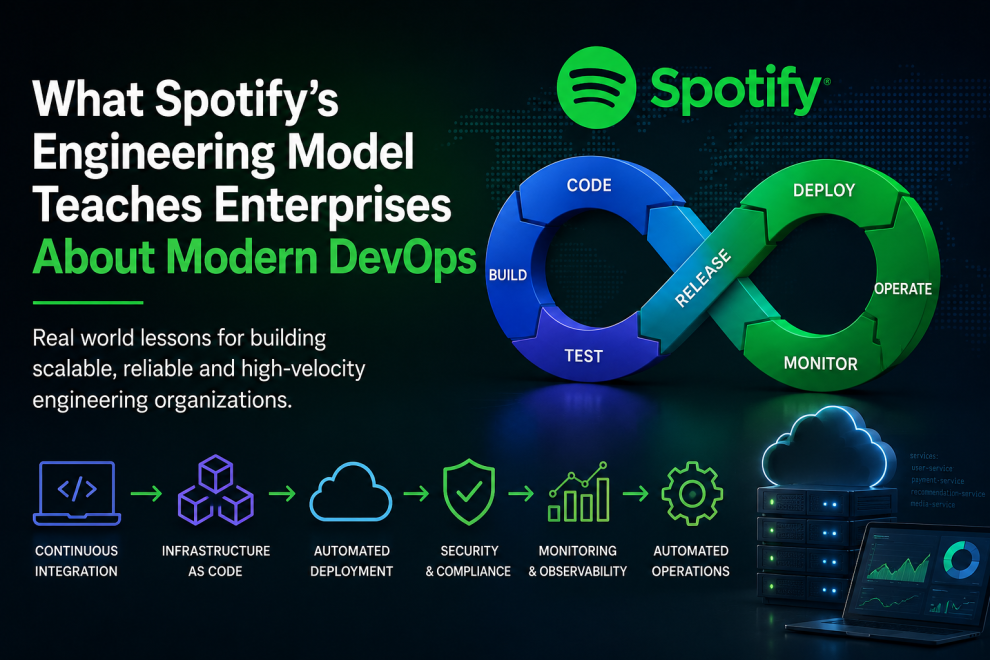
With engineering teams continuously delivering updates across mobile, web, backend, and recommendation platforms, manual deployment processes would never have kept pace. Every release required automated testing, infrastructure provisioning, deployment orchestration, monitoring, and rollback mechanisms working together.
When millions of users expect uninterrupted music streaming, every deployment carries business risk. A failed release doesn’t simply affect developers. It impacts customer retention, subscription revenue, and brand trust.
Spotify addressed this challenge by building highly automated delivery pipelines supported by continuous integration, continuous deployment, infrastructure as code, and extensive production observability. The objective wasn’t simply releasing software faster. It was reducing deployment risk while allowing engineering teams to innovate continuously.
Many large enterprises now face similar operational challenges, even if their industries look very different.
DevOps Has Become a Platform Strategy
For many organizations, DevOps was initially introduced to improve collaboration between development and operations teams.
Today, its role extends much further.
Modern DevOps determines how quickly organizations launch digital products, recover from production incidents, scale cloud infrastructure, and introduce AI-powered capabilities.
Engineering leaders increasingly evaluate DevOps investments through business outcomes rather than deployment metrics alone. Faster releases matter because they accelerate revenue opportunities. Automated infrastructure matters because it reduces operational costs. Reliable monitoring matters because customer experience depends on rapid issue detection and recovery.
The conversation has shifted from tooling to organizational capability.
AI Is Raising the Bar for DevOps
Artificial intelligence is placing new demands on enterprise platforms.
AI applications introduce additional deployment pipelines, model versioning, GPU infrastructure, vector databases, security policies, and continuous monitoring requirements. Unlike traditional applications, AI systems require ongoing operational oversight long after deployment.
Organizations that already operate mature DevOps platforms are finding it significantly easier to integrate AI into production environments.
Those with fragmented delivery pipelines often discover that AI exposes weaknesses in automation, infrastructure management, and observability that previously went unnoticed.
For many enterprises, AI readiness now depends as much on DevOps maturity as it does on machine learning expertise.
Automation Alone Doesn’t Create Operational Excellence
Many enterprises have invested heavily in CI/CD tools while continuing to struggle with slow releases and production incidents.
The reason is straightforward.
Automation improves individual processes, but DevOps succeeds only when the entire delivery lifecycle is designed as an integrated system.
Deployment pipelines, infrastructure provisioning, security scanning, compliance validation, monitoring, incident response, and rollback procedures must operate as connected workflows rather than isolated tools.
Organizations that achieve this integration reduce operational friction while improving engineering productivity.
Platform Engineering Is Reshaping Enterprise DevOps
As software portfolios grow, engineering teams increasingly expect internal platforms that abstract operational complexity.
Rather than asking every development team to build deployment pipelines from scratch, platform engineering teams provide standardized environments, reusable infrastructure templates, centralized observability, and automated governance.
This approach allows developers to focus on delivering business capabilities while platform teams maintain consistency, security, and operational reliability across the organization.
For enterprises managing hundreds of engineering teams, platform engineering is becoming a natural extension of modern DevOps.
Choosing the Right DevOps Partner
Enterprise DevOps initiatives rarely succeed through tooling alone.
Success depends on designing scalable cloud architectures, automating infrastructure, improving deployment reliability, strengthening observability, and aligning operational processes with business objectives.
Engineering partners increasingly play a strategic role in helping organizations modernize delivery platforms while minimizing disruption to existing operations.
Companies such as GeekyAnts have expanded their capabilities beyond application development to support cloud-native engineering, DevOps automation, platform modernization, and scalable deployment strategies. For enterprises balancing modernization with operational continuity, experience across development, cloud infrastructure, and platform engineering can significantly reduce implementation risk.
DevOps Is Becoming a Competitive Advantage
Customers rarely notice a successful deployment.
They notice when digital services become unavailable, applications slow down, or new features arrive months later than expected.
The organizations leading digital transformation today are not necessarily those writing the most code. They are the ones capable of delivering reliable software continuously, adapting infrastructure as demand changes, and responding quickly when production environments behave unexpectedly.
In an economy where software increasingly defines customer experience, DevOps is no longer an operational concern.
It has become one of the strongest indicators of an enterprise’s ability to innovate, compete, and scale.
For more, visit our homepage!


Add Comment