








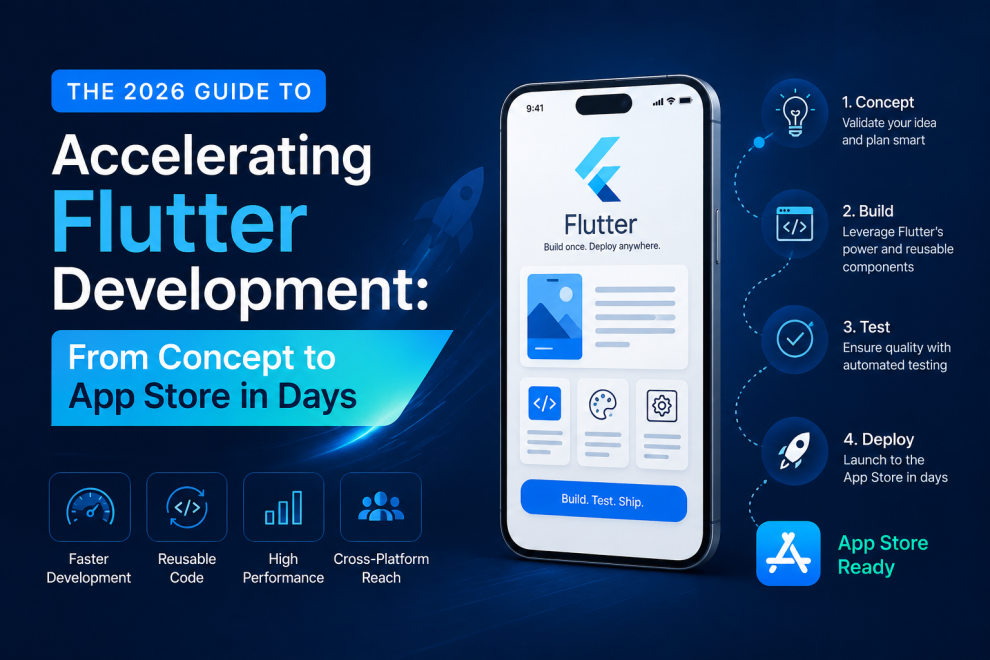

Enterprise mobile delivery has changed dramatically over the past few years. In 2026, organizations are no longer asking whether Flutter is production-ready. That debate is over. The real question has become much more practical:
How can engineering organizations deliver secure, high-quality Flutter applications in days instead of months without increasing operational risk?
For enterprises managing multiple product teams, regional releases, compliance requirements, and complex backend systems, application speed is no longer just a developer productivity metric. It directly affects revenue, customer retention, competitive advantage, and digital transformation initiatives.
The companies shipping mobile products the fastest are not necessarily writing code more quickly. They are building delivery platforms that automate repetitive work, standardize development, and eliminate deployment bottlenecks.
This is where DevOps becomes the real accelerator behind modern Flutter development.
Flutter Is Fast. Your Delivery Pipeline Needs to Be Faster.
Flutter already provides significant engineering advantages through its single codebase for Android, iOS, desktop, and web. Teams spend less time maintaining multiple platforms and more time building customer value.
However, enterprise engineering leaders know that application development rarely slows down because of UI development.
The biggest delays usually happen because of:
- fragmented CI/CD pipelines
- inconsistent environments
- manual testing
- security approvals
- release coordination
- infrastructure provisioning
- deployment failures
In large organizations, these delays often consume more engineering time than writing the application itself.
The fastest Flutter teams treat delivery infrastructure as a product instead of an afterthought.
DevOps Is Now Part of Flutter Development
Flutter projects increasingly depend on mature platform engineering practices from the first sprint.
Instead of waiting until launch to introduce automation, successful organizations build deployment workflows alongside the application itself.
A modern Flutter DevOps workflow typically includes automated infrastructure provisioning, pull request validation, security scanning, dependency analysis, artifact management, automated testing, staged deployments, feature flags, monitoring, and rollback automation.
The result is predictable delivery rather than unpredictable release cycles.
Instead of spending release week fixing deployment issues, engineering teams focus on improving customer experience.
Infrastructure Standardization Removes Hidden Bottlenecks
Enterprise Flutter teams often have dozens of developers contributing simultaneously.
Without standardized environments, simple issues become expensive.
One engineer uses a different Flutter SDK.
Another has outdated dependencies.
Someone else builds using a different Xcode version.
These inconsistencies introduce deployment failures that are difficult to reproduce.
Modern platform engineering eliminates these variables using containerized build environments, Infrastructure as Code, automated dependency management, and repeatable build pipelines.
Standardization allows every team to work from the same engineering foundation regardless of geography or business unit.
Automation Creates Delivery Confidence
Manual release processes rarely scale beyond a few applications.
Large organizations frequently manage dozens of customer-facing mobile applications alongside internal enterprise tools.
Every manual approval, deployment step, or testing activity increases operational risk.
Automation changes this equation.
Every code commit can automatically trigger:
Code quality validation.
Unit testing.
Integration testing.
Performance benchmarking.
Security analysis.
Artifact generation.
Deployment to testing environments.
This continuous feedback loop allows engineering leaders to detect issues within minutes rather than days.
The impact extends beyond engineering productivity.
Faster feedback significantly reduces production incidents and release failures.
Observability Should Begin Before Production
Many organizations still treat monitoring as something added after deployment.
In reality, production visibility should be designed during development.
Modern Flutter delivery pipelines integrate crash reporting, performance monitoring, API tracing, logging, and user analytics directly into release workflows.
Engineering leaders gain immediate visibility into:
application startup performance
device-specific failures
network latency
memory consumption
regional deployment health
release adoption
Instead of reacting to customer complaints, teams identify issues before they affect business metrics.
Platform Engineering Enables Repeatable Mobile Delivery
Many enterprise organizations now operate internal platform engineering teams.
Their objective is not to build applications.
Their objective is to make application delivery dramatically easier.
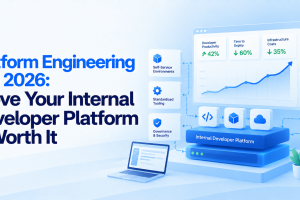
Instead of every Flutter team creating unique CI/CD pipelines, internal developer platforms provide reusable deployment templates, security policies, build automation, testing frameworks, monitoring integrations, and deployment workflows.
This reduces operational overhead while improving governance across hundreds of engineering projects.
Platform engineering has become one of the biggest competitive advantages for organizations scaling Flutter adoption.
AI Is Accelerating Flutter Delivery, Not Replacing Engineers
Generative AI has become deeply integrated into enterprise software development.
Developers increasingly rely on AI for code generation, documentation, test creation, migration assistance, and debugging.
However, the largest productivity improvements occur when AI operates inside well-designed DevOps workflows.
Automatically generated code still passes through security checks, automated testing, code review, policy validation, and deployment automation.
AI speeds development.
DevOps ensures reliability.
The two are complementary rather than competing approaches.
Choosing the Right Engineering Partner Matters
Many enterprises successfully build internal Flutter expertise.
Others accelerate delivery by partnering with organizations that already have mature engineering practices, reusable architecture patterns, and established DevOps workflows.
Companies such as GeekyAnts, Very Good Ventures, and Invertase have contributed significantly to Flutter’s enterprise ecosystem through large-scale implementations, open-source contributions, consulting, and platform expertise.
The most valuable partners are not simply writing Flutter applications. They help organizations establish repeatable delivery pipelines, improve engineering velocity, reduce technical debt, and create sustainable mobile engineering practices that continue delivering value long after the first release.
What Enterprise Leaders Should Measure
Application delivery is becoming a business KPI rather than a technical metric.
Instead of measuring only development velocity, enterprise leaders increasingly evaluate:
Deployment frequency.
Lead time for production releases.
Change failure rate.
Recovery time after incidents.
Developer onboarding speed.
Infrastructure consistency.
Release predictability.
These indicators provide a much clearer picture of engineering effectiveness than traditional project timelines.
Organizations that consistently improve these metrics often achieve faster product innovation while maintaining operational stability.
Final Thoughts
Accelerating Flutter development in 2026 is not primarily about writing code faster.
It is about reducing friction across the entire software delivery lifecycle.
Organizations investing in DevOps automation, platform engineering, standardized infrastructure, observability, and intelligent deployment pipelines consistently deliver mobile products more quickly without sacrificing security or quality.
For enterprise engineering leaders, Flutter has evolved into more than a cross-platform framework. Combined with modern DevOps practices, it becomes a strategic capability that enables faster innovation, shorter release cycles, and more resilient digital products.
The organizations that succeed over the next few years will be those that treat software delivery as a competitive advantage rather than simply a development process.
Frequently Asked Questions
Is Flutter suitable for large enterprise applications?
Yes. Flutter is widely adopted for enterprise-grade applications because it enables a shared codebase across platforms while integrating well with existing backend services, authentication systems, and cloud infrastructure.
How does DevOps improve Flutter development?
DevOps automates building, testing, security validation, deployment, and monitoring. This reduces manual work, shortens release cycles, and improves software reliability.
What role does platform engineering play?
Platform engineering provides standardized development environments, reusable CI/CD pipelines, deployment templates, and governance that help multiple engineering teams ship applications consistently.
Can AI replace Flutter developers?
No. AI improves developer productivity by assisting with coding, testing, and documentation, but engineering judgment, architecture, security, and operational decision-making remain human responsibilities.
What should enterprise leaders prioritize first?
Begin with automated CI/CD, infrastructure standardization, security scanning, observability, and deployment automation. These improvements typically produce the fastest gains in engineering velocity and release reliability.
For more, visit our homepage!




Add Comment