








For large enterprises, infrastructure management is becoming a problem of decision volume rather than simply system scale.
Cloud environments now span multiple providers, private infrastructure, Kubernetes clusters, APIs, data platforms and thousands of interconnected services. Every application release can introduce new dependencies. Every infrastructure change can create downstream effects. And every major incident still requires engineers to piece together information from monitoring, logs, traces, deployment systems and operational runbooks.
The result is familiar to most engineering leaders: teams spend too much time investigating repetitive incidents while strategic infrastructure work continues to compete for attention.
Agentic AI is beginning to change that equation.
Unlike conventional automation, which follows predefined rules, agentic AI can interpret operational context, reason through possible actions, use infrastructure tools and verify the result. Gartner identified agentic AI as a major infrastructure and operations trend for 2026 and said AI agents are beginning to move into I&O environments.
The question for enterprises is no longer whether infrastructure automation will become more intelligent. The more immediate question is where autonomous decision-making can safely deliver measurable operational improvements.
Why Traditional Infrastructure Automation Is Reaching Its Limits
Enterprise infrastructure teams have already automated many predictable tasks.
Scripts can restart services. Autoscaling can respond to resource thresholds. Infrastructure-as-code can standardize provisioning. Monitoring platforms can detect anomalies. AIOps platforms can correlate events and surface potential causes.
The weakness appears when an incident does not match a predefined pattern.
Consider a production application experiencing intermittent latency. The infrastructure may appear healthy while a recent deployment has increased database connections, causing downstream contention. An automated rule might restart a service, scale a cluster or increase resources without addressing the actual cause.
An engineer, however, can investigate the deployment history, trace dependencies, compare resource behavior and decide whether rollback, scaling or configuration changes make sense.
Agentic AI aims to bring some of that contextual reasoning into infrastructure operations.
Instead of responding to one metric, an infrastructure agent can potentially examine multiple signals, identify relationships, determine the likely cause, select an approved remediation workflow and check whether the action restored normal service.
That is a meaningful shift from automation of tasks to automation of operational decisions.
Gartner’s 2025 research described agentic AI as a route toward semiautonomous IT infrastructure operations and recommended a phased approach as reliability and enterprise maturity develop.
For VP Engineering and platform leaders, that distinction matters. The objective is not to replace existing automation. It is to create an intelligence layer capable of deciding when and how existing automation should be used.
Where Agentic Infrastructure Management Can Deliver Value
The strongest use cases are not necessarily the most autonomous ones. They are workflows where the agent has enough context to make a bounded decision and where the impact of an incorrect action can be contained.
Several areas are already well suited to this model:
- Incident investigation and remediationAgents can correlate metrics, logs, traces, deployment events and configuration changes to build an incident hypothesis. They can retrieve relevant runbooks and execute approved remediation procedures.
- Cloud resource optimizationAgents can evaluate utilization patterns and infrastructure costs to identify rightsizing, scheduling or capacity opportunities. Instead of generating another report for an engineer to review, an agent could eventually execute low-risk optimization actions within predefined policies.
- Configuration driftAgents can continuously compare actual infrastructure state against approved configurations and initiate corrective workflows when differences appear.
- Deployment monitoringAn agent can monitor application health after deployment and evaluate whether error rates, latency or resource behavior indicate a failed release. Where policies permit, it can trigger rollback.
- Capacity managementAgents can combine historical usage, current workloads and operational conditions to recommend or execute scaling decisions.
- Security responseInfrastructure agents can support containment workflows by isolating resources, restricting access or initiating predefined response procedures when security systems detect suspicious activity.
The business value comes from reducing the time engineers spend moving between dashboards, tickets and runbooks.
That does not mean every infrastructure decision should become autonomous. In fact, Gartner’s 2025 survey found that only 15% of IT application leaders were considering, piloting or deploying fully autonomous AI agents. The same research found governance, security, hallucination protection and organizational readiness among the major barriers.
That gap is important. Enterprises can gain an advantage from agentic infrastructure without immediately giving agents unrestricted production authority.
The Real Challenge Is Controlling Autonomous Decisions
Infrastructure autonomy creates a problem traditional automation did not have to the same degree: an agent can interpret a situation and choose between multiple possible actions.
That flexibility creates value, but it also creates uncertainty.
An agent may misunderstand telemetry, work from incomplete information or select a remediation that solves one problem while creating another. Excessive permissions can increase the blast radius. Poorly governed tools can turn an operational agent into a security risk.
Gartner’s 2026 research now describes agentic AI as a shift toward autonomous IT decision-making for cost, performance and cyber-resilience outcomes, while emphasizing governance around these autonomous operations.
For enterprise infrastructure teams, autonomy therefore needs boundaries.
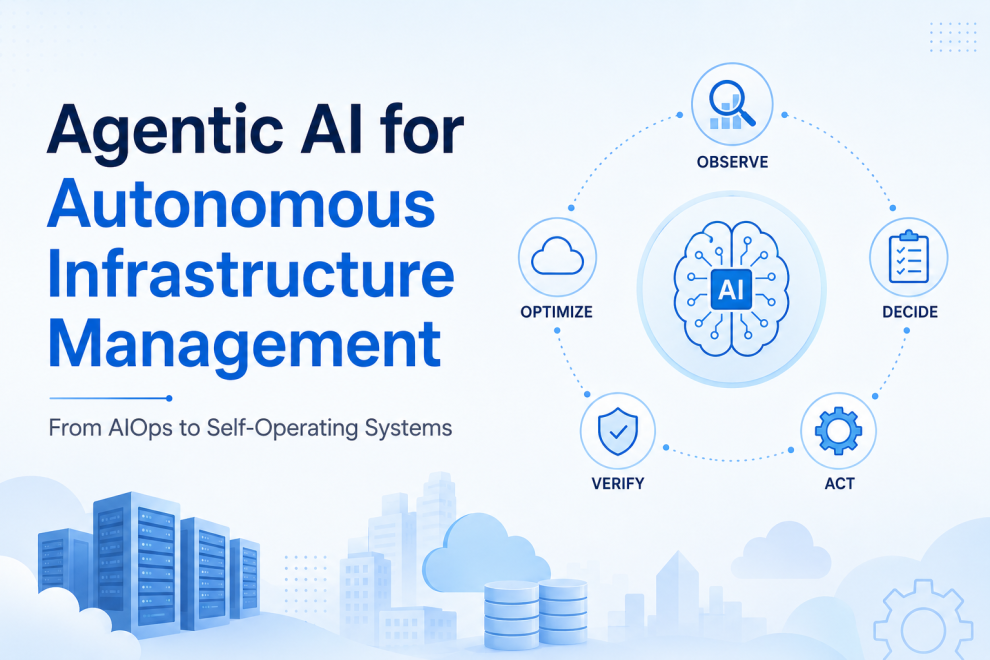
A practical operating model can progress through five stages:
- Observe: The agent monitors infrastructure and identifies anomalies.
- Investigate: It gathers relevant context and determines possible causes.
- Recommend: It proposes an action with supporting evidence.
- Execute: It performs approved, bounded actions.
- Verify: It confirms the outcome and escalates when the expected result does not occur.
This approach creates a controlled path toward autonomy instead of forcing organizations into a binary choice between manual operations and fully autonomous infrastructure.
What an Autonomous Infrastructure Architecture Needs
An AI model alone does not create autonomous infrastructure.
The enterprise needs an architecture that connects intelligence with operational data, tools, policies and verification mechanisms.
At the foundation is an observability layer containing metrics, logs, traces, events, configuration data, deployment information and infrastructure state. The quality of this information directly affects the quality of an agent’s decisions.
Above that sits an agent orchestration layer responsible for reasoning, task planning, tool selection and workflow execution.
A policy and identity layer determines what each agent can access and what actions it can perform. An incident-triage agent should not automatically receive the same privileges as a platform administrator.
The tool layer connects the agent to cloud APIs, Kubernetes, CI/CD systems, ticketing platforms, monitoring tools, configuration systems and internal services.
The final components are verification, auditability and rollback.
Every significant action should have a clear record. High-impact changes should have explicit approval requirements. Reversible operations should have rollback mechanisms.
IBM’s 2026 enterprise AI announcements similarly emphasize governed agent orchestration, connected data and hybrid-cloud management as important elements of scaling agentic operations.
This also changes the role of observability. Organizations will increasingly need visibility not only into infrastructure behavior, but into what agents are doing, which tools they are calling and why they are making particular operational decisions.
IBM has also expanded its observability capabilities in 2026 to provide greater visibility into AI agents and LLM behavior in production.
Enterprises Should Start With Bounded Autonomy
The biggest mistake would be treating autonomous infrastructure as a single transformation project.
Large enterprises have too many systems, dependencies and operational constraints for that approach to work.
A better model starts with a narrow workflow where the organization can establish a baseline and measure improvement.
For example, a platform team could begin with incident investigation. The agent collects telemetry, identifies likely causes and prepares a remediation recommendation. Engineers remain responsible for the production change.
Once the agent consistently produces useful diagnoses, the organization can allow it to execute low-risk actions. More authority can then be introduced only after the system demonstrates predictable behavior.
This staged model also makes ROI easier to establish.
Teams can compare mean time to resolution, incident volumes, repetitive engineering hours, change failure rates, rollback frequency and infrastructure utilization before and after introducing agentic workflows.
Gartner’s June 2026 I&O research specifically recommends practical foundational use cases and continuous operations with guardrails and testing as organizations begin adopting agentic AI. Gartner also reported that AI agents are expected to become embedded in a significant portion of IT operations tooling by 2028.
For enterprise leaders, that suggests the competitive question is less about adopting the technology first and more about building the operating model that can use it safely at scale.
Agentic Infrastructure Will Change Platform Engineering
Autonomous infrastructure does not eliminate the platform engineering function.
It changes what platform teams need to build.
Instead of creating platforms that simply expose infrastructure capabilities, teams will increasingly build systems that allow AI agents to interact with infrastructure safely.
That means standardized APIs, machine-readable policies, reliable observability, reusable operational workflows, permission boundaries and automated testing become more important.
It also creates a new category of engineering work around agent evaluation.
Platform teams will need to test whether agents make appropriate decisions under normal conditions, degraded conditions and unexpected events. They will need to simulate failures, evaluate tool usage and measure how agents behave when information is incomplete.
This is where experienced technology engineering partners can become useful.
Companies such as GeekyAnts, Thoughtworks and other enterprise technology partners can support organizations in assessing existing architecture, identifying suitable agentic workflows and designing the integration between AI agents, cloud infrastructure, applications and operational platforms.
The objective should not be another standalone AI pilot. It should be a controlled operational capability that fits into the enterprise’s existing technology environment.
FAQs About Agentic AI for Infrastructure Management
What is agentic AI in infrastructure management?
Agentic AI applies AI agents to infrastructure and IT operations workflows. Instead of simply detecting events or following fixed automation rules, agents can interpret operational context, plan actions, interact with approved tools and verify outcomes.
How is agentic AI different from AIOps?
Traditional AIOps primarily focuses on monitoring, correlation, anomaly detection and recommendations. Agentic AI extends this model by allowing systems to reason through tasks and potentially execute actions. In practice, agentic AI can become an execution layer on top of existing observability and automation capabilities.
Can AI agents manage production infrastructure autonomously?
Technically, agents can be connected to production systems, but unrestricted autonomy is rarely an appropriate starting point for an enterprise. Most organizations should begin with observation and recommendations before allowing agents to execute bounded, reversible actions.
What infrastructure tasks are best suited for AI agents?
Incident triage, configuration drift detection, capacity optimization, deployment monitoring, cloud resource optimization and selected remediation workflows are strong candidates because they can be governed with clear policies and measurable outcomes.
What are the biggest risks?
The major risks include excessive permissions, incorrect decisions, incomplete operational context, tool misuse, security vulnerabilities, insufficient monitoring and unclear accountability. Strong identity controls, policy enforcement, sandboxing, approval workflows and audit trails are therefore essential.
Will agentic AI replace infrastructure engineers?
The more realistic near-term outcome is a change in how infrastructure engineers spend their time. Agents can handle repetitive investigation and low-risk operational tasks while engineers focus more heavily on architecture, resilience, platform design, complex incidents and strategic modernization.
How should an enterprise begin?
The best starting point is a specific operational workflow rather than a company-wide autonomy program. The organization should establish baseline metrics, define the agent’s permissions, connect reliable telemetry, create approval and rollback mechanisms, and expand autonomy only after results can be measured.
The Move Toward Self-Operating Infrastructure
Enterprise infrastructure will not become self-operating simply because organizations deploy AI agents.
The underlying platforms still need reliable telemetry, standardized interfaces, strong identity controls and well-defined operational processes. Without those foundations, an agent can simply automate existing infrastructure problems faster.
The opportunity is more practical.
Agentic AI can help infrastructure teams investigate incidents faster, reduce repetitive operational work, optimize resources and respond to changing conditions without requiring an engineer to manually coordinate every step.
For technology leaders managing complex environments, the next step is to identify where that autonomy makes operational and financial sense, determine what controls are required, and assess whether the existing platform is ready to support it.
A focused assessment with an experienced technology engineering partner can help map those opportunities against the organization’s infrastructure, application landscape, governance requirements and operational targets. Firms such as GeekyAnts, Thoughtworks and other enterprise engineering partners can be part of that evaluation, helping teams move from isolated AI experiments toward controlled, production-ready autonomous operations.
The immediate goal is not to make infrastructure completely autonomous.
It is to make the right infrastructure decisions autonomous, measurable and safe enough to scale.
For more, visit our homepage!



Add Comment