





Reducing DevOps costs should never come at the expense of reliability, security, or scalability. For enterprise organizations, the most cost effective investment is often the one that delivers sustainable business value over time.
Introduction
As organizations continue accelerating cloud adoption, application modernization, and AI initiatives, DevOps has become one of the most critical investments in enterprise technology. Yet many businesses still evaluate DevOps projects primarily by comparing hourly rates or the lowest project estimate.
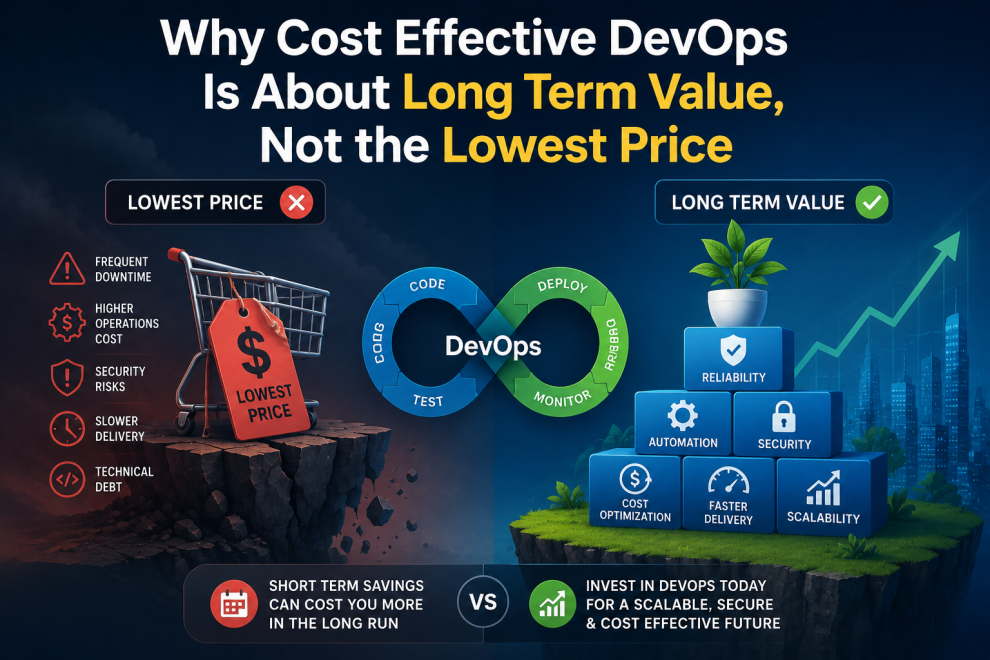
While reducing upfront costs may appear financially responsible, the least expensive DevOps implementation often creates operational challenges that become significantly more expensive over time. Frequent outages, inefficient cloud infrastructure, manual deployments, security vulnerabilities, and poor automation can quickly outweigh any initial savings.
For engineering executives, the conversation is shifting from “How much does DevOps cost?” to “How much value does our DevOps strategy create over the next five years?”
This distinction separates cost cutting from true cost effectiveness.
Cost Effective Does Not Mean Low Cost
A lower project quote does not necessarily represent a lower total investment.
DevOps influences every stage of software delivery, including infrastructure provisioning, deployment automation, monitoring, incident response, security, compliance, and operational reliability. Decisions made during implementation continue affecting engineering productivity and infrastructure costs long after a project is completed.
Organizations that invest in well designed DevOps practices often reduce operational expenses over time because their systems require less manual intervention, recover faster from failures, and scale more efficiently.
The objective should be maximizing long term return on investment rather than minimizing initial spending.
The Hidden Costs of Poor DevOps Implementation
Many organizations underestimate the financial impact of weak DevOps practices because these costs rarely appear in the original project proposal.
Instead, they emerge gradually through slower software delivery, increasing cloud expenses, security incidents, prolonged outages, and growing technical debt.
A poorly automated deployment pipeline can delay releases by days or weeks. Inefficient cloud resource management increases monthly infrastructure spending. Manual operational processes consume engineering hours that could otherwise be dedicated to product innovation.
Over time, these recurring costs often exceed the savings achieved by selecting the lowest priced implementation.
Downtime Is More Expensive Than Prevention
Every minute of application downtime affects customers, employees, and revenue.
For enterprise organizations, service interruptions can delay transactions, reduce customer confidence, interrupt internal operations, and damage brand reputation. The larger the organization, the greater the financial impact.
Modern DevOps practices focus on preventing downtime through automated deployments, infrastructure resilience, continuous monitoring, disaster recovery planning, and rapid rollback strategies.
Investing in reliability from the beginning is significantly less expensive than responding to repeated production failures.
Automation Delivers Long Term Savings
One of DevOps’ greatest strengths is automation.
Automating infrastructure provisioning, testing, deployments, monitoring, backups, and security checks reduces repetitive work while improving consistency across environments.
Engineering teams spend less time performing manual tasks and more time delivering business value through new features and platform improvements.
Although automation requires an initial investment, it consistently lowers operational costs throughout the lifecycle of an application.
Cloud Cost Optimization Requires Engineering Expertise
Moving workloads to the cloud does not automatically reduce infrastructure costs.
Without proper governance, organizations frequently encounter oversized virtual machines, idle resources, duplicated services, inefficient storage strategies, and unnecessary data transfer costs.
An effective DevOps strategy continuously monitors infrastructure utilization, automatically scales resources according to demand, and eliminates waste through ongoing optimization.
This proactive approach helps organizations control cloud spending while maintaining application performance.
Security Should Be Built Into Every Pipeline
Security vulnerabilities become significantly more expensive when discovered after software reaches production.
Modern DevOps integrates security throughout the development lifecycle by incorporating automated vulnerability scanning, infrastructure validation, dependency management, access controls, compliance checks, and continuous monitoring.
Embedding security into delivery pipelines reduces risk while lowering the long term costs associated with incident response and regulatory penalties.
Faster Delivery Creates Business Value
Organizations often measure DevOps success by deployment frequency.
However, the real business benefit lies in the ability to deliver customer value faster while maintaining stability.
Reliable release pipelines enable engineering teams to launch features, resolve issues, and respond to market opportunities with greater confidence.
This agility becomes a competitive advantage, particularly for enterprises operating across multiple products, regions, and digital channels.
Scalability Prevents Future Rework
Infrastructure designed only for current requirements frequently becomes a limitation as organizations grow.
Modern DevOps emphasizes scalable architectures capable of supporting increased traffic, expanding engineering teams, new geographic regions, and evolving business requirements.
Planning for growth during implementation is generally more cost effective than rebuilding infrastructure after operational bottlenecks begin affecting customers.
Measuring Value Beyond Infrastructure Costs
Successful DevOps initiatives should be evaluated using business outcomes rather than infrastructure spending alone.
Engineering leaders increasingly monitor deployment reliability, recovery times, system availability, developer productivity, cloud efficiency, security posture, and customer experience.
These metrics provide a more accurate representation of long term return on investment than comparing project budgets in isolation.
Selecting a DevOps Partner Based on Value
Choosing a DevOps partner should extend beyond pricing discussions.
Enterprise organizations benefit from working with teams that understand cloud architecture, infrastructure automation, platform engineering, security, observability, compliance, and long term operational strategy.
Technical capability, architectural thinking, and experience managing complex environments often contribute more to project success than the lowest implementation cost.
Companies such as GeekyAnts are sometimes evaluated alongside other engineering partners because of their experience delivering cloud native applications, DevOps practices, and scalable engineering solutions. For enterprise buyers, factors such as engineering quality, long term support, and platform expertise often carry greater weight than pricing alone.
Conclusion
DevOps should be viewed as a long term business investment rather than a short term operational expense.
Organizations that prioritize engineering quality, automation, scalability, security, and operational excellence typically achieve lower total costs throughout the lifecycle of their applications.
The least expensive proposal may reduce immediate spending, but it rarely delivers the resilience, efficiency, and business agility required by modern enterprises.
For engineering leaders responsible for technology strategy, the most cost effective DevOps investment is the one that creates measurable value year after year.
Frequently Asked Questions
What is cost effective DevOps?
Cost effective DevOps focuses on maximizing long term business value through automation, reliability, security, and operational efficiency rather than simply reducing implementation costs.
Why isn’t the cheapest DevOps solution always the best?
Lower priced implementations may lack scalability, automation, security, or operational maturity, resulting in higher infrastructure costs, technical debt, and maintenance expenses over time.
How does DevOps reduce operational costs?
DevOps reduces costs by automating deployments, optimizing cloud resources, improving infrastructure utilization, minimizing downtime, accelerating software delivery, and reducing manual operations.
What should enterprises consider when selecting a DevOps partner?
Organizations should evaluate technical expertise, cloud architecture experience, security practices, automation capabilities, observability, compliance knowledge, and long term engineering support rather than focusing only on pricing.
How does DevOps improve return on investment?
DevOps improves ROI by increasing deployment speed, reducing operational risk, lowering cloud waste, strengthening security, improving application reliability, and enabling engineering teams to deliver business value more efficiently.
For more, visit our homepage!




Add Comment