





Enterprise software systems have become more complex than ever. Large organizations now operate across multiple cloud environments, thousands of services, distributed applications, and constantly evolving digital platforms. While traditional DevOps practices transformed how companies build and deploy software, many enterprises are reaching a point where manual monitoring, incident response, and infrastructure management are no longer enough.
The next evolution of DevOps is being shaped by artificial intelligence. AI-powered DevOps is helping engineering teams move from reactive problem-solving toward predictive and autonomous operations, where systems can identify issues, recommend solutions, and even recover from failures with minimal human intervention.
Why Traditional DevOps Is Facing New Enterprise Challenges
DevOps helped organizations improve collaboration between development and operations teams by introducing automation, continuous integration, continuous delivery, and infrastructure as code. However, as businesses scale, their technology environments become increasingly difficult to manage.
Modern enterprises deal with thousands of deployments, complex microservice architectures, multi-cloud environments, and large volumes of operational data. Engineering teams often spend significant time analyzing alerts, troubleshooting incidents, and maintaining infrastructure instead of focusing on innovation.
The challenge is no longer just deploying software faster. It is about maintaining reliability, security, and performance while applications continue to grow in complexity.
This is where AI-powered DevOps is creating a major shift.
Moving From Reactive Operations to Predictive Intelligence
Traditional monitoring systems usually alert teams after something goes wrong. Engineers then investigate logs, analyze system behaviour, identify the root cause, and implement a solution.
AI-powered DevOps introduces a more proactive approach. Machine learning models can analyze large amounts of operational data, identify unusual patterns, and predict potential failures before they impact customers.
For enterprise teams, this means fewer unexpected outages, faster issue resolution, and improved system reliability. Instead of waiting for incidents to happen, engineering teams can address risks before they become business disruptions.
The Emergence of Self-Healing Cloud Infrastructure
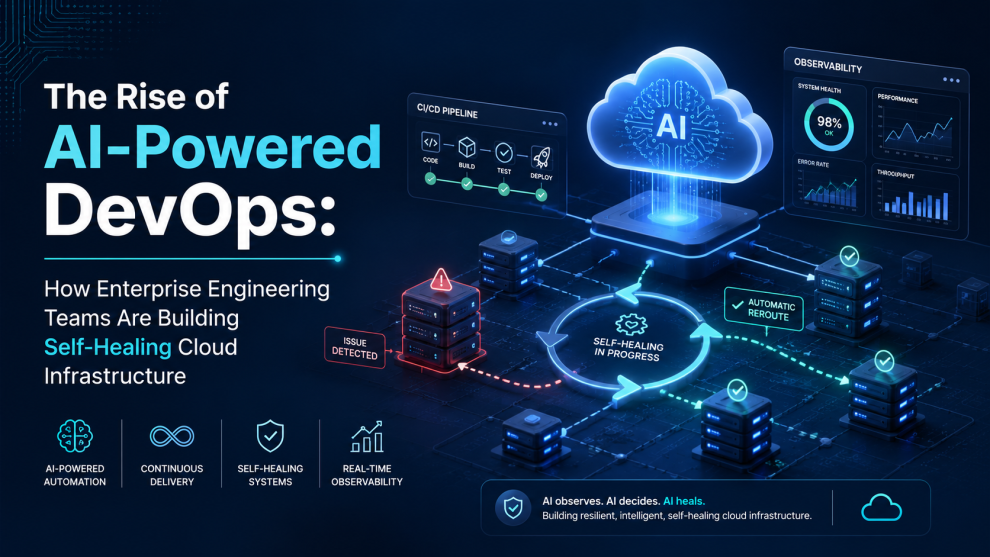
One of the most significant developments in AI-powered DevOps is the rise of self-healing infrastructure.
Self-healing systems use AI-driven automation to detect abnormal behaviour and take corrective actions automatically. For example, an intelligent system could identify a failing service, restart affected components, adjust resources based on demand, or recommend changes to improve application performance.
For companies operating mission-critical platforms, this capability can significantly reduce downtime and improve customer experiences.
However, self-healing infrastructure is not about removing engineers from the process. Instead, it allows engineering teams to focus on higher-value decisions while automated systems handle repetitive operational tasks.
AI Agents Are Changing Incident Management
Incident response is one area where AI is creating significant improvements. In large organizations, even minor failures can require multiple teams to investigate logs, review deployments, and identify dependencies.
AI-powered agents can assist by analyzing system information, correlating events, identifying possible causes, and suggesting remediation steps. In more advanced environments, these agents can execute approved actions based on predefined rules and security policies.
This reduces the time required to resolve incidents and helps engineering teams maintain consistent operational standards across complex environments.
Why Platform Engineering Is Becoming Critical
As enterprises adopt AI-powered DevOps, platform engineering is becoming a key part of modern technology strategies.
Internal developer platforms help organizations create standardized environments where developers can build, test, and deploy applications efficiently. They provide teams with self-service capabilities while maintaining governance, security, and compliance requirements.
For large enterprises, platform engineering creates a balance between developer speed and operational control. It enables engineering teams to innovate faster without creating unnecessary infrastructure complexity.
Building the Right Foundation for AI-Powered DevOps
AI cannot solve every operational challenge without the right engineering foundation. Organizations need strong cloud architectures, reliable observability systems, secure deployment pipelines, and scalable application platforms.
Many enterprises are realizing that successful AI adoption requires more than implementing new tools. It requires modernizing engineering practices and creating systems that are designed for scalability, security, and continuous improvement.
Companies with expertise in cloud-native development, product engineering, and AI-driven transformation are helping organizations bridge the gap between experimental AI solutions and production-ready enterprise systems. Engineering partners such as GeekyAnts work with businesses to modernize digital platforms and build scalable solutions that support evolving technology needs.
The Future of Enterprise DevOps
The future of DevOps will not be defined only by faster deployments. It will be defined by intelligent systems that can understand, predict, and adapt to changing environments.
AI-powered DevOps represents a shift toward autonomous, resilient, and efficient infrastructure. For enterprise engineering leaders, the goal is not complete automation without oversight. The goal is creating smarter systems that empower teams, improve reliability, and allow organizations to focus on innovation.
As businesses continue to scale their digital platforms, self-healing infrastructure and AI-driven operations will become essential components of modern enterprise technology strategies.
For more, visit our homepage!


Add Comment