





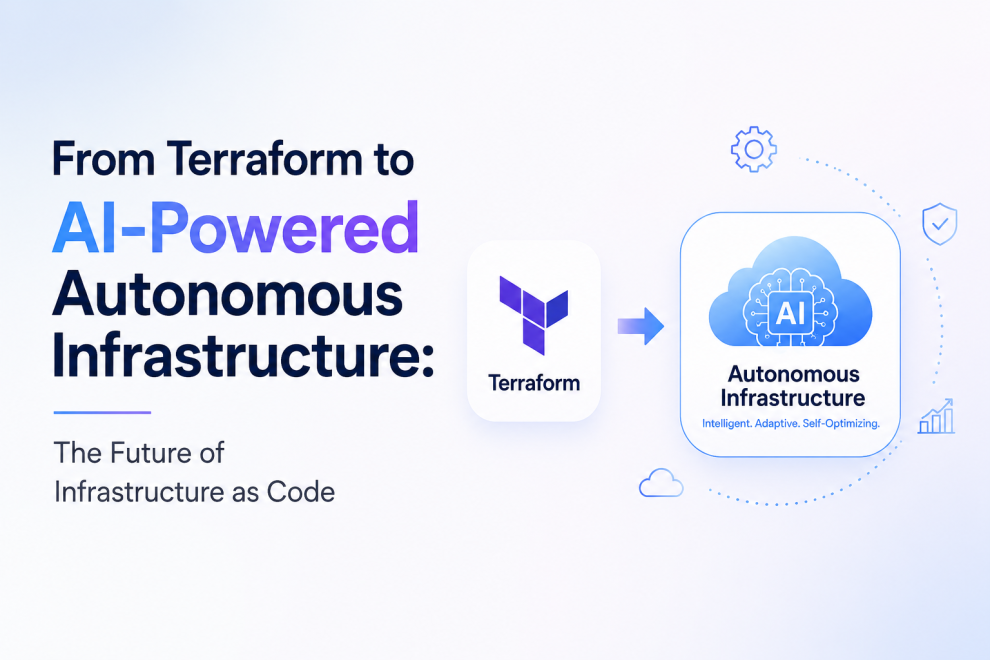

Cloud infrastructure has matured dramatically over the past decade. What began as a shift from manually provisioning virtual machines evolved into Infrastructure as Code (IaC), where tools like Terraform, Pulumi, and AWS CloudFormation enabled engineering teams to describe infrastructure declaratively and deploy it consistently.
For many enterprises, that transformation delivered enormous value. Infrastructure became version-controlled, deployments became repeatable, and platform teams gained the ability to manage environments at scale. Yet as organizations expand their cloud estates, adopt AI-powered products, and operate across multiple cloud providers, a new challenge has emerged.
Writing infrastructure as code is no longer the hardest part.
Operating it continuously, securely, and intelligently has become the real competitive advantage.
Infrastructure Is Becoming an Operational Intelligence Problem
Large enterprises rarely struggle with creating infrastructure. They struggle with maintaining thousands of cloud resources across hundreds of engineering teams while balancing security, governance, compliance, performance, and cost.
Platform engineering leaders are increasingly asking questions that traditional IaC tools were never designed to answer.
Which infrastructure changes create unnecessary cloud spend?
Which environments are drifting from organisational standards?
Can compliance issues be detected before deployment instead of after an audit?
Can production incidents trigger automated infrastructure remediation instead of waiting for human intervention?
These questions point toward a future where infrastructure is no longer static code but an intelligent operational system capable of understanding context and making informed decisions.
The Evolution Beyond Declarative Infrastructure
Infrastructure as Code solved consistency.
Autonomous infrastructure aims to solve decision-making.
Rather than simply applying configuration files, next-generation infrastructure platforms combine IaC with AI, policy engines, observability platforms, and automation workflows.
Imagine a deployment pipeline that recognises an unusual configuration, predicts that it may exceed cost budgets, identifies potential security risks, suggests a safer architecture, and automatically opens a pull request with recommended improvements before the deployment even begins.
This is no longer a theoretical concept. Many enterprises are already integrating AI into platform engineering workflows to assist engineers with infrastructure planning, security validation, and operational decision support.
The goal is not replacing infrastructure engineers.
It is removing repetitive operational work so engineering teams can focus on architecture and innovation.
Infrastructure Becomes Self-Optimising
Traditional Terraform workflows typically follow a predictable sequence.
An engineer writes code.
The pipeline validates syntax.
Infrastructure is provisioned.
Monitoring tools report problems later.
Autonomous infrastructure introduces intelligence throughout that lifecycle.
Instead of waiting for failures, systems continuously analyse telemetry, deployment history, security posture, utilisation patterns, and cloud costs to recommend or even execute corrective actions automatically under controlled governance.
An oversized Kubernetes cluster may be resized before monthly cloud costs increase significantly.
Unused cloud resources may be identified and safely decommissioned.
Security policies may automatically prevent risky configurations from reaching production.
Infrastructure drift can be detected and corrected before operational issues appear.
The result is infrastructure that continuously improves rather than simply existing.
AI Is Becoming a Core Platform Engineering Capability
Artificial intelligence is increasingly being embedded into platform engineering workflows, but its role extends beyond generating Terraform snippets.
The real opportunity lies in infrastructure reasoning.
Modern AI systems can correlate deployment history, production incidents, cloud utilisation, infrastructure policies, and operational metrics to provide recommendations that would otherwise require hours of investigation across multiple dashboards.
Instead of searching logs, engineers receive actionable insights.
Instead of manually reviewing hundreds of pull requests, AI highlights high-risk infrastructure changes.
Instead of reacting to incidents, engineering teams begin preventing them.
For organisations managing thousands of services across multiple regions, this shift has significant implications for operational efficiency.
Governance Remains the Foundation
Greater automation also introduces greater responsibility.
Autonomous infrastructure cannot become uncontrolled infrastructure.
Enterprise leaders must ensure that every automated decision remains transparent, auditable, and compliant with internal governance standards.
Policy-as-Code becomes even more important.
Approval workflows remain essential.
Human oversight continues to play a critical role, particularly for regulated industries such as financial services, healthcare, insurance, and telecommunications.
The future is not fully autonomous infrastructure.
It is responsibly autonomous infrastructure.
Platform Engineering Will Lead the Next Wave
The organisations moving fastest are investing in internal developer platforms that standardise infrastructure delivery while embedding security, compliance, and operational intelligence directly into engineering workflows.
Rather than expecting every product team to become cloud experts, platform teams provide reusable golden paths that developers can consume with confidence.
This approach reduces cognitive load while improving consistency across the organisation.
Infrastructure becomes a product delivered by the platform engineering team rather than a collection of scripts maintained independently by individual development teams.
Choosing the Right Technology Partner
Building autonomous infrastructure requires expertise across cloud architecture, DevOps, platform engineering, AI integration, security, observability, and enterprise software delivery. Few organisations possess deep capabilities across all of these domains internally.
As a result, many enterprises collaborate with specialised engineering partners to accelerate platform modernisation while maintaining governance and operational excellence. Companies such as GeekyAnts, Thoughtworks, EPAM Systems, and Globant work with enterprises to modernise cloud platforms, implement scalable DevOps practices, and build AI-enabled engineering ecosystems that support long-term digital transformation. The right partner brings not only implementation expertise but also experience designing platforms that remain maintainable, secure, and adaptable as technology continues to evolve.
Looking Beyond Infrastructure as Code
Infrastructure as Code fundamentally changed how enterprises build cloud platforms.
The next transformation is not about replacing Terraform or abandoning declarative infrastructure.
It is about adding intelligence to every stage of the infrastructure lifecycle.
The future belongs to organisations where infrastructure can reason about risk, optimise itself, enforce governance automatically, and assist engineers in making better operational decisions.
For technology executives responsible for large-scale digital platforms, the question is no longer whether autonomous infrastructure will become mainstream.
The more important question is whether their platform strategy is prepared for a future where infrastructure evolves from executable code into an intelligent operational system that continuously learns, adapts, and improves.
For more, visit our homepage!


Add Comment