




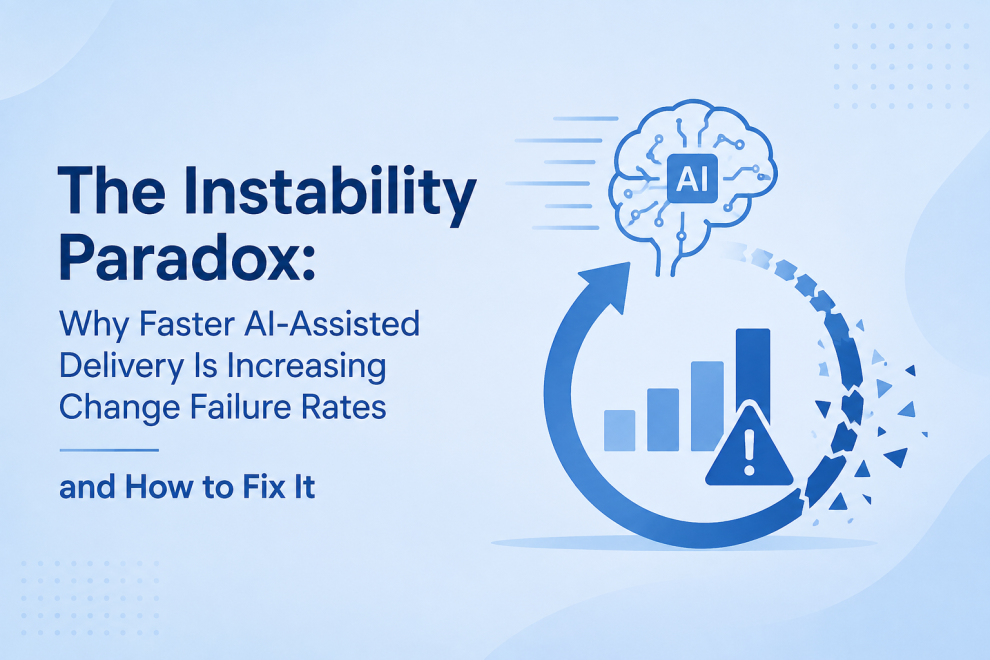

AI-assisted software delivery has changed the economics of engineering. Teams can generate code faster, automate testing, create infrastructure configurations in minutes, and move product ideas from backlog to production at a pace that would have seemed unrealistic a few years ago. For large enterprises, however, speed is exposing a less obvious problem: the faster teams can create changes, the easier it becomes to overwhelm the systems responsible for validating, governing, and absorbing those changes. This is the instability paradox. Engineering organizations may improve development throughput while simultaneously increasing production incidents, rollback frequency, emergency remediation, deployment fatigue, and customer-impacting failures. The problem is not necessarily that AI-generated code is inherently unreliable. The deeper issue is that delivery velocity can increase faster than organizational control velocity. For VP-level engineering and technology leaders, this creates a strategic question: How do you capture the productivity benefits of AI-assisted engineering without allowing change failure rates to rise?
The Real Problem Is Not Faster Coding
AI coding assistants can accelerate many parts of the software lifecycle. Engineers can generate boilerplate, refactor existing modules, write tests, investigate unfamiliar codebases, produce API integrations, and troubleshoot defects more quickly. But production systems do not fail because code was written slowly. They fail because changes interact with complex environments. A seemingly small modification can affect authentication, data contracts, caching, observability, infrastructure, third-party integrations, mobile clients, APIs, or downstream services. In an enterprise environment with thousands of engineers and hundreds or thousands of services, the number of possible interactions becomes enormous. AI reduces the cost of producing a change. It does not automatically reduce the complexity of the environment receiving that change.
AI Is Compressing the Software Delivery Cycle
Traditional development often contained natural friction. A feature might move through requirements, architecture, implementation, code review, testing, security review, staging, release approval, and production monitoring. AI-assisted development compresses several of these stages. An engineer can now move from idea to prompt to code to test to pull request much faster than before. That is valuable when the change is well understood. The problem occurs when organizational controls remain designed for a slower delivery model. If engineering output doubles while review capacity, test coverage, environment parity, observability, and release governance remain unchanged, the organization has created a bottleneck. The bottleneck simply moves downstream.
More Changes Mean More Interactions
Consider a large North American enterprise with thousands of engineers and a distributed technology stack. Before widespread AI-assisted development, a platform team might process a manageable number of significant changes each week. With AI-assisted development, individual teams can produce substantially more pull requests, configuration updates, API modifications, feature flags, dependency changes, and infrastructure changes. The organization may celebrate this as increased engineering velocity. But every production change introduces some degree of risk. The important question is therefore not simply, “How many changes can we deploy?” It is, “How many changes can our organization safely absorb?” If the answer to the second question does not grow alongside the first, change failure rates can increase even while engineering productivity metrics improve.
Why Change Failure Rates Can Rise
Code Generation Is Accelerating Faster Than System Understanding
AI can produce technically valid code without fully understanding the operational history of a system. Legacy applications contain undocumented dependencies, historical workarounds, implicit contracts, and unusual data assumptions. An AI assistant can generate a clean implementation that is locally correct but operationally incompatible. For enterprise systems, correctness is not simply whether the code compiles or passes unit tests. Correctness includes whether the change behaves safely within the larger system.
Review Becomes the New Bottleneck
When developers produce more code, human review becomes harder. A reviewer who previously examined a few carefully prepared changes may now encounter substantially more AI-assisted pull requests. Review remains mandatory, but its effectiveness can decline because humans are processing too many changes. Engineering leaders should therefore ask whether they are measuring code review completion or actual risk reduction through review. Those are very different metrics.
More Tests Do Not Automatically Mean More Confidence
AI can generate tests quickly, but more tests do not automatically mean better validation. A generated test may confirm that an implementation behaves according to its own assumptions without testing the assumptions that matter operationally. Tests can miss race conditions, data consistency problems, downstream failures, permission boundary violations, resource exhaustion, and compatibility issues with older clients. Coverage can increase while actual production confidence remains unchanged.
Infrastructure Changes Are Becoming Easier to Produce
AI-assisted infrastructure work introduces another dimension. Engineers can generate Terraform, Kubernetes configurations, CI/CD workflows, IAM policies, observability configurations, and deployment scripts rapidly. That is powerful, but infrastructure changes can have a significantly larger blast radius than application-level changes. A small configuration mistake can affect thousands of workloads. Organizations therefore need stronger automated policy enforcement as infrastructure velocity increases.
Dependency Velocity Is Increasing
AI-assisted development also makes it easier to introduce libraries, frameworks, APIs, SDKs, and third-party services. Every new dependency introduces questions around security vulnerabilities, license compatibility, maintenance, versioning, performance, data handling, vendor reliability, and long-term architectural fit. The answer is not to stop adopting new dependencies. It is to make dependency decisions more automated and governed as adoption accelerates.
The Enterprise Version of the AI Productivity Problem
For a startup, an unstable release might affect a relatively small customer population. For a company serving millions of customers, operating healthcare systems, financial platforms, retail infrastructure, logistics networks, or global digital products, the consequences are different. A failed deployment can create customer disruption, operational escalation, engineering recovery work, reputational impact, and delayed roadmap execution. This means a productivity gain can be partially or completely consumed by recovery work. A team that becomes 30% faster at producing software but spends substantially more engineering capacity handling incidents, rollbacks, hotfixes, and production investigations has increased gross delivery velocity without necessarily increasing net delivery capacity.
Stop Treating Deployment Frequency as the Definition of Speed
Deployment frequency remains useful, but it should not be interpreted in isolation. A mature engineering organization should evaluate delivery through a broader operating model. Change failure rate shows what percentage of deployments result in degraded service, rollback, incident, or remediation. Mean time to recovery shows how quickly the organization can restore reliable service. Rework rate reveals how much engineering capacity is spent correcting or revisiting recent changes. Escaped defect rate shows how many defects reach production despite existing validation. Rollback frequency reveals how often teams need to reverse production changes. Change risk distribution helps identify which types of changes generate the highest operational impact. AI-assisted change ratio shows what percentage of production changes involve AI-generated or AI-modified code. The goal is not to penalize teams for using AI. The goal is to determine whether AI-assisted throughput is translating into reliable technology and customer outcomes.
Build a Change Safety Layer
The answer is not to slow engineering teams down with additional manual approvals. Instead, organizations should build an automated change safety layer around high-velocity development. This can combine static analysis, policy-as-code, automated testing, contract testing, progressive delivery, runtime observability, and dynamic risk scoring. Static analysis can identify code quality, security, and architectural issues. Policy-as-code can automatically enforce organizational rules for infrastructure, dependencies, authentication, data access, and deployment configuration. Automated testing can prioritize validation based on the areas affected by a change. Contract testing can detect compatibility problems between services and APIs. Progressive delivery can use canary releases, staged rollouts, feature flags, and automated rollback mechanisms. Runtime observability can connect deployment events to application, infrastructure, and customer-impact signals. Dynamic risk scoring can evaluate changes based on affected services, dependencies, historical failures, and production criticality. The objective is simple: make safe changes faster, not simply make all changes faster.
Move From Approval-Based Governance to Risk-Based Governance
Traditional enterprise governance often assumes that every significant change deserves human approval. That model does not scale well when AI increases change volume. Instead, organizations can classify changes by risk. A low-risk documentation update can move through an automated pipeline. A moderate-risk API change might require additional contract testing and staged deployment. A high-risk modification to authentication, customer identity, core infrastructure, or critical transaction systems could trigger deeper automated validation and targeted human review. This makes governance proportional to potential impact rather than organizational bureaucracy.
Use AI to Review AI-Assisted Changes
One practical response to AI-assisted development is to use AI further down the delivery pipeline. AI systems can analyze pull requests for architectural risks, identify suspicious dependency changes, compare modifications against established patterns, summarize affected services, and highlight areas that deserve human attention. AI should not become the final authority for production risk, particularly in critical systems. A stronger model is: AI generates, AI validates, automation enforces, and humans decide where judgment matters most. This allows engineering organizations to reserve human expertise for ambiguous, high-impact decisions instead of spending it on repetitive inspection.
Build an AI-Aware CI/CD Pipeline
CI/CD pipelines designed before AI-assisted development may not be sufficient for today’s delivery volumes. An AI-aware pipeline should understand more than whether tests passed. It should understand which services changed, which teams own those services, which dependencies are affected, whether the component has experienced previous incidents, whether sensitive data is involved, whether infrastructure has changed, whether a new external dependency has been introduced, what production traffic is exposed, what rollback mechanism exists, and whether sufficient observability is available. The result is a pipeline that evaluates risk rather than simply syntax and test status.
Establish Production Guardrails Before Scaling AI Adoption
Large organizations should resist the temptation to roll out AI coding tools everywhere and measure success through lines of code or pull requests. A better sequence is to establish production guardrails first, increase AI-assisted development second, and measure whether reliability remains stable as throughput increases. If AI-assisted delivery increases output while change failure rates remain flat or decline, the organization is capturing genuine productivity gains. If output increases while incidents and rework increase sharply, the organization has identified an operational constraint that needs attention.
Architecture Matters More Than Ever
AI-assisted development exposes architectural weaknesses that were previously hidden by slower delivery. Tightly coupled systems, unclear service ownership, fragile APIs, undocumented dependencies, and weak observability become more problematic when development accelerates. Large enterprises should invest in clear service ownership, stable API contracts, strong domain boundaries, standardized platform capabilities, centralized observability, automated security controls, reusable deployment patterns, and well-defined dependency management. AI can accelerate engineering execution, but it cannot compensate indefinitely for architectural ambiguity.
The Platform Engineering Opportunity
This is where platform engineering becomes strategically important. A strong internal developer platform can provide engineers with safe defaults instead of asking every team to reinvent deployment, observability, security, infrastructure, and release processes. An internal platform can make the safest path the easiest path. Developers should not need to manually configure multiple systems to deploy a service safely. The platform can provide standardized pipelines with automated testing, security scanning, policy validation, observability, progressive delivery, and rollback. AI can then operate inside these boundaries, allowing organizations to increase developer capability while platform guardrails contain risk.
What Technology Leaders Should Measure
For organizations with thousands of engineers, the most important AI engineering dashboard should connect productivity with reliability. Track engineering throughput through pull requests, deployment frequency, cycle time, and lead time. Track operational stability through change failure rate, incident volume, rollback rate, and mean time to recovery. Track engineering efficiency through rework, remediation effort, time spent on incidents, and time spent reviewing changes. Track customer impact through availability, latency, conversion impact, support volume, and customer-facing defects. Track AI adoption through AI-assisted changes, generated-code acceptance rates, AI-generated defects, and AI-related remediation. The more useful question is not, “How much code is AI producing?” It is, “How much reliable product capacity is AI creating?”
For enterprises adopting AI-assisted engineering, the challenge is not simply selecting a coding assistant. It is connecting accelerated development with production architecture, application engineering, platform practices, observability, and release governance. GeekyAnts can be considered within this broader engineering modernization approach when organizations need to connect faster application development with the operational practices required to run those systems reliably at scale.
The New Definition of Engineering Velocity
The next phase of enterprise software delivery will not be won by organizations that simply generate the most code. It will be won by organizations that can increase the rate of change without increasing the rate of failure. AI-assisted development is a force multiplier, but a force multiplier amplifies the system around it, including weaknesses. If architecture is fragile, AI can accelerate changes against fragile architecture. If testing is weak, AI can accelerate unvalidated changes. If governance is manual, AI can overwhelm governance teams. If platform engineering is mature, AI can accelerate teams within reliable boundaries. The strategic advantage therefore comes from combining AI velocity with engineering control systems. For technology leaders, the goal is not slower development or more approvals. It is higher change velocity with predictable reliability. That is how enterprises move beyond the instability paradox: by making the organization capable of absorbing the speed that AI is now making possible.
For more, visit our homepage!



Add Comment