



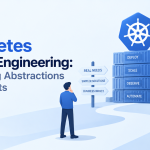



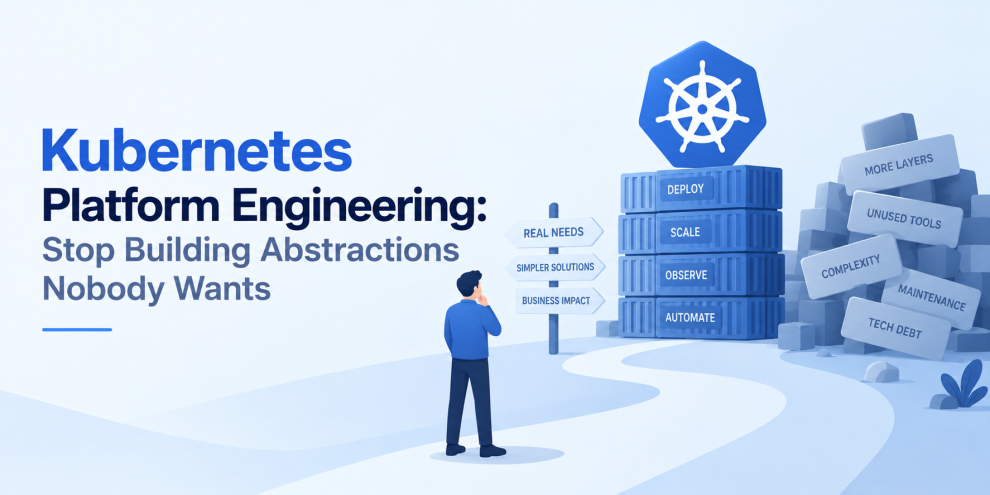

Kubernetes made modern infrastructure dramatically more capable, but it also made infrastructure more complicated. Teams can automate deployments, manage containers, configure networking, enforce policies, scale workloads, and integrate observability across clusters. The problem is that giving developers more infrastructure capabilities does not automatically make their work easier. This is where Kubernetes platform engineering can go wrong. A platform team can spend months building internal portals, custom deployment workflows, abstraction layers, templates, dashboards, and automation while developers continue bypassing the platform because it makes their work slower or harder. The organization ends up with another internal product that nobody really wanted. The purpose of platform engineering is not to hide Kubernetes behind as many layers as possible. It is to remove unnecessary complexity from the developer experience while preserving the infrastructure capabilities teams actually need.
Kubernetes Is Powerful, but Developers Should Not Need to Master It
Kubernetes exposes a large operational surface. Developers may encounter deployments, services, ingress, namespaces, ConfigMaps, secrets, probes, resource requests, autoscaling, service accounts, network policies, persistent volumes, admission controls, and custom resources. Infrastructure teams may understand these concepts deeply, but application developers should not have to become Kubernetes administrators simply to ship a service. A well-designed platform can allow developers to describe what their application needs while the platform handles much of the underlying Kubernetes configuration. The objective is not to hide everything. It is to expose the right level of abstraction.
The Abstraction Trap
Platform teams can make the same mistake as product teams by building what they believe users need without observing how those users actually work. A team might create a custom deployment platform with its own YAML format, internal CLI, service catalog, approval workflow, and configuration model. Technically, the platform may be impressive. Practically, developers may now have to learn Kubernetes plus the company’s custom version of Kubernetes. Every new abstraction introduces another interface that must be documented, maintained, tested, upgraded, and understood. If the abstraction does not remove enough complexity to justify that cost, the platform becomes another source of engineering friction. The important question is therefore not “What can we abstract?” but “What complexity should developers never have to deal with?”
Start With Developer Friction
Platform engineering should begin with problems rather than technology. Before building an internal developer platform, teams should examine where developers actually lose time. Maybe creating a new service requires multiple infrastructure tickets. Perhaps deployments require unnecessary manual approvals. Maybe configuring observability takes hours. Developers may struggle to obtain temporary cloud credentials or repeatedly implement health checks differently across services. These are genuine platform opportunities. If teams can already deploy applications quickly using existing Kubernetes tooling, building another deployment interface may provide little value. Platform roadmaps should therefore be driven by measurable friction such as deployment frequency, lead time for changes, failed deployments, infrastructure support requests, onboarding time, and developer feedback.
Platform Engineering Is an Internal Product
A platform is not simply a collection of Terraform modules and Kubernetes manifests. It is an internal product used by engineering teams. That means platform teams need to understand their users, define developer journeys, measure adoption, gather feedback, communicate changes, and retire features that do not provide value. Developers using the platform are effectively internal customers. This mindset changes how platform teams prioritize work. Instead of asking whether a feature is technically sophisticated, they should ask whether it makes application delivery faster, safer, or more predictable.
Build Golden Paths, Not Golden Cages
Golden paths are one of the most useful concepts in platform engineering. A golden path provides a recommended way to perform a common task without forcing developers to understand every underlying infrastructure detail. An organization might provide a standard path for creating a production-ready service with deployment automation, logging, metrics, tracing, secrets management, health checks, and autoscaling already configured. Developers receive a reliable starting point without having to assemble every component themselves. However, the path should remain flexible enough for legitimate exceptions. A golden path becomes a golden cage when developers cannot escape it even when their workload has different requirements. Good platform engineering provides sensible defaults while maintaining controlled escape hatches.
Do Not Build a New Platform for Every Problem
Kubernetes already has a large ecosystem covering deployment automation, secrets, observability, policy management, service networking, autoscaling, GitOps, security, and infrastructure provisioning. Platform teams do not need to build replacements for every capability. Custom development should be reserved for problems where existing tools cannot adequately address an organization’s specific needs. Before building a custom platform component, teams should determine whether an established solution already provides most of the required functionality. The objective is not to demonstrate how much the platform team can build. It is to reduce operational complexity.
The Platform Should Hide Implementation Details, Not Important Decisions
A useful abstraction removes unnecessary implementation details while keeping important decisions visible to the people responsible for the application. Developers should not need to understand every Kubernetes object required to deploy a standard service. However, they should understand important decisions involving resource requirements, availability, scaling behavior, deployment strategy, and application dependencies. Over-abstraction becomes dangerous when the platform hides these decisions completely. If a service suddenly consumes excessive CPU or starts scaling unexpectedly, developers need enough visibility to understand the configuration behind that behavior. Good platform engineering reduces complexity without destroying transparency.
Self-Service Is More Important Than Another Dashboard
Internal developer portals have become common in platform engineering, but a portal is not automatically a platform. A portal may provide service catalogs, deployment controls, documentation, ownership information, environment details, and operational links. However, if developers click through a dashboard only to generate the same tickets or configuration they previously created manually, the portal has simply changed the interface. Real self-service means developers can complete meaningful workflows independently, such as creating a service, provisioning an environment, deploying an application, requesting approved infrastructure, viewing operational information, or rolling back a deployment. The interface matters less than whether the workflow actually becomes easier.
Kubernetes Complexity Should Be Absorbed Selectively
A platform team exists partly to absorb infrastructure complexity, but it cannot absorb everything. If every Kubernetes feature is hidden behind a custom platform API, the platform team can quickly become a bottleneck. Every new infrastructure capability then requires platform engineers to expose another abstraction. A better approach is to define a stable core of supported capabilities. Common workloads can receive highly automated paths, while specialized workloads can access lower-level Kubernetes interfaces under appropriate controls. This allows the platform to remain opinionated without becoming restrictive.
Measure Platform Success Through Outcomes
Platform teams should avoid measuring success primarily through the number of services registered, dashboards created, templates published, or Kubernetes clusters managed. These are activity metrics rather than evidence of value. More meaningful indicators include developer onboarding time, time required to create a production service, deployment frequency, lead time for changes, deployment failure rate, infrastructure-related support requests, platform adoption, developer satisfaction, and recovery time after failed deployments. These measurements show whether the platform is actually improving engineering productivity. A platform with hundreds of features but frustrated developers is not necessarily successful. A smaller platform that solves critical workflows exceptionally well may create significantly more value.
The Platform Needs a Clear Contract
Developers interact with platforms through interfaces such as CLIs, portals, Git repositories, APIs, templates, and deployment configurations. The underlying interface should remain stable even when infrastructure changes. An organization should ideally be able to change its Kubernetes cluster architecture without forcing every application team to redesign its deployment process. This is where abstraction provides genuine value. The platform creates a stable contract between application teams and infrastructure. That contract should be intentionally designed, documented, versioned, and supported.
Avoid Platform-Specific Configuration Everywhere
One warning sign is when every infrastructure concept gets translated into another proprietary configuration format. Developers may start with Kubernetes YAML, then encounter platform YAML, application metadata YAML, environment configuration, and custom deployment definitions. Instead of reducing complexity, the platform has created multiple configuration languages. Whenever possible, platform teams should prefer familiar interfaces and standard tooling. Abstractions should simplify configuration rather than multiply it.
Treat Kubernetes as an Implementation Detail When It Makes Sense
Developers do not necessarily need to know whether their application is running on a particular Kubernetes cluster, node pool, or infrastructure configuration. A platform can expose application-level concepts such as service, environment, compute profile, scaling policy, and deployment strategy while Kubernetes implements those requirements behind the scenes. This creates a useful separation between application intent and infrastructure implementation. However, the platform should not pretend Kubernetes does not exist when teams need deeper operational control. Advanced teams should have documented ways to inspect and troubleshoot the underlying infrastructure.
Every Platform Needs an Escape Hatch
No platform can predict every application requirement. Machine learning workloads, stateful applications, high-throughput services, low-latency systems, specialized networking, and legacy workloads may require capabilities outside the standard golden path. Forcing every workload through the same abstraction can lead developers to create dangerous workarounds. An escape hatch allows experienced teams to access lower-level infrastructure when necessary while still maintaining organizational security and governance. The platform should make the common case easy without making the uncommon case impossible.
Security Should Be Built Into the Platform
A well-designed internal platform can make secure practices easier to adopt. Instead of asking every application team to independently configure security controls, the platform can provide secure defaults for identity, secrets, network policies, image validation, vulnerability scanning, logging, and access management. This is one of the strongest arguments for platform engineering. The platform can turn security requirements into reusable infrastructure capabilities. Developers do not need to remember every security configuration because the recommended path already includes appropriate controls. At the same time, security should remain visible so developers understand which protections are applied automatically and which responsibilities remain with the application team.
Observability Should Be a Default Capability
Production services should not have to reinvent monitoring for every deployment. A standard platform path can automatically integrate applications with centralized logging, metrics, tracing, health monitoring, and alerting. This creates consistency across teams and makes incident response easier because platform engineers can establish common telemetry conventions. The goal is not to overwhelm developers with dozens of dashboards. A platform should expose the operational information developers actually need while providing deeper infrastructure visibility when troubleshooting requires it.
Platform Engineering Needs Versioned Contracts
Infrastructure changes continuously. Kubernetes versions change, cloud services evolve, security requirements are updated, observability systems are replaced, and networking architectures are redesigned. If a platform does not maintain stable contracts, every infrastructure change can become an application migration. Versioning helps separate platform evolution from application delivery. Platform teams should define what a supported interface guarantees, how breaking changes are communicated, how migrations work, and how long older versions remain supported. This turns the platform into a dependable engineering product rather than a collection of infrastructure scripts.
Where Engineering Partners Can Help
Building a useful platform requires a combination of DevOps, cloud architecture, backend engineering, security, developer experience, and application modernization expertise. Teams such as GeekyAnts, Thoughtworks, and other engineering-led technology organizations support organizations that need to design or modernize Kubernetes-based platforms while keeping the focus on developer workflows rather than infrastructure complexity. The strongest implementations typically begin by understanding existing engineering bottlenecks and then introduce automation and abstraction only where they remove measurable friction.
The Best Platform May Be Smaller Than You Think
Platform teams sometimes assume that a mature organization needs a massive internal developer platform. Not necessarily. A smaller platform with excellent service templates, automated deployments, standardized observability, secure defaults, reliable infrastructure provisioning, and strong documentation can deliver more value than a highly customized platform with dozens of features. Complexity should be earned. Every additional abstraction should have a measurable reason to exist. Every platform component should solve a real developer problem. Every workflow should make something faster, safer, or easier.
The Real Purpose of Kubernetes Platform Engineering
Kubernetes platform engineering is not about creating another layer between developers and infrastructure. It is about creating the right layer. The platform should absorb repetitive infrastructure work, provide secure defaults, establish reliable engineering patterns, and give developers self-service access to the capabilities they need. It should not force developers through unnecessary workflows, proprietary abstractions, or interfaces that exist simply because the platform team can build them. The most successful Kubernetes platforms may eventually become almost invisible. Developers create and operate applications without thinking about every Kubernetes object underneath them. Platform engineers maintain the infrastructure and guardrails. Security teams receive consistent controls. Operations teams gain visibility. Engineering organizations move faster without losing reliability. That is the real measure of platform engineering. If developers need a manual workaround to use your platform, the problem may not be developer behavior. The abstraction may simply be solving the wrong problem.
FAQs
What is Kubernetes platform engineering?
Kubernetes platform engineering is the practice of building internal tools, automation, infrastructure capabilities, and developer workflows that make it easier for application teams to build, deploy, operate, and scale services on Kubernetes.
Why do Kubernetes platforms fail?
Kubernetes platforms often fail when they are designed around infrastructure capabilities instead of developer needs. Excessive abstractions, complicated workflows, poor documentation, limited flexibility, and lack of user feedback can reduce adoption.
What is a golden path in platform engineering?
A golden path is a recommended, automated workflow for common engineering tasks. It provides sensible defaults while allowing controlled customization when applications have specialized requirements.
Should developers need to know Kubernetes?
Developers benefit from understanding basic Kubernetes concepts, but they should not need deep Kubernetes expertise to perform common application delivery tasks. A platform should absorb unnecessary infrastructure complexity.
Are internal developer portals the same as platform engineering?
No. A developer portal is an interface that can be part of a platform. Platform engineering encompasses the underlying infrastructure, automation, workflows, security controls, APIs, and developer experience.
How can platform teams increase Kubernetes adoption?
Platform teams can increase adoption by solving real developer problems, providing self-service workflows, reducing operational friction, maintaining good documentation, and allowing developers to provide continuous feedback.
What should a Kubernetes platform team measure?
Useful metrics include deployment frequency, lead time, deployment failure rate, developer onboarding time, infrastructure support requests, platform adoption, recovery time, and developer satisfaction.
When should a platform team build custom tooling?
Custom tooling makes sense when an organization has a recurring problem that existing tools cannot adequately solve. Building custom abstractions simply to replace established Kubernetes tooling can create unnecessary maintenance and complexity.
For more, visit our homepage!




Add Comment