





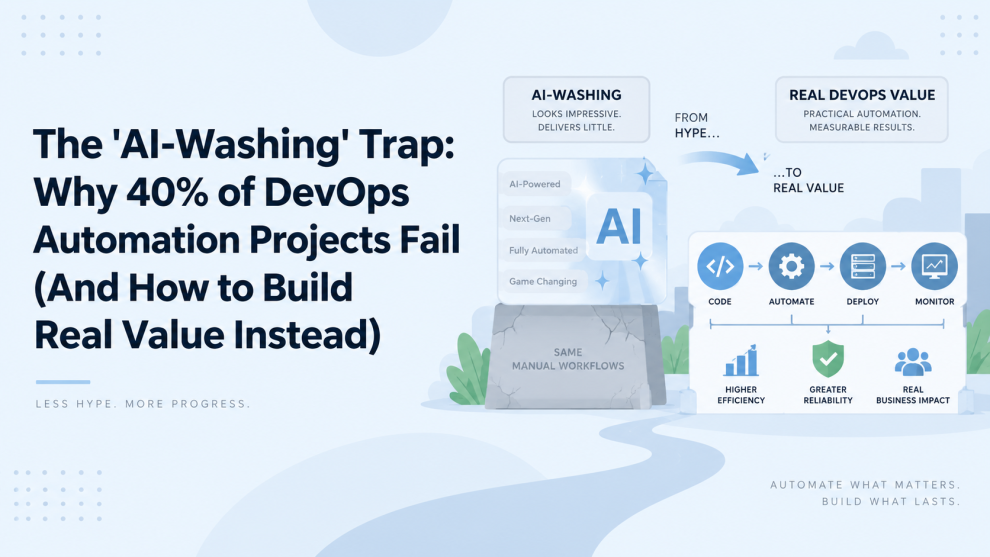

AI has become the easiest word to add to a DevOps roadmap. AI-powered monitoring. AI-driven incident response. Self-healing infrastructure. Autonomous deployments. Intelligent remediation. On paper, it sounds like the future of software operations. But there is a growing gap between calling something AI-powered and actually creating value with AI. Gartner’s 2026 research found that only 28% of AI use cases in infrastructure and operations fully succeed while meeting ROI expectations, while 20% fail outright. The research points to a bigger problem: organizations are adopting AI faster than they are building the operational foundations needed to make it reliable.
What Is AI-Washing in DevOps?
AI-washing happens when an existing automation process gets an AI label without meaningfully improving the underlying workflow. A monitoring platform groups alerts and suddenly becomes “AI-powered.” A deployment system follows predefined rules and gets marketed as “autonomous.” A chatbot retrieves information from a runbook and is described as an “AI operations agent.” None of these technologies are necessarily bad. The problem is assuming that adding AI automatically creates intelligence, efficiency, or measurable value. Real AI automation should improve decisions, reduce operational effort, increase reliability, or solve a problem that traditional automation could not handle effectively. If it does none of those things, the AI label is mostly marketing.
The Real Problem Starts Before the AI Model
Many DevOps automation projects begin with the wrong question: “Where can we use AI?” A better question is: “Where are our engineers spending time on repetitive decisions, and could intelligent automation improve the outcome?” That difference matters. Suppose an engineering team spends hours investigating hundreds of alerts every week. An AI system that correlates logs, traces, deployments, and historical incidents could potentially reduce that workload. But imagine another team has inconsistent deployment processes, incomplete monitoring, unclear ownership, and poorly documented infrastructure. Adding an AI agent on top of that environment will not magically fix those problems. It may actually make them harder to diagnose. Perforce’s 2026 State of DevOps research found that DevOps maturity materially affects AI success, reinforcing the importance of strong engineering foundations.
When Automation Looks Smarter Than It Really Is
Consider a typical incident. A production service suddenly becomes slow. The monitoring system detects the problem. An AI model analyzes the available telemetry and concludes that the latest deployment is responsible. It automatically rolls the deployment back. Latency improves. The demo looks fantastic. But production is rarely that simple. The latest deployment may have been unrelated to the original problem. Another service may already depend on the new version. The rollback could introduce a compatibility issue. A database migration may have already occurred. The AI may have fixed one symptom while creating another. The problem is not necessarily that the AI made a bad prediction. The problem is that the system acted without enough context.
Self-Healing Does Not Mean Unlimited Autonomy
“Self-healing infrastructure” sounds attractive because nobody wants engineers manually fixing repetitive failures at 3 a.m. But self-healing should not mean giving an AI unrestricted control over production. Some actions are relatively low risk. Restarting a failed worker may be acceptable. Clearing a temporary cache may be safe. Rebalancing a non-critical workload might be reasonable. Other actions carry much greater consequences. Changing database configurations, modifying network rules, deleting infrastructure, altering security policies, or rolling back major releases should involve stronger validation and approval. The more destructive an action can be, the stronger the guardrails should be. That is the difference between automation that is merely autonomous and automation that is production-ready.
Start With the Workflow, Not the Model
One of the easiest ways to avoid AI-washing is to design the operational workflow first. Identify a recurring problem. Measure how often it happens. Measure how much engineering time it consumes. Understand how engineers currently respond. Separate predictable decisions from decisions that require judgment. Then determine whether AI actually improves the process. This also prevents teams from using an LLM where conventional automation would be better. A simple rule can sometimes be faster, cheaper, easier to test, and more reliable than an AI model. There is nothing wrong with using traditional automation when traditional automation is the right solution. The goal is not to maximize the amount of AI. The goal is to maximize the value of automation.
Give AI a Job You Can Measure
“Use AI to improve DevOps” is not a useful objective. Reducing mean time to resolution by 25% is useful. Reducing false alerts by 40% is useful. Reducing repetitive incident investigation by 30% is useful. Increasing deployment success rates is useful. Reducing unnecessary infrastructure usage is useful. These metrics turn AI from an innovation project into an engineering initiative with measurable outcomes. Perforce’s 2026 research also points toward this broader shift, with organizations increasingly measuring AI through outcomes rather than simply tracking how much AI they have deployed.
Observability Becomes More Important, Not Less
There is another misconception around AI automation: that intelligent systems somehow reduce the need for observability. The opposite is true. AI automation depends on reliable operational context. If logs are incomplete, traces are missing, dependencies are poorly mapped, and deployment history is inconsistent, an AI system has less information to make good decisions. Imagine an AI agent investigating a latency problem. It needs to know what changed recently, which services are affected, whether infrastructure configuration changed, whether traffic patterns are unusual, and whether similar incidents happened before. Without that context, the model is working with an incomplete picture. AI does not replace observability. It makes high-quality observability even more valuable.
The Difference Between Recommendation and Execution
One of the safest ways to introduce AI into DevOps is to separate recommendation from execution. An AI system can investigate an incident and suggest three possible remediation steps. An engineer can review the recommendation. The system can then execute the approved action. Over time, teams can identify actions that consistently produce safe outcomes and automate those actions fully. This creates a gradual path toward autonomy. Instead of moving directly from manual operations to unrestricted AI agents, organizations can establish increasing levels of automation based on evidence.
Every Autonomous Action Needs a Boundary
A production AI system should have clearly defined limits. It should know which systems it can access. It should know which actions it can perform. It should have resource limits. It should have rollback mechanisms. It should maintain an audit trail. It should have escalation paths. Engineers should also have the ability to stop or override it. The critical question is not simply, “Can the AI fix this incident?” The more important question is, “What happens if the AI is wrong?” That question changes the architecture completely.
AI Can Amplify Bad DevOps Too
This is perhaps the most overlooked part of the AI automation conversation. If a mature engineering organization adopts AI, it can amplify existing strengths. Reliable pipelines become more efficient. Strong observability becomes more useful. Well-defined incident processes become easier to automate. Standardized environments become easier for AI systems to understand. But if an organization has inconsistent processes, unclear ownership, fragile deployments, and poor operational visibility, AI can amplify those weaknesses too. Perforce’s 2026 research highlights this maturity gap, with mature DevOps environments better positioned to scale AI successfully.
What a Real AI-Powered DevOps Strategy Looks Like
A stronger approach starts with a small number of high-value workflows. Choose a problem that occurs frequently. Collect reliable operational data. Define what the AI is allowed to recommend or change. Establish measurable success criteria. Introduce human approval where the risk is high. Test the system against failure scenarios. Track its decisions. Then expand only when the results justify greater autonomy. This approach may sound less exciting than announcing an “autonomous DevOps platform,” but it is far more likely to produce something useful. The objective should be controlled autonomy, not maximum autonomy.
Where Engineering Discipline Makes the Difference
For teams trying to move beyond AI experiments, GeekyAnts brings together AI engineering, DevOps, automation, observability, and production-focused architecture. Its approach is relevant to organizations that need to connect AI capabilities with real operational workflows, measurable outcomes, human oversight, and safeguards instead of simply adding AI to an existing toolchain. The important part is not the presence of AI. It is the engineering discipline around it.
AI Should Improve DevOps, Not Replace It
There is a temptation to believe that AI will eventually make traditional DevOps practices irrelevant. The evidence points in the opposite direction. AI works best when it has strong foundations underneath it: reliable CI/CD, consistent deployment processes, good observability, effective testing, clear ownership, documented runbooks, controlled infrastructure, security policies, incident management, and governance. These practices may not sound as exciting as autonomous agents, but they are what make autonomous agents useful. DevOps is not disappearing because of AI. It is becoming more important because AI increases the speed at which engineering systems operate.
The Real Measure of AI Automation
The success of AI in DevOps will not be measured by the number of agents deployed. It will be measured by what those agents actually improve: fewer incidents, faster recovery, more reliable deployments, less repetitive engineering work, better developer productivity, lower operational waste, safer infrastructure changes, and better use of engineering time. That is the difference between AI-washing and real AI adoption. The companies that get AI-powered DevOps right in 2026 will not necessarily be the ones using the most sophisticated models. They will be the ones that understand where AI genuinely adds value, where conventional automation is enough, where humans still need to make decisions, and what controls are required before machines are allowed to act. AI can make DevOps significantly more capable, but the value does not come from putting “AI” in front of DevOps. It comes from building the engineering foundation that allows AI to do something useful.
Frequently Asked Questions
What is AI-washing in DevOps?
AI-washing is the practice of adding AI terminology to existing automation without creating meaningful improvements in capability, reliability, productivity, or measurable outcomes.
Why do AI-powered DevOps projects fail?
Common causes include weak operational foundations, poor observability, unclear use cases, inadequate governance, unrealistic expectations, poor measurement, and giving AI too much autonomy before it has been properly validated.
Is self-healing infrastructure safe?
It can be, but only when autonomous actions have clear boundaries. Low-risk remediation can often be automated, while high-impact changes should include validation, approval, rollback mechanisms, and auditability.
How can companies avoid AI-washing?
Start with a measurable operational problem rather than a desire to use AI. Establish baseline metrics, determine whether AI is actually necessary, define its permissions, introduce human oversight where appropriate, and measure the resulting improvement.
Does AI replace traditional DevOps automation?
No. AI and traditional automation can complement each other. Rules and deterministic automation remain useful for predictable tasks, while AI can help with complex analysis, classification, recommendations, and situations where context matters.
What should companies measure in AI DevOps projects?
Teams can measure metrics such as mean time to resolution, deployment success rate, false-alert reduction, incident frequency, engineering hours saved, remediation accuracy, infrastructure utilization, and the number of actions that require human intervention.
What is the biggest mistake when implementing autonomous DevOps?
Giving an AI system the ability to make high-impact production changes before establishing reliable observability, clear permissions, testing, audit trails, and rollback mechanisms.
For more, visit our homepage!



Add Comment