




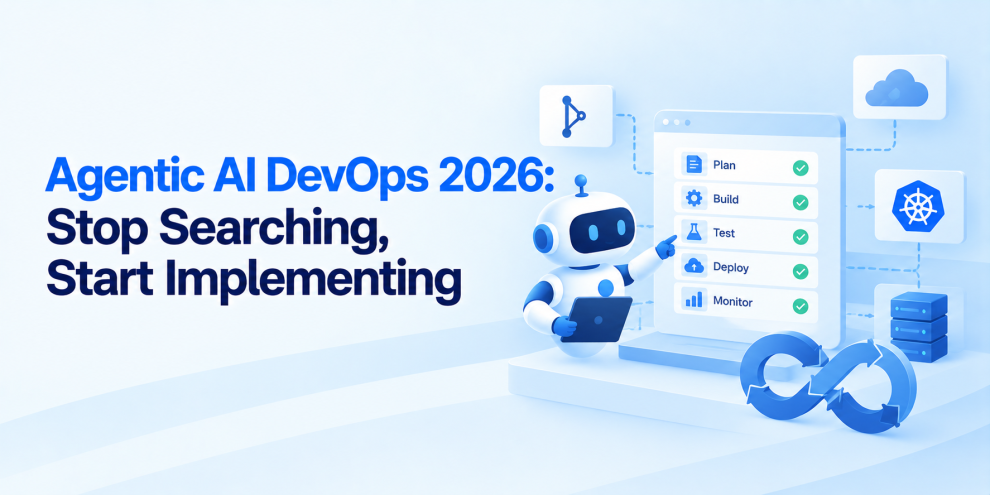

For the past few years, DevOps teams have been surrounded by advice about AI. Search for the right AIOps platform. Compare AI coding assistants. Evaluate autonomous agents. Read another report about intelligent infrastructure. Test another proof of concept. At some point, the problem stops being a lack of information. It becomes a lack of implementation.
In 2026, agentic AI is moving beyond simple recommendations and chatbot-style assistance. AI agents can increasingly inspect telemetry, investigate incidents, analyze deployment changes, generate infrastructure modifications, open pull requests, execute approved operational tasks, and coordinate workflows across engineering systems.
But putting an AI agent into a DevOps environment is not the same as making DevOps autonomous. The difficult part is not connecting an LLM to Kubernetes. The difficult part is deciding what the agent can see, what it can change, what it must prove before acting, and when it needs to stop.
Stop Treating Agentic AI as Another DevOps Tool
Traditional DevOps tools generally perform well-defined operations. A monitoring system detects an alert. A deployment platform releases an artifact. An infrastructure tool provisions resources. A ticketing system records an incident.
An agent operates differently. It can observe several systems, reason about the information, choose a next step, use a tool, evaluate the result, and continue the workflow.
That makes agentic AI less like another monitoring dashboard and more like a new operational layer.
A production agent might receive an alert about increased API latency. Instead of simply notifying an engineer, it could inspect traces, compare recent deployments, review infrastructure metrics, examine logs, check dependency health, identify a likely change, and prepare a remediation.
The implementation challenge begins immediately. Should it be allowed to execute the remediation?
For a low-risk restart, perhaps. For a production database change, probably not without additional controls. This distinction should shape the architecture from the beginning.
Start With Workflows, Not Models
One of the easiest mistakes is beginning an agentic DevOps project by selecting an AI model. The better starting point is the operational workflow.
Ask where engineers repeatedly spend time collecting information, correlating signals, performing predictable analysis, or executing low-risk actions.
Incident investigation is one example. A typical engineer may need to inspect monitoring alerts, application logs, distributed traces, recent deployments, Kubernetes events, infrastructure metrics, Git changes, service ownership, dependency information, and previous incidents.
An agent can potentially bring these sources together before an engineer starts making decisions.
The value is not that the AI “knows DevOps.” The value is that it can reduce the amount of manual investigation required to understand a specific operational problem.
Build the Agent Around Your Existing Engineering Stack
Agentic DevOps should not require organizations to replace every tool they already use. The agent should sit on top of existing systems and interact with them through controlled interfaces.
A typical architecture could connect an agent to observability, source control, CI/CD, Kubernetes, cloud infrastructure, incident management, and knowledge systems.
The agent becomes a coordination layer across these systems.
For example, an incident investigation agent could retrieve telemetry from an observability platform, inspect the latest Git changes, check deployment history, query the service catalog, and summarize the evidence.
The existing tools remain responsible for their core functions. The agent coordinates them.
That distinction makes implementation considerably more practical.
Give Agents Tools, Not Unlimited Access
An AI agent becomes useful when it can take action. It also becomes dangerous for exactly the same reason.
Giving an agent unrestricted shell access, broad cloud credentials, or administrator permissions creates a security problem that no prompt can solve.
Instead, expose narrowly defined tools. Rather than giving an agent unrestricted Kubernetes access, provide operations such as inspecting deployment status, retrieving pod health, restarting a specific workload, scaling a defined service within limits, retrieving recent deployment information, comparing configuration versions, or creating a rollback proposal.
Each tool should have a defined input schema, authorization policy, logging requirement, and operational boundary.
The agent should not decide what it is allowed to do. The platform should decide that.
Establish an Agent Identity
An agent needs its own identity.
Using a shared administrator credential makes it difficult to determine which actions came from a human, an automation workflow, or an AI system.
A dedicated machine identity allows organizations to establish clear permissions and audit trails. Every action should answer basic questions: Who initiated the workflow? Which agent performed the operation? What permissions did it have? What tool did it invoke? What parameters were supplied? What policy allowed the action? What happened afterward?
This becomes increasingly important as agents begin performing production operations.
Separate Diagnosis From Execution
A strong implementation pattern is to separate what the agent thinks from what the platform allows it to do.
The agent can investigate an incident and propose an action. A deterministic policy layer can then evaluate the proposal.
For example:
Telemetry → Agent Diagnosis → Proposed Action → Policy Check → Execution → Verification
Suppose the agent proposes scaling a production service from 20 to 40 replicas. The policy layer can verify whether the service is eligible for autonomous scaling, whether 40 replicas are within the approved limit, whether the cluster has enough capacity, whether the database connection limit could be exceeded, and whether scaling has occurred too frequently.
Only after these checks pass should the action be executed.
This architecture preserves the flexibility of AI while keeping critical controls deterministic.
Use Risk-Based Autonomy
Not every DevOps operation deserves the same level of autonomy.
A useful implementation model is to classify actions by risk.
Low-risk operations could be fully automated. Examples include collecting diagnostics, restarting a disposable development workload, refreshing non-production environments, or opening an incident ticket.
Medium-risk actions could require progressive execution and monitoring. Examples include scaling production services within predefined limits or shifting a small percentage of traffic.
High-risk actions could require human approval. Examples include modifying production databases, changing network security controls, rotating critical credentials, deleting infrastructure, or making irreversible changes.
The principle is simple: The higher the potential impact, the stronger the evidence and authorization required.
Give Agents a Blast-Radius Budget
Traditional permissions answer the question: “Can this identity perform this action?” Agentic systems also need to answer: “How much damage could this action cause?”
That is the idea behind a blast-radius budget.
An agent might be allowed to restart up to three workloads within an hour. It might be permitted to scale a service by 50%, but not beyond a defined replica count. It might be able to modify resources in development automatically but require approval for production.
These limits create boundaries around autonomous behavior.
If an agent reaches its operational budget, it should stop rather than continue experimenting.
Make Infrastructure Changes Reversible
Autonomous systems should prefer reversible operations.
A configuration change that can be rolled back is safer than an irreversible deletion. A gradual traffic shift is safer than immediately moving all traffic. A canary deployment is safer than replacing every production instance simultaneously. A temporary scaling adjustment is safer than permanently changing infrastructure capacity.
Reversibility gives the agent room to make mistakes without turning every mistake into an incident.
Progressive Remediation Should Be the Default
Agentic systems should avoid jumping from diagnosis to maximum intervention.
Suppose an agent detects elevated latency. Instead of immediately increasing capacity by several hundred percent, it could make a smaller change, observe the result, and decide whether further action is necessary.
The same principle applies to traffic routing and deployments.
A safe remediation loop looks like:
Observe → Change a little → Measure → Reassess → Continue or Stop
This turns autonomous remediation into a controlled feedback system rather than an unrestricted command executor.
Give the Agent System Context
An agent cannot reason effectively about infrastructure if it only sees isolated metrics.
Production systems are dependency graphs. The agent needs access to relevant context such as service ownership, deployment history, API dependencies, infrastructure relationships, configuration versions, maintenance windows, and known operational constraints.
Consider a service that suddenly reports elevated errors after a deployment. A metric alone may suggest rolling back. A service dependency map might reveal that another application has already been updated to depend on the new API contract.
That information could completely change the remediation decision.
Agentic DevOps therefore requires more than an LLM. It requires a useful operational context layer.
Your Knowledge Base Becomes Part of the Control Plane
Engineering organizations already have large amounts of operational knowledge: runbooks, architecture documentation, incident reports, deployment procedures, service ownership records, troubleshooting guides, and security policies.
Much of this information can become accessible to agents through retrieval systems.
But documentation should not automatically become authority.
A runbook can explain how to restart a service. It should not by itself grant the agent permission to restart it.
Knowledge tells the agent what might be appropriate. Policy determines what is allowed.
That separation is essential.
Observability Needs to Become Agent-Aware
Traditional observability tells engineers what happened. Agentic operations also need to explain what the AI did.
Every agent workflow should produce an audit trail containing the relevant trigger, evidence considered, decision summary, tool calls, policy checks, actions executed, and resulting system state.
This allows engineers to reconstruct an autonomous workflow after the fact.
If an agent investigated an incident, changed a deployment, scaled a service, and then reverted the change, the entire sequence should be visible.
Without this visibility, the organization effectively creates another operational black box.
Do Not Send Every Telemetry Record to the Model
More context is not always better.
Sending every log, metric, trace, event, and configuration record to an AI model can create enormous costs and introduce unnecessary data exposure.
Agentic DevOps systems should use targeted retrieval. The agent can begin with the incident signal and progressively retrieve relevant evidence.
For example: alert, recent deployment, affected service traces, dependency health, relevant logs, and configuration changes.
This approach reduces context size while making the reasoning process more focused. It can also reduce the amount of sensitive operational data exposed to the model.
Security Must Be Designed Into the Agent
Agentic DevOps creates a new security boundary.
The agent may have access to infrastructure information, source code, cloud resources, deployment systems, secrets metadata, and operational controls. That access should be treated as privileged.
Organizations should apply least privilege, short-lived credentials, strong authentication, network restrictions, tool-level authorization, audit logging, and approval controls.
Secrets should not be placed into model context simply because the agent has access to a system that contains them. The agent should receive only the information necessary to complete the task.
AI Agents Should Not Become the Authorization Layer
An AI model can determine that an action appears reasonable. It should not determine whether the organization permits that action.
Authorization should remain deterministic.
If an agent requests a production database modification, a policy engine should evaluate whether that operation is permitted. The model’s reasoning should not override the policy.
This separation is particularly important for enterprises operating regulated workloads or shared platforms.
The AI can recommend. The platform authorizes. The execution layer performs.
Measure Operational Outcomes, Not Agent Activity
A common mistake in AI projects is measuring how much the agent does: number of tool calls, number of automated actions, or number of incidents investigated.
Those metrics may look impressive but do not necessarily demonstrate business value.
Better measurements include mean time to detection, mean time to resolution, incident investigation time, false remediation rate, human escalation rate, change failure rate, rollback frequency, infrastructure cost, production availability, and engineer time saved.
The objective is not to maximize autonomous actions. It is to improve engineering outcomes.
Start With One High-Value Workflow
Organizations do not need to build an autonomous platform on day one.
Pick one workflow where the operational process is already reasonably understood.
Incident investigation is a strong starting point because an agent can provide value without immediately receiving production write access.
The first version might simply collect relevant evidence and generate an incident summary. The next version could recommend a remediation. The following version could execute low-risk actions automatically.
This gradual progression creates an opportunity to evaluate reliability before expanding permissions.
A Practical Agentic DevOps Roadmap
A realistic implementation can progress through five stages.
Stage 1: Observe. Connect the agent to telemetry, documentation, source control, and deployment history. Give it read-only access.
Stage 2: Recommend. Allow the agent to investigate incidents and propose actions, but keep execution under human control.
Stage 3: Execute Safely. Enable narrowly scoped, reversible, low-risk actions under deterministic policies.
Stage 4: Automate Progressively. Introduce controlled scaling, traffic management, deployment workflows, and other medium-risk operations with blast-radius limits.
Stage 5: Optimize. Measure outcomes, improve context retrieval, refine policies, reduce unnecessary escalation, and expand automation only where evidence supports it.
This approach avoids the common mistake of trying to make an AI agent autonomous before understanding how reliably it performs the underlying workflow.
What Engineering Leaders Should Ask Before Deployment
Before giving an agent access to production systems, engineering leaders should ask: What exact workflow is the agent responsible for? What systems can it read? What systems can it modify? What identity does it use? Which actions are automatically permitted? Which actions require approval? What is the maximum blast radius? Can every action be reversed? How is the agent’s reasoning and execution audited? What happens when telemetry is incomplete? What happens when the agent is wrong? Can its permissions be revoked immediately? Can the organization prove what changed during an autonomous workflow?
These questions are more important than choosing the newest model.
Where Engineering Partners Fit
Implementing agentic DevOps requires more than connecting an LLM to an infrastructure API. It involves platform engineering, cloud architecture, CI/CD, Kubernetes, observability, security, identity, backend systems, and AI engineering.
Engineering organizations such as GeekyAnts contribute across these layers when teams need to move from AI experimentation toward production-ready automation. The focus should be on building controlled agent workflows that integrate with existing engineering systems while keeping authorization, observability, and operational safeguards outside the model itself.
The Goal Is Not Fully Autonomous DevOps
There is a temptation to describe the future of DevOps as a world where AI handles everything.
That is probably the wrong objective.
The more useful goal is bounded autonomy.
Let agents investigate repetitive problems. Let them collect evidence faster. Let them propose changes. Let them execute low-risk actions. Let them operate within clearly defined limits. And make them stop when the situation exceeds those limits.
That model gives engineering teams the productivity benefits of AI without turning production infrastructure into an uncontrolled experiment.
Stop Searching. Start Implementing.
The agentic AI conversation has reached a point where organizations can spend months comparing platforms, models, frameworks, and vendors without changing how their engineering teams actually operate.
Implementation should begin with a smaller question:
What operational workflow consumes engineering time today that an agent could safely improve?
Start there.
Give the agent access to the minimum information required. Connect it to existing systems. Define the tools it can use. Establish deterministic policies. Set a blast-radius budget. Make actions observable and reversible. Measure the outcome.
Then expand.
Agentic DevOps does not require giving AI unrestricted control over production. It requires designing an environment where AI can reason within context, act within boundaries, and stop when it reaches the edge of its authority.
That is the difference between experimenting with agentic AI and actually implementing it.
FAQs
What is agentic AI in DevOps?
Agentic AI in DevOps refers to AI systems that can observe engineering environments, reason about operational conditions, use connected tools, and perform defined actions rather than simply generating recommendations.
How is agentic AI different from traditional AIOps?
Traditional AIOps commonly focuses on monitoring, anomaly detection, correlation, and automated responses. Agentic AI can add multi-step reasoning, tool use, context retrieval, and workflow execution.
Should AI agents have production access?
Only when there is a clearly defined operational need and appropriate controls. Production access should be narrowly scoped, policy-controlled, auditable, and limited according to the risk of each action.
What DevOps tasks are suitable for AI agents?
Incident investigation, log and telemetry analysis, deployment analysis, diagnostic collection, documentation retrieval, low-risk remediation, and controlled workflow automation are potential starting points.
Can AI agents deploy applications automatically?
They can, but deployment permissions should be carefully scoped. Progressive delivery, automated validation, approval gates, rollback mechanisms, and blast-radius controls can reduce the risk of autonomous deployment failures.
How do you secure agentic DevOps?
Use dedicated identities, least-privilege permissions, tool-level authorization, short-lived credentials, deterministic policies, network controls, audit logging, approval mechanisms, and strict limits on autonomous actions.
What is bounded autonomy?
Bounded autonomy means an AI agent can act independently within predefined permissions, policies, resource limits, and risk boundaries. When an action exceeds those boundaries, the agent must stop or request approval.
How should companies start implementing agentic DevOps?
Start with one well-understood, high-value workflow. Begin with read-only investigation, move to recommendations, then introduce narrowly scoped automation for reversible and low-risk operations before expanding autonomy.
What should organizations measure?
Measure operational outcomes such as incident investigation time, mean time to resolution, change failure rate, false remediation rate, human escalation, infrastructure cost, availability, and engineering time saved.
Will agentic AI replace DevOps engineers?
Agentic AI is more likely to change how DevOps engineers work than eliminate the need for them. Engineers will increasingly focus on architecture, reliability, security, platform design, policy, automation boundaries, and complex operational decisions while agents handle defined repetitive workflows.
For more visit our homepage!


Add Comment