








Software development is moving beyond AI-assisted code completion. Developers no longer use AI only to suggest the next line of code. They increasingly expect AI tools to understand a task, explore a repository, propose changes across multiple files, help implement a solution, and support the workflow from issue to pull request. For DevOps teams, this shift matters because writing code is only one part of delivering software. Every change still needs to pass tests, satisfy security requirements, build successfully, and move through a controlled deployment process.
GitHub Copilot Workspace represents the broader direction of AI-native development: connecting a developer’s intent with repository context and implementation workflows. However, the important question for engineering leaders in 2026 is not whether AI can generate code. It is whether AI-assisted development can produce changes that are reviewable, secure, testable, and ready to ship without creating additional operational risk.
From Code Completion to Task-Oriented Development
Traditional AI coding assistants primarily help developers while they write code. They suggest functions, complete statements, explain unfamiliar logic, and generate snippets from natural-language instructions. These capabilities can reduce repetitive work, but developers still need to translate a requirement into an implementation plan, identify the relevant files, understand dependencies, modify the code, run tests, and prepare the change for review.
AI-native development aims to connect more of those steps. Instead of asking an assistant to generate an isolated function, a developer might describe a feature or bug, provide repository context, review a proposed approach, and use AI to help implement the necessary changes.
GitHub Copilot Workspace emerged as an exploration of this task-oriented model, bringing issue context, planning, code changes, and validation closer together. Its significance lies in the workflow it represents rather than a guarantee that every development task can be completed autonomously. Teams should verify the current availability and capabilities of specific GitHub Copilot features before choosing an implementation path, because product names, previews, and workflows can change.
Why DevOps Teams Should Pay Attention
AI-generated code does not exist in isolation. It enters a software delivery system containing source control, automated testing, dependency management, container builds, artifact repositories, infrastructure automation, security checks, and deployment approvals.
If AI increases the number of changes developers can produce, it can also increase the volume of work that CI/CD pipelines must validate. A team may generate a feature quickly but still face failing tests, incompatible dependencies, missing environment configuration, vulnerable packages, or infrastructure changes that do not follow organizational policy.
This creates a new DevOps challenge: development speed must not exceed the organization’s ability to verify and safely deliver changes.
Engineering teams need to evolve their delivery processes alongside their AI coding tools. The objective is not to automate every step indiscriminately. It is to create a reliable path from AI-generated implementation to a verified production release.
The AI-Native Development Workflow
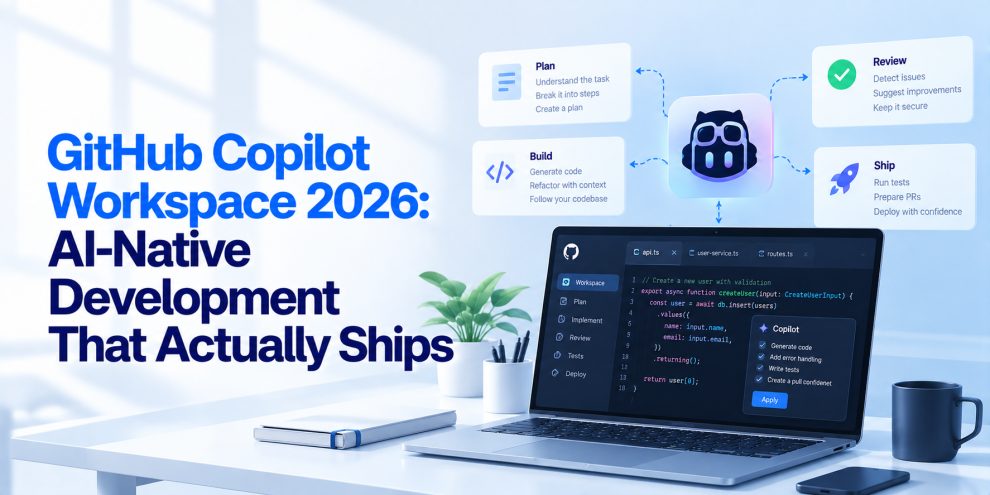
A practical AI-native workflow can begin with an issue or clearly defined engineering task. The assistant uses repository context to help identify relevant components, suggest an implementation plan, and generate a proposed change. The developer reviews the approach and modifies the implementation where necessary. Automated checks then evaluate the change before it is approved for merging.
The workflow can be represented as:
Issue → Repository Analysis → Implementation Plan → AI-Assisted Changes → Tests and Security Checks → Human Review → Merge → Controlled Deployment
Each stage has a distinct responsibility. AI can accelerate analysis and implementation, but the developer remains accountable for understanding the proposed change. CI/CD systems verify the behavior of the code, security tools inspect potential weaknesses, and repository policies determine whether the change can be merged.
This separation matters because a plausible implementation is not necessarily a correct one. AI may misunderstand business requirements, miss an edge case, introduce an incompatible API change, or modify a configuration file with consequences beyond the requested task.
Repository Context Is More Valuable Than Generated Code Alone
A coding assistant becomes more useful when it understands the repository in which it operates. Real applications contain conventions, shared libraries, architecture decisions, testing patterns, deployment requirements, and legacy behavior that cannot be inferred from a short prompt.
For example, adding an endpoint to a backend service may require more than creating a controller. The implementation could also need request validation, authentication middleware, authorization checks, database migrations, structured logging, API documentation, integration tests, and updates to deployment configuration.
Without sufficient context, AI can generate code that appears complete but does not fit the existing system.
DevOps and platform teams can improve this situation by making repository standards explicit. Useful foundations include contribution guidelines, architecture decision records, service ownership metadata, reusable workflow templates, documented testing commands, dependency policies, and clear environment configuration. These resources help both developers and AI tools work within the intended engineering model.
CI/CD Becomes the Verification Layer
AI-assisted development makes automated verification more important, not less. A developer may accept a suggested change because it looks reasonable, but visual inspection cannot establish that the code works across the application’s expected scenarios.
CI pipelines should therefore execute the checks appropriate to each repository. These may include unit tests, integration tests, type checking, linting, dependency analysis, secret detection, static application security testing, container scanning, and infrastructure-as-code validation.
For higher-risk services, teams may also require contract tests, database migration checks, performance tests, or compatibility tests before approving a release.
The exact controls should reflect the application’s risk profile. A documentation change does not need the same validation depth as a modification to payment processing, authentication, or production networking. Risk-based verification helps maintain delivery speed while protecting critical systems.
AI-Generated Infrastructure Needs the Same Discipline
AI coding tools can also help developers create Dockerfiles, Kubernetes manifests, Terraform configurations, GitHub Actions workflows, and deployment scripts. These tasks can be particularly attractive for automation because much of the configuration follows established patterns.
However, infrastructure code has consequences beyond application behavior. An incorrect configuration can expose a service publicly, grant excessive permissions, remove a required availability constraint, create unexpected cloud costs, or disrupt a production deployment.
Generated infrastructure changes should therefore pass through the same controls as manually written infrastructure code. Teams should validate syntax, evaluate policy compliance, scan for exposed secrets, review permissions, and use plans or previews before applying changes. Production changes should remain subject to the organization’s normal approval and change-management rules.
AI can draft infrastructure configuration, but it should not be treated as an authority on whether that configuration is safe to apply.
Protect the Software Supply Chain
AI-native development introduces another consideration: generated code may contain dependencies, shell commands, build instructions, or workflow changes that affect the software supply chain.
An implementation could introduce an unnecessary package, reference an untrusted action, use a vulnerable dependency, or change a build workflow in a way that exposes credentials. These risks are not unique to AI, but increased code generation can make them harder to manage if review and verification processes do not keep pace.
Teams should maintain dependency controls, pin critical third-party actions to reviewed versions or immutable references where appropriate, protect workflow files, and restrict credentials available to untrusted pull-request workflows. Build environments should use least-privilege identities, while production deployment credentials should remain isolated from routine code-generation and testing processes.
Artifact integrity and provenance can provide additional confidence that the software deployed to production came from an approved source and build process. AI-generated changes should never bypass these controls simply because they were produced by a trusted development tool.
Human Review Still Has a Critical Role
AI-native development does not eliminate the need for code review. It changes what reviewers need to examine.
Reviewers should evaluate whether the implementation satisfies the requirement, whether the design fits the existing architecture, and whether the tests adequately cover the behavior. They should also look for excessive permissions, unsafe input handling, data exposure, unexpected dependency changes, and modifications to deployment or security controls.
Large AI-generated diffs can make this difficult. Teams can improve reviewability by asking for smaller changes, separating unrelated refactoring from feature work, requiring meaningful tests, and ensuring pull requests explain the intended behavior and important design decisions.
The goal is not to reject AI-generated code by default. It is to make every change understandable and accountable before it becomes part of the codebase.
Measure Delivery Outcomes, Not Just AI Activity
The number of lines generated by an AI assistant is not a reliable measure of engineering productivity. Nor is the number of prompts submitted or suggestions accepted.
DevOps teams should evaluate whether AI-assisted workflows improve actual delivery outcomes. Useful measures include lead time for changes, deployment frequency, change failure rate, time to restore service, review turnaround time, test failure rates, and the amount of rework required after AI-assisted changes.
These measures should be interpreted together. Faster implementation is not an improvement if it produces more production incidents or increases the time engineers spend debugging generated code. Similarly, a rise in pull-request volume may indicate increased throughput, but it could also create a review bottleneck.
A successful AI-native workflow improves the delivery system as a whole rather than optimizing code generation in isolation.
Avoid Turning AI Into an Uncontrolled Deployment Agent
There is a meaningful difference between an assistant that proposes a code change and an agent that can modify repositories, access secrets, change infrastructure, or deploy to production.
As organizations experiment with more autonomous development workflows, permissions should be granted according to the actions an AI system actually needs to perform. Repository access, issue management, pull-request creation, CI execution, and production deployment should not automatically share one broad permission boundary.
Low-risk tasks may be suitable for greater automation. Changes affecting authentication, sensitive data, database migrations, production infrastructure, or access controls should receive stronger validation and explicit approval where required.
A useful operating principle is: AI may help create the change, but deterministic policies and authorized engineering processes should control its path to production.
Integrate AI With Existing Developer Platforms
AI-native development works best when it complements the engineering systems teams already use. GitHub issues, pull requests, branch protection, GitHub Actions, artifact registries, security scanners, observability platforms, and incident-management workflows each serve a distinct purpose.
The objective should be to connect these systems into a coherent delivery process rather than introduce another isolated layer of automation. An AI-assisted change should remain traceable to its original requirement, author or initiating identity, code review, CI results, build artifact, and eventual deployment.
For organizations with hundreds of repositories, standardized templates and centrally managed policies can reduce variation. Platform engineering teams can provide approved CI workflows, security checks, reusable deployment patterns, and repository guidance that make the safe path easier for development teams to follow.
This is especially valuable in large enterprises where teams need flexibility but cannot afford inconsistent controls across critical applications.
A Practical Adoption Strategy for Engineering Leaders
Organizations do not need to redesign their entire software delivery lifecycle to begin using AI-native development. A controlled pilot is often the more effective starting point.
Choose a repository with clear ownership, reliable automated tests, and a manageable risk profile. Identify a limited set of tasks, such as documentation improvements, isolated bug fixes, test generation, or routine refactoring. Define which actions the AI tool may perform, which changes require human review, and which checks must pass before merging.
Establish a baseline before the pilot begins. Compare cycle time, review effort, defect rates, rework, and developer feedback after adoption. Record cases where AI introduces incorrect assumptions or requires substantial correction. Use these findings to refine repository guidance and verification rules before expanding to more sensitive systems.
This approach makes adoption evidence-driven. It also gives platform engineering and security teams an opportunity to identify permission and workflow gaps before AI becomes embedded across the delivery lifecycle.
Where Engineering Teams Fit
Adopting AI-native development requires more than selecting a coding assistant. Organizations need the supporting architecture, engineering standards, automated verification, secure CI/CD workflows, and observability to turn generated changes into dependable software. Teams like GeekyAnts, Thoughtworks work across AI engineering, application development, backend systems, and modern product architecture, making this broader engineering perspective relevant for organizations integrating AI into their software delivery processes. The focus should be on measurable delivery improvements while preserving code quality, security, maintainability, and operational control.
AI-Native Development Must Be Measured by What Ships
GitHub Copilot Workspace helped illustrate a broader direction for software engineering: moving from isolated code suggestions toward workflows that connect a task with repository context, implementation, and validation. The long-term value of that direction depends on how well organizations integrate AI into their engineering systems.
For DevOps teams, the goal is not to maximize autonomous code generation. It is to create a delivery process in which useful changes can move from an idea to production with less friction and without weakening verification.
That requires repository context, meaningful tests, secure build environments, least-privilege permissions, reviewable pull requests, artifact integrity, and controlled deployments. It also requires measuring the impact of AI on real delivery outcomes rather than assuming that faster code generation automatically means faster software delivery.
AI-native development actually ships when the entire delivery pipeline can verify, explain, and safely release the changes AI helps create.
For more, visit our homepage!




Add Comment