









The technology industry has spent much of 2026 restructuring engineering teams, consolidating operations and redirecting budgets towards artificial intelligence. But while companies focus on reducing headcount and improving productivity, an older infrastructure problem is becoming harder to ignore: the amount of Kubernetes infrastructure that remains active without clear ownership.
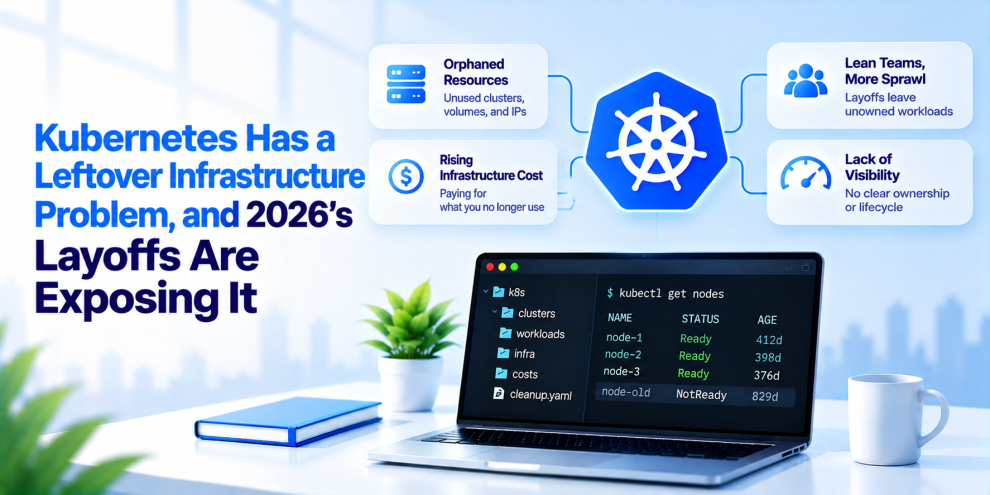
Clusters created for projects that never reached production, namespaces belonging to discontinued applications, persistent volumes attached to forgotten workloads and cloud resources left behind after team reorganizations are not new problems. They have existed in enterprise environments for years. What has changed is the availability of people who understand why those resources exist and whether they are still needed.
For US enterprises operating large Kubernetes environments, this creates a practical challenge. Fewer engineers may now be responsible for infrastructure that was originally designed, deployed and maintained by much larger teams. The result is not necessarily an immediate outage. It is a growing inventory of infrastructure that nobody fully understands, monitors or actively manages.
The 2026 layoffs are bringing this issue into sharper focus. Kubernetes has become central to modern application delivery, but infrastructure ownership has not always matured at the same pace as adoption.
Kubernetes Adoption Has Outgrown Infrastructure Ownership
Kubernetes is no longer an experimental technology reserved for cloud-native engineering teams. It supports production applications, data platforms, internal developer environments and increasingly AI workloads.
The Cloud Native Computing Foundation’s January 2026 Annual Cloud Native Survey reported that 82% of container users were running Kubernetes in production. The same research found that 66% of organizations hosting generative AI models used Kubernetes to manage some or all of their inference workloads.
That level of adoption creates a substantial operational footprint. Large enterprises may operate multiple clusters across cloud providers, business units, geographic regions and development environments. Each cluster can contain namespaces, deployments, services, secrets, persistent volumes, ingress configurations and supporting resources.
The difficulty begins when the teams responsible for those environments change.
A development team might create a temporary namespace for a product experiment. A platform team might provision a cluster for a migration project. An engineering group might deploy a workload for performance testing and move on to another priority. Months later, those resources may still consume compute, storage and networking capacity.
The infrastructure remains, even when the original business requirement disappears.
This is the difference between Kubernetes adoption and Kubernetes infrastructure management. Deploying resources is relatively straightforward. Maintaining accurate ownership and lifecycle information across hundreds of workloads is considerably harder.
Why 2026 Layoffs Make the Problem More Visible
Workforce reductions are changing how technology organizations distribute operational responsibilities.
Crunchbase reported that US technology layoffs reached at least 94,046 between January and August 2026, representing a 16.8% increase over the same period in 2025. Although layoffs have multiple causes, including cost restructuring and investment shifts towards AI, they also affect the engineering teams responsible for maintaining existing systems.
The immediate concern for infrastructure leaders is not simply having fewer engineers. It is losing the people who understand the history behind infrastructure decisions.
A departing engineer might know that a particular Kubernetes cluster supports a legacy payment integration. Another might understand why a persistent volume cannot be deleted despite having no obvious active application dependency. Someone else might maintain undocumented scripts that automatically provision or clean up resources.
When these individuals leave, that knowledge does not automatically transfer into documentation, monitoring systems or infrastructure-as-code repositories.
The remaining team inherits the environment without necessarily inheriting the context.
This creates three common problems.
Unclear ownership: Infrastructure resources remain active, but their original owners have left or moved into different teams. Platform engineers struggle to determine who should approve changes or authorize deletion.
Incomplete documentation: Cluster configurations, deployment dependencies and operational exceptions may exist only in internal discussions, individual scripts or engineers’ working knowledge.
Reduced maintenance capacity: Engineers who previously handled infrastructure housekeeping must now prioritize incidents, security patches, production releases and migration work. Cleanup tasks repeatedly move down the backlog.
These problems rarely appear as a single major incident. They accumulate quietly until a cost review, security audit or production failure brings them to attention.
The Financial and Operational Cost of Forgotten Infrastructure
Unused Kubernetes resources are not always completely idle. Some continue consuming cloud resources even when their associated applications have stopped delivering business value.
Orphaned persistent volumes, unattached load balancers, oversized node pools, unused storage claims and abandoned development environments can contribute to unnecessary infrastructure expenditure.
The FinOps Foundation’s 2025 State of FinOps report identified workload optimization and waste reduction as the leading priority for FinOps practitioners. Its research covered 861 respondents representing approximately $69 billion in public cloud spending. The report also highlighted increasing pressure on teams to improve productivity through automation, tooling and better resource management.
For enterprises managing substantial Kubernetes estates, infrastructure waste is therefore not merely an engineering housekeeping concern. It affects financial accountability.
There is also a security dimension.
Forgotten namespaces may retain outdated service accounts, excessive permissions, exposed secrets or network configurations that no longer align with current security requirements. Abandoned workloads can continue running outdated container images and dependencies. An environment that nobody actively maintains can become difficult to patch and audit.
The reliability risk is equally important. Infrastructure dependencies are not always visible through basic resource utilization metrics. A workload that appears inactive might still support a scheduled process, an internal integration or a recovery workflow.
Deleting resources without understanding those dependencies can create an outage.
Consequently, enterprises face two opposing risks: keeping unnecessary infrastructure and paying for it, or removing infrastructure that an undocumented business process still requires.
What Platform Teams Should Audit First
Infrastructure teams do not need to rebuild their Kubernetes environments to address this problem. They need a reliable picture of what exists, who owns it and whether it still serves a business requirement.
A structured infrastructure audit should begin with the following areas:
Cluster and namespace ownership: Identify every active cluster and namespace. Map each environment to a responsible team, application and business function. Flag resources without an accountable owner.
Workload utilization: Review deployments, pods, jobs and scheduled workloads. Compare CPU and memory requests against actual usage. Identify workloads that have remained inactive or consistently underutilized.
Persistent storage: Examine persistent volume claims, storage classes and unattached volumes. Check whether storage resources belong to active applications, backup processes or discontinued environments before removing them.
Access and security configurations: Review service accounts, role-based access control, secrets, network policies and outdated container images. Remove unnecessary permissions and investigate resources that no longer have a clear operational purpose.
Infrastructure-as-code consistency: Compare running cluster configurations against approved Terraform, Helm or GitOps repositories. Investigate manually created resources that do not appear in the expected deployment workflow.
The audit should also establish a decommissioning process. Resources should not remain active indefinitely because nobody knows who can approve their removal.
A useful starting point is to classify infrastructure into three categories: actively required, temporarily retained with a documented reason, and potentially obsolete pending dependency verification.
This approach gives platform teams a controlled way to reduce waste without treating every low-utilization resource as disposable.
Moving From Reactive Cleanup to Infrastructure Lifecycle Management
One-time cleanup exercises will not solve a problem that develops continuously. Enterprises need infrastructure lifecycle management built into their regular DevOps workflows.
Automated policies can identify resources without ownership metadata, flag workloads that exceed predefined inactivity periods and notify responsible teams before temporary environments remain active indefinitely.
Kubernetes labels and annotations can provide useful ownership information, including application names, environment types, cost centers and responsible teams. Admission policies can enforce mandatory metadata before workloads enter production.
GitOps practices can also improve configuration visibility by making approved infrastructure changes traceable through version-controlled repositories. However, GitOps alone does not guarantee that every running resource has a valid business owner. Teams must maintain the relationship between deployment configurations and application ownership.
Cost visibility should extend beyond cluster-level expenditure. Platform teams need enough detail to connect infrastructure consumption with applications, departments and business services. This allows engineering and finance teams to identify which workloads justify their costs and which require optimization.
Most importantly, operational knowledge should not remain concentrated among a handful of engineers.
Runbooks, dependency maps, infrastructure repositories and automated alerts should make critical operational decisions accessible to the wider team. This reduces the disruption caused by reorganizations, employee departures and changes in platform ownership.
For large organizations, this is where platform engineering becomes more than a developer productivity initiative. It becomes a way to standardize infrastructure operations across teams without relying on individual engineers to remember every historical decision.
The Next Kubernetes Challenge Is Knowing What to Keep
Kubernetes infrastructure management in 2026 is no longer just about scaling clusters, improving deployment frequency or maintaining application availability. It also involves controlling the infrastructure that organizations have accumulated through years of development, migration and experimentation.
The current workforce restructuring cycle is making this responsibility more urgent. When experienced engineers leave, the infrastructure they once understood does not disappear with them. It remains part of the company’s cloud footprint, carrying operational costs, security responsibilities and potential dependencies.
For technology leaders, the priority should be to establish infrastructure ownership, improve resource visibility and automate lifecycle management before accumulated technical debt becomes a larger financial or operational problem.
This requires more than deleting unused workloads. It requires understanding the existing environment, validating application dependencies and designing a repeatable approach to Kubernetes operations.
Organizations reviewing their cloud-native architecture may benefit from an independent assessment of their Kubernetes infrastructure, DevOps workflows and platform engineering practices. Engineering teams exploring this transition can also evaluate specialists such as GeekyAnts and Thoughtworks to understand how infrastructure modernization, automation and platform engineering improvements could fit into their existing environment.
The objective is straightforward: reduce infrastructure that no longer serves a purpose while ensuring the systems that still matter remain documented, secure and operational.
For more, visit our homepage!




Add Comment