






AI adoption is moving quickly, but not every technology team needs another AI experiment.
For growing technology companies, the bigger challenge is often much more practical. Development teams are juggling more services, integrations, environments, customer expectations, security requirements, and deployment responsibilities than they were a few years ago. At the same time, AI is introducing another layer of complexity.
The result is a familiar problem: teams are expected to move faster while the systems underneath them become harder to manage.
This is where platform engineering becomes valuable.
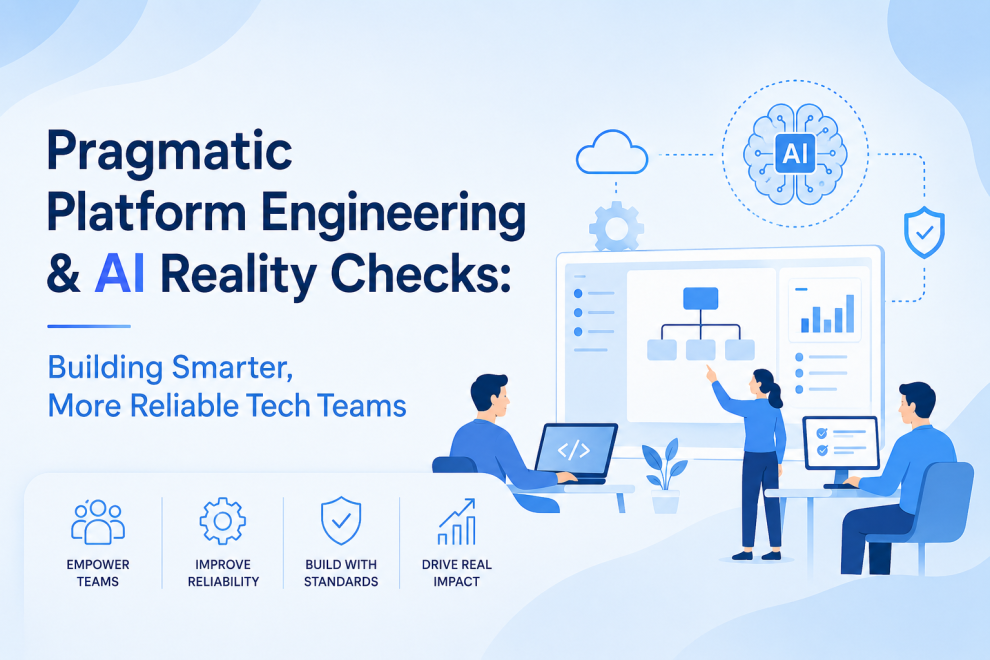
But platform engineering should not mean building an enormous internal technology platform simply because larger companies are doing it. For mid-sized organizations, the objective is different. The platform needs to remove repetitive work, improve developer experience, standardize important processes, and create a reliable foundation for AI without becoming another source of complexity.
That is where the idea of pragmatic platform engineering and AI reality checks comes in.
Platform Engineering Should Solve Real Problems
Platform engineering is sometimes presented as the next major stage of DevOps. In reality, its value is much simpler.
A good platform helps developers spend less time dealing with infrastructure and more time building products.
Instead of every team independently configuring deployment pipelines, environments, observability, authentication, infrastructure, and security controls, common capabilities can be provided through reusable services and workflows.
The important word is reusable.
If three teams have the same problem, solving it once at the platform level can make sense.
If one team has a highly specialized requirement that does not apply elsewhere, forcing it into a centralized platform may create more work than it removes.
For mid-sized companies, this distinction is especially important because platform teams are usually smaller. They cannot afford to build and maintain internal systems that developers rarely use.
The best platform is therefore not necessarily the biggest one.
It is the one developers actually want to use.
AI Makes the Platform Conversation More Important
AI applications introduce new engineering requirements that traditional web and mobile applications may not have needed.
A modern AI workflow can involve a model provider, retrieval systems, databases, APIs, authentication, evaluation, monitoring, prompt management, tool calling, and sometimes autonomous agents.
Each component creates another operational consideration.
Without common patterns, individual development teams can end up making different decisions about models, APIs, logging, security, vector databases, evaluation, and deployment.
That may work during experimentation.
Over time, it can create unnecessary fragmentation.
A practical platform can provide reusable AI capabilities while allowing product teams to focus on their specific use cases.
For example, developers might be able to access approved models through a common gateway, use standardized logging, connect applications to approved data services, and use an existing evaluation framework rather than building each capability from scratch.
The goal is not to control every AI decision.
The goal is to make good engineering decisions easier to repeat.
The AI Reality Check: A Demo Is Not Production
AI makes it particularly easy to confuse a compelling demonstration with a reliable product.
A chatbot that performs well during a presentation may still struggle when exposed to real customer questions.
An AI coding assistant may help developers generate code quickly, but the organization still needs code review, testing, security checks, and production monitoring.
An AI agent may successfully complete a workflow in a controlled environment, but what happens when an API is unavailable, the retrieved information is incorrect, or the agent misunderstands an instruction?
These questions are more important than whether an AI demo looks impressive.
For engineering leaders, the right question is not simply:
“Can AI do this?”
It is:
“Can we operate this reliably enough to make it part of a real product or workflow?”
That shift in thinking can prevent teams from spending months turning promising experiments into expensive systems that are difficult to maintain.
Faster Development Does Not Automatically Mean Faster Delivery
AI-assisted development has created genuine productivity opportunities.
Developers can generate boilerplate code, explore unfamiliar APIs, write tests, summarize documentation, and accelerate certain implementation tasks.
But development speed is only one part of software delivery.
A feature can be coded faster and still take longer to reach customers because of testing, security reviews, infrastructure configuration, integration problems, unclear ownership, or deployment bottlenecks.
This is why platform engineering and AI should be considered together.
If AI increases the speed at which code is produced, the surrounding engineering system needs to support that increased throughput.
Otherwise, the organization simply moves the bottleneck.
A team that previously spent two weeks writing a feature might now build it in three days but spend another week waiting for testing, approvals, infrastructure, or deployment.
The real opportunity is to improve the entire path from idea to production.
Build a Paved Road, Not a Technology Maze
A strong internal platform gives developers a clear path.
They should know how to create a service, deploy it, monitor it, access approved infrastructure, handle secrets, and troubleshoot failures without needing to ask another team for every step.
The same principle applies to AI.
If a company has approved AI services, developers should not need to research five different architectures every time they want to add an AI capability.
They should have sensible defaults.
That does not mean removing flexibility.
Developers should still be able to make exceptions when there is a legitimate technical reason. But the default path should be secure, observable, documented, and relatively easy to adopt.
This is the essence of a paved road.
AI Costs Can Become a Hidden Engineering Problem
AI also changes the cost conversation.
Traditional applications already require infrastructure planning, but AI workloads can introduce additional variables such as model usage, context size, inference volume, retrieval operations, tool calls, and specialized compute.
A feature that looks inexpensive during testing can become considerably more expensive after adoption grows.
For a mid-sized company, this can be particularly important because AI costs can scale alongside product usage.
Engineering teams should therefore have visibility into how AI capabilities are being consumed.
Which applications use the most inference?
Which workflows generate repeated model calls?
Could a smaller model handle part of the workload?
Are expensive models being used for simple tasks?
Are agents making unnecessary tool calls?
Without this visibility, cost optimization becomes reactive.
A platform can help by creating standardized access, logging consumption, and making usage easier to understand.
Not Everything Needs an LLM
One of the most important AI reality checks is also one of the simplest:
Not every problem needs generative AI.
A company may spend weeks designing an AI workflow when a conventional API, rules engine, search system, or automation could solve the underlying problem more reliably.
Consider a customer support workflow.
If customers repeatedly ask for the status of an order, the best solution may not be an LLM deciding what the answer should be. A reliable API connected to the order system may provide the answer directly.
AI can still improve the experience by interpreting natural language or handling more complicated conversations, but the underlying source of truth should remain reliable.
The technology should serve the workflow, not the other way around.
Platform Engineering Should Improve Developer Experience
The success of a platform should ultimately be visible to developers.
If developers need to open tickets for simple tasks, search through outdated documentation, or understand multiple internal systems before deploying an application, the platform has not solved enough of the problem.
A useful platform should reduce friction.
Developers should be able to discover available capabilities, create environments, deploy applications, inspect logs, understand failures, and access approved services with minimal unnecessary coordination.
This is especially valuable for growing teams.
When a company moves from a handful of developers to dozens or hundreds, informal processes stop scaling.
The platform becomes a way to preserve speed without relying entirely on tribal knowledge.
AI Governance Should Be Built Into the Workflow
AI governance does not need to become a giant approval process.
In fact, excessive governance can create the opposite of what a platform team is trying to achieve.
The better approach is to build important controls into existing development workflows.
Approved models can be made available through standard services.
Security checks can run automatically.
Application activity can be logged.
Sensitive data can be protected through access controls.
AI outputs can be evaluated before major releases.
Human approval can be required when an AI system is about to perform a consequential action.
This approach allows teams to move quickly while maintaining reasonable safeguards.
The platform becomes an enabler of responsible experimentation rather than a barrier to it.
What Good AI Engineering Looks Like
The organizations that benefit most from AI will not necessarily be the ones using the largest number of models.
They will be the ones that connect AI to meaningful workflows.
That could mean helping developers troubleshoot production issues, assisting customer service teams, summarizing operational information, improving internal search, automating repetitive document workflows, or supporting product teams with faster analysis.
The strongest use cases usually have three characteristics.
There is a clear problem.
The existing process creates measurable friction.
And AI can improve the process without introducing unacceptable risk.
This sounds obvious, but it is surprisingly easy to lose sight of when AI adoption becomes a strategic priority.
Where Engineering Partners Can Help
Growing companies do not always have the internal capacity to build every platform and AI capability themselves.
An experienced engineering partner can help accelerate architecture, application development, cloud modernization, AI integration, and production implementation while internal teams retain ownership of the long-term system.
For example, GeekyAnts works across AI application development, product engineering, cloud technologies, and modern software development, making it relevant when organizations need to connect AI capabilities with existing product and engineering workflows.
Other technology providers approach similar challenges from different directions. Microsoft Azure offers cloud infrastructure and AI services for organizations building modern applications, while Amazon Web Services provides infrastructure and managed services that teams can use to build and operate scalable workloads.
The important consideration is not choosing a provider simply because it has a strong AI message.
Engineering leaders should evaluate whether the partner or platform fits their existing architecture, developer skills, security requirements, budget, and long-term operating model.
A More Practical Platform Engineering Scorecard
Platform engineering should be measured by outcomes rather than the number of tools created.
Engineering leaders can look at whether developers are spending less time on repetitive infrastructure tasks, whether deployments are becoming easier, whether incidents are easier to diagnose, and whether teams can independently use approved capabilities.
AI introduces additional questions.
Are AI applications reliable?
Can teams understand their AI consumption?
Can model changes be evaluated before reaching users?
Are security and data controls consistent?
Can applications fall back gracefully when an AI service fails?
Most importantly, are these systems improving a real business or customer outcome?
Those questions provide a much more useful picture than simply counting how many AI features have been launched.
The Future Is Practical, Not Anti-AI
Being pragmatic about AI does not mean being skeptical of AI.
It means being selective.
There are situations where AI can fundamentally improve how teams build software, support customers, analyze information, and operate products.
There are also situations where AI adds complexity without enough value to justify it.
Good platform engineering creates the environment where teams can distinguish between the two.
It provides reusable foundations, sensible defaults, observability, security, and automation while allowing developers to experiment responsibly.
For growing technology organizations, that combination can become a significant advantage.
The objective is not to build the most complicated platform or deploy the most AI models.
It is to create a development environment where engineers can move quickly, products can remain reliable, and AI can be introduced where it genuinely improves the outcome.
That is the practical reality behind Pragmatic Platform Engineering & AI Reality Checks.
The next competitive advantage may not come from simply adopting more AI.
It may come from becoming much better at deciding where AI belongs, how it should be engineered, and how it can operate reliably once it reaches production.
FAQs
What is pragmatic platform engineering?
Pragmatic platform engineering focuses on solving real developer and infrastructure problems with reusable tools, automation, standards, and services without creating unnecessary complexity.
Why is platform engineering important for AI adoption?
AI applications can involve models, data, APIs, retrieval, monitoring, security, evaluation, and infrastructure. A platform can provide common capabilities so individual teams do not have to rebuild them repeatedly.
Does every company need an internal platform team?
Not necessarily. The size and maturity of the platform function should match the organization’s needs. Smaller teams may start with a few reusable workflows and services rather than building a large dedicated platform.
Does AI always improve developer productivity?
No. AI can accelerate coding and other tasks, but overall delivery can still be limited by testing, security, deployment, infrastructure, and review processes.
How can companies control AI costs?
Companies should monitor model usage, inference volume, context size, tool calls, and workload patterns. They should also evaluate whether smaller or less expensive models can handle particular tasks.
Should every AI application use a large language model?
No. Traditional automation, APIs, search, rules-based systems, and conventional software can sometimes solve problems more reliably and efficiently.
What should engineering leaders look for in an AI platform?
Key considerations include security, observability, model flexibility, evaluation, cost visibility, developer experience, integration capabilities, and the ability to evolve as AI technologies change.
How should companies evaluate an AI project?
Start with the problem and define a measurable outcome. Then evaluate technical feasibility, reliability, security, cost, user experience, and operational requirements before moving from experimentation to production.
For more, visit our homepage!



Add Comment