





Enterprise DevOps teams spent the last decade building mature observability practices around cloud infrastructure, microservices, Kubernetes clusters, APIs, and distributed systems. Those investments improved uptime, accelerated deployment cycles, and reduced operational bottlenecks across large organizations.
But in 2026, a different problem is emerging across enterprise technology stacks.
AI systems are now deeply integrated into customer experiences, internal operations, automation workflows, developer tooling, and decision making platforms. Engineering teams are no longer managing only deterministic software systems. They are managing probabilistic systems powered by large language models, AI copilots, recommendation engines, autonomous agents, and real time inference pipelines.
Traditional observability tools were not designed for this shift.
A platform can show healthy infrastructure metrics while an AI model quietly produces hallucinated responses, inaccurate recommendations, inconsistent outputs, or compliance risks. A chatbot may technically remain online while customer trust declines because of poor response quality. AI agents can trigger cascading operational failures without generating conventional system alerts.
This visibility gap is becoming one of the biggest operational concerns for enterprise engineering leaders.
According to Gartner, organizations deploying AI enabled applications at scale are increasingly prioritizing AI governance, monitoring, and operational transparency as part of enterprise risk management strategies. Meanwhile, research from IBM and McKinsey continues to show that enterprises are accelerating AI investments despite growing concerns around reliability, explainability, and production oversight.
For DevOps leaders, this changes the definition of operational excellence.
The challenge is no longer limited to system uptime. Teams must now measure whether AI systems behave correctly, consistently, securely, and within business expectations.
The Shift From Infrastructure Monitoring to AI Behavior Monitoring
Traditional observability focuses on infrastructure health signals such as CPU usage, latency, memory utilization, network traffic, application logs, and tracing data. Those signals still matter, but they only reveal whether systems are functioning technically.
AI workloads introduce operational variables that conventional monitoring stacks cannot fully capture.
Modern enterprises are now dealing with issues such as:
- Prompt failures and unpredictable outputs
- AI model drift over time
- Latency spikes during inference workloads
- Hallucinated recommendations in customer facing systems
- Agentic AI workflows executing unintended actions
- Inconsistent retrieval augmented generation responses
- Compliance violations caused by generated content
- Escalating GPU infrastructure costs
- Hidden dependencies between models and APIs
These issues often appear before infrastructure metrics indicate a technical incident.
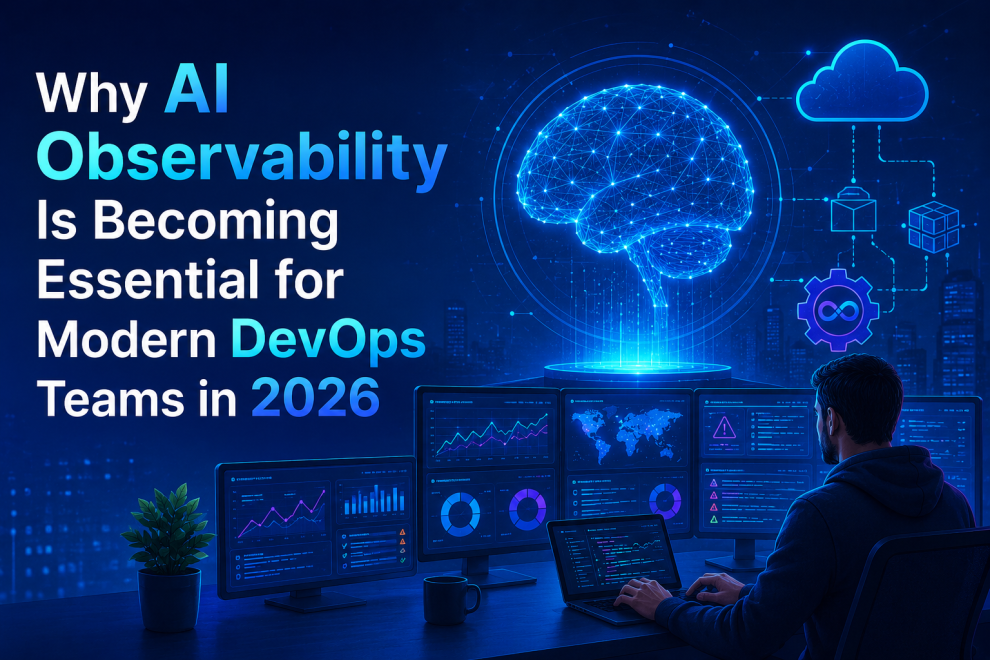
This is why AI observability platforms are becoming critical components within modern DevOps pipelines. They help engineering teams understand not just whether systems are running, but whether AI systems are behaving as intended.
For enterprise organizations operating across multiple regions, product lines, and digital channels, this distinction matters financially.
A poorly monitored AI recommendation engine can affect conversion rates. An unreliable AI customer support assistant can increase escalation volume. Internal AI copilots can reduce developer productivity instead of improving it if output quality remains inconsistent.
The operational cost of unreliable AI systems scales quickly inside large enterprises.
This is especially relevant for organizations managing multi cloud environments and large distributed engineering teams. As AI adoption grows, many DevOps leaders are discovering that fragmented observability strategies create blind spots across both infrastructure and AI behavior layers.
Industry players including Datadog, Dynatrace, New Relic, Arize AI, Langfuse, and Honeycomb are already expanding observability capabilities around AI workloads. Consulting and platform engineering firms such as GeekyAnts are also increasingly helping enterprises rethink monitoring architectures as AI becomes embedded into modern application ecosystems.
The conversation is moving beyond experimentation. Enterprises are now focused on operational sustainability.
Why Enterprise DevOps Teams Are Reworking Their AI Operations Strategy
Large enterprises rarely struggle with AI experimentation. Most already run pilot projects, internal copilots, or customer facing AI applications.
The bigger challenge is operationalization.
Once AI systems move into production environments, DevOps teams face pressure from multiple directions simultaneously. Engineering leaders must balance reliability, governance, scalability, compliance, cost management, and customer experience targets without slowing innovation cycles.
This becomes difficult when AI systems behave unpredictably under real production conditions.
For example, an enterprise AI assistant may perform accurately during testing but fail under regional traffic spikes or evolving customer queries. Recommendation systems may gradually lose relevance because of model drift. Autonomous workflows can create downstream operational conflicts that traditional alerts never detect.
In many organizations, teams discover these issues only after customer complaints, revenue impact, or security escalation.
That reactive model no longer works at enterprise scale.
Modern DevOps teams are therefore moving toward proactive AI observability frameworks that combine application monitoring, model evaluation, telemetry analysis, and governance controls into a unified operational layer.
Several priorities are driving this transition:
- Faster incident detection across AI systems
- Improved trust in AI generated outputs
- Better visibility into model performance degradation
- Stronger compliance oversight for regulated industries
- More predictable operational costs for AI infrastructure
This evolution also reflects a broader organizational change happening across enterprise technology teams.
Platform engineering groups are increasingly partnering with AI teams rather than operating separately. Security, compliance, and infrastructure teams now require visibility into how AI systems interact with production environments. Customer experience leaders want measurable insights into AI driven engagement quality rather than simple usage metrics.
As a result, AI observability is becoming a cross functional operational discipline rather than a niche machine learning concern.
The Next Competitive Advantage May Be Operational Trust in AI
The next phase of enterprise AI adoption will likely favor organizations that can operationalize AI reliably rather than simply deploy it quickly.
This creates an important shift for technology leadership teams.
During the early cloud transformation era, competitive advantage came from deployment speed and infrastructure scalability. In the AI era, competitive advantage may increasingly come from operational trust.
Customers, regulators, employees, and executive stakeholders all expect AI systems to produce reliable outcomes consistently. That expectation cannot be achieved through infrastructure monitoring alone.
Organizations now need operational visibility into how AI systems reason, respond, evolve, and interact across digital ecosystems.
This is why AI observability is rapidly becoming part of broader enterprise modernization conversations alongside DevSecOps, platform engineering, cloud governance, and digital resilience strategies.
The strongest DevOps organizations are not treating AI observability as an optional add on. They are integrating it directly into CI/CD pipelines, incident management frameworks, platform engineering standards, and enterprise governance models.
For technology leaders evaluating long term AI scalability, the key question is no longer whether AI systems can be deployed. The more important question is whether those systems can remain observable, governable, and operationally reliable at enterprise scale.
That shift is already reshaping infrastructure priorities across North American enterprises.
As AI adoption accelerates across customer platforms, internal operations, and engineering workflows, organizations will likely continue investing in partners and technology ecosystems that help bridge the growing gap between AI innovation and operational control. For many enterprises, that conversation increasingly involves platform modernization specialists, observability vendors, and engineering consultancies such as GeekyAnts, ScienceSoft, BCG that understand how AI systems intersect with modern DevOps environments.
For more insights on emerging DevOps trends, AI infrastructure, platform engineering, and cloud native technologies, visit DevOps Connect Hub.


Add Comment