





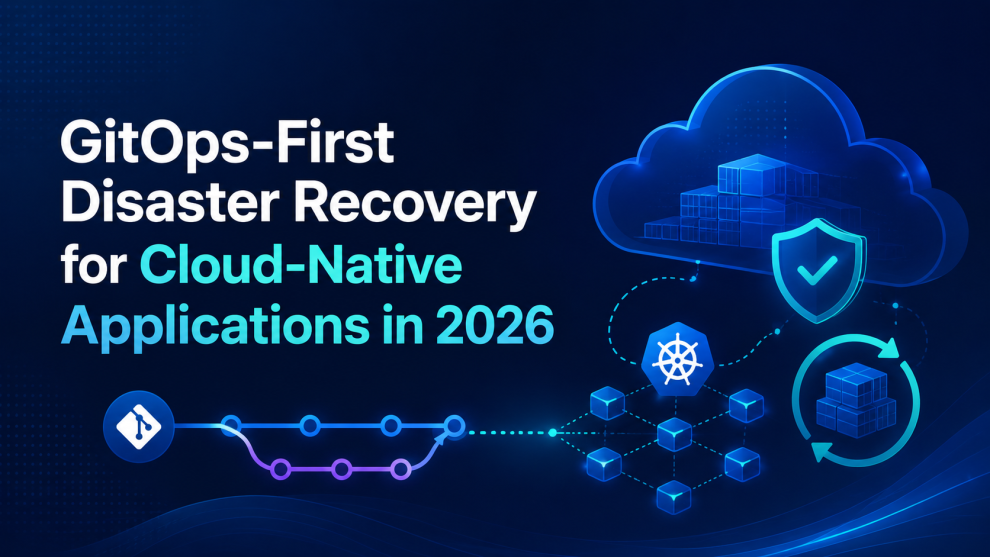

GitOps First Disaster Recovery for Cloud Native Applications
Disaster recovery became significantly more complicated once enterprises moved aggressively into cloud native infrastructure.
Traditional disaster recovery models were designed around static infrastructure, predictable failover environments, and centralized operational control. That model no longer reflects how modern enterprise systems operate. In 2026, most large organizations run distributed Kubernetes environments, multi cloud workloads, API driven services, containerized applications, and globally distributed deployment pipelines simultaneously.
The result is a new operational challenge: infrastructure changes faster than traditional disaster recovery processes can realistically keep up with.
That is why GitOps first disaster recovery strategies are gaining momentum across enterprise cloud environments.
The shift is not driven by hype. It is driven by operational pressure. Platform engineering leaders now manage increasingly complex application ecosystems where downtime directly affects revenue, customer experience, regulatory exposure, and digital transformation metrics.
The problem is not simply recovering workloads after failure. The problem is restoring entire operational states consistently across rapidly changing infrastructure environments.
In many enterprises, disaster recovery processes still depend heavily on manual coordination, fragmented infrastructure scripts, inconsistent configuration management, and environment specific operational knowledge. These weaknesses become visible immediately during outages.
Engineering teams often discover that production environments drifted significantly from documented recovery configurations. Kubernetes clusters differ across regions. Infrastructure as code repositories no longer reflect runtime reality. Recovery runbooks become outdated within months.
At enterprise scale, those inconsistencies create serious operational risk.
This is where GitOps changes the conversation.
GitOps first recovery models treat Git repositories as the authoritative operational source for infrastructure, configuration, deployment states, and recovery orchestration. Instead of rebuilding environments manually during outages, teams recreate environments through automated reconciliation processes tied directly to version controlled infrastructure definitions.
For large enterprises operating cloud native systems, this approach fundamentally changes disaster recovery operations.
Traditional Disaster Recovery Models Struggle in Kubernetes Environments
Cloud native architecture introduced operational flexibility, but it also introduced significant infrastructure complexity.
Modern enterprise environments now include ephemeral workloads, autoscaling clusters, distributed service meshes, multi region deployments, and continuously changing infrastructure states. Traditional recovery strategies were never designed for this level of dynamism.
That operational mismatch creates several enterprise problems.
Recovery testing becomes inconsistent. Infrastructure drift increases over time. Environment parity breaks across regions. Recovery point objectives and recovery time objectives become harder to guarantee reliably.
For platform leaders responsible for uptime and resilience, these problems directly affect executive level performance metrics.
According to industry reports from Gartner, CNCF, and major cloud providers throughout 2025, Kubernetes complexity remains one of the biggest operational barriers for enterprise cloud modernization initiatives. Disaster recovery consistently ranks among the most difficult operational areas for platform engineering teams managing large scale containerized environments.
The issue is not Kubernetes itself. The issue is operational coordination across constantly changing infrastructure.
GitOps reduces much of that coordination burden.
By maintaining declarative infrastructure states inside version controlled repositories, engineering teams can restore environments with greater consistency and automation. Recovery becomes less dependent on tribal knowledge and more dependent on reproducible deployment pipelines.
This is especially important for large North American enterprises operating under strict compliance, uptime, and auditability requirements.
A GitOps first model creates clearer operational visibility into:
- Infrastructure state changes
- Deployment history and rollback events
- Environment drift detection
- Cluster recovery orchestration
- Multi region synchronization
These capabilities matter because outages rarely occur in clean, isolated conditions. Failures often happen during active deployments, scaling events, cloud incidents, or cascading service disruptions.
Under those conditions, manual recovery coordination becomes extremely difficult.
GitOps introduces a more deterministic operational model.
GitOps Is Becoming a Governance Layer, Not Just a Deployment Model
One of the biggest misconceptions around GitOps is that it only improves developer workflows.
In reality, enterprises increasingly treat GitOps as a governance framework for cloud operations.
That distinction matters for disaster recovery planning.
Modern recovery strategies now involve platform engineering, infrastructure operations, security governance, compliance teams, and executive risk management stakeholders simultaneously. Recovery processes must support auditability, consistency, and operational transparency across globally distributed systems.
GitOps aligns naturally with those requirements because infrastructure changes become observable, version controlled, and policy driven.
This is one reason GitOps adoption accelerated rapidly inside regulated industries including finance, healthcare, telecommunications, and large scale SaaS operations.
The operational value becomes even more significant in multi cloud environments.
Many enterprises no longer rely on a single cloud provider. They distribute workloads across AWS, Azure, Google Cloud, and private infrastructure environments for resilience, cost optimization, and regional compliance requirements.
However, multi cloud resilience introduces additional recovery complexity.
Different infrastructure provisioning standards, networking models, IAM policies, and deployment configurations increase operational fragmentation. During outages, those inconsistencies slow recovery coordination significantly.
GitOps first architecture helps standardize operational behavior across those environments.
Instead of managing cloud recovery through provider specific manual procedures, teams manage infrastructure recovery through centralized declarative workflows. This creates more consistent operational patterns regardless of underlying infrastructure providers.
Companies like GeekyAnts, Thoughtworks, Red Hat, and Platform9 are actively working with enterprises to modernize Kubernetes operations around GitOps principles, infrastructure automation, and cloud native resilience engineering.
The rise of platform engineering also accelerated this trend.
Large organizations increasingly build internal developer platforms designed to standardize deployment, governance, and infrastructure management across engineering teams. GitOps fits naturally into these models because it supports scalable operational consistency.
For enterprise technology leaders, the appeal is straightforward: fewer manual recovery dependencies, improved governance visibility, and more predictable operational behavior during incidents.
The Biggest Challenge Is Organizational, Not Technical
Despite the momentum behind GitOps first recovery models, implementation remains difficult for many enterprises.
The technology itself is often not the biggest obstacle.
Organizational complexity is.
Large enterprises frequently operate fragmented infrastructure ownership models where DevOps teams, cloud infrastructure groups, security operations, compliance stakeholders, and product engineering teams all manage different operational layers independently.
GitOps requires tighter operational alignment across these groups.
That shift can expose governance gaps very quickly.
Many organizations also underestimate the importance of repository discipline, policy enforcement, and infrastructure standardization. GitOps recovery only works effectively when repositories accurately reflect production reality.
If infrastructure definitions become inconsistent, incomplete, or poorly governed, disaster recovery automation loses reliability.
This is why mature GitOps adoption often requires broader operational transformation rather than isolated tooling implementation.
Observability also becomes increasingly critical.
Enterprises need visibility into deployment state reconciliation, infrastructure drift, policy enforcement failures, and cluster synchronization behavior across environments. Without strong observability, automated recovery pipelines can introduce additional operational confusion during incidents.
Security governance presents another challenge.
Git repositories now become operational control planes for infrastructure environments. That elevates the importance of access control, policy validation, secrets management, and supply chain security inside GitOps workflows.
Enterprise platform leaders are paying much closer attention to these concerns in 2026 as software supply chain attacks and infrastructure security incidents continue affecting cloud native environments globally.
Why Enterprises Are Rebuilding Recovery Strategies Around GitOps
The broader shift toward GitOps first disaster recovery reflects a larger operational reality.
Cloud native systems move too quickly for traditional recovery coordination models.
Infrastructure changes continuously. Deployments happen globally. AI workloads increase scaling unpredictability. Platform teams manage increasingly distributed application environments. Manual disaster recovery processes cannot scale effectively under those conditions.
GitOps provides a more operationally sustainable model.
It allows enterprises to treat recovery as an automated infrastructure capability rather than an isolated operational event. That distinction improves consistency, reduces dependency on manual intervention, and strengthens governance visibility across complex cloud environments.
The organizations adapting fastest are approaching disaster recovery differently from previous generations of infrastructure leadership. They prioritize reproducibility, declarative infrastructure management, policy driven automation, and continuous recovery testing from the beginning.
That shift is becoming increasingly important as cloud native architectures continue expanding across enterprise digital ecosystems.
For engineering executives, the core question is no longer whether disaster recovery plans exist on paper. The more important question is whether recovery processes can realistically operate at the speed and complexity of modern cloud native infrastructure.
That discussion is becoming central across platform engineering, cloud modernization, and digital resilience initiatives throughout North America.
And increasingly, GitOps sits at the center of that conversation.
Organizations evaluating these transitions are also engaging more frequently with cloud native consultants and platform modernization specialists that understand both Kubernetes operations and enterprise scale governance realities. The objective is not simply automating deployments. It is building recovery systems capable of supporting continuously evolving infrastructure without increasing operational fragility over time.
To learn more about enterprise cloud modernization, platform engineering, and cloud native transformation strategies, visit our homepage !




Add Comment