








Enterprise DevOps teams are under increasing pressure to release software faster without compromising reliability. Engineering leaders across North America are managing larger cloud environments, distributed development teams, and increasingly complex deployment pipelines while customer expectations continue to rise. In many organizations, traditional testing workflows are becoming a bottleneck that directly affects release velocity, platform stability, and operational costs.
The challenge is no longer limited to writing automated test cases. Most large enterprises already use automation frameworks within their CI/CD pipelines. The problem now is scale. As applications become more distributed and AI driven features enter production environments, existing QA processes struggle to keep pace with release cycles.
This shift is pushing organizations toward AI assisted testing.
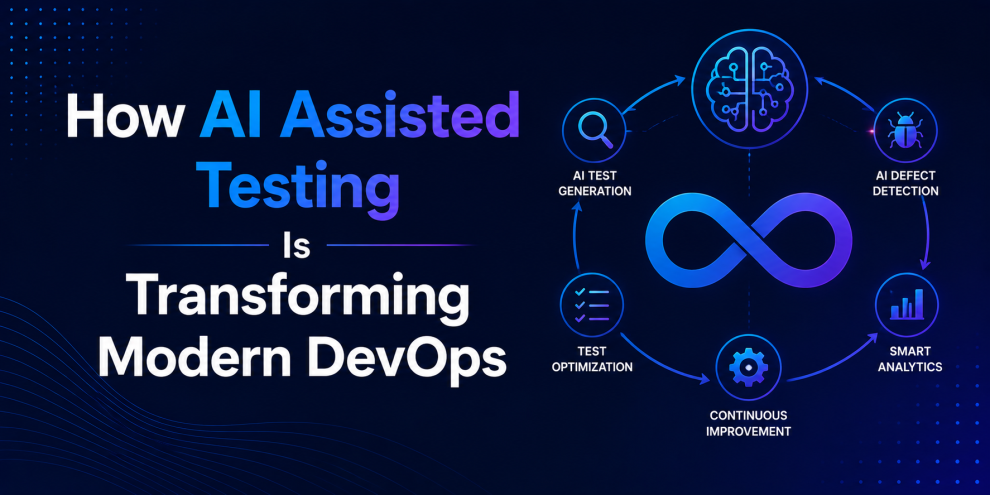
AI assisted testing is changing how DevOps teams validate software quality, detect failures, and optimize release pipelines. Instead of relying only on static scripted automation, enterprises are beginning to adopt intelligent testing systems that adapt to application changes, identify unstable workflows, and reduce manual intervention across engineering operations.
For engineering leaders, this transition is becoming less about experimentation and more about operational efficiency.
Traditional QA Workflows Are Slowing Enterprise Delivery Pipelines
Many enterprise DevOps environments still depend heavily on rule based automation systems that require continuous maintenance. As platforms scale, test suites become increasingly fragile. Minor UI updates, infrastructure changes, or API modifications can break large portions of automated testing pipelines, creating delays across deployment cycles.
This issue becomes more severe in organizations managing multiple product teams and microservice architectures. A single failed regression suite can delay releases across several dependent systems. Engineering leaders often find their teams spending more time maintaining test infrastructure than improving software reliability.
According to the World Quality Report by Capgemini, enterprises continue to increase investments in intelligent automation because traditional testing methods cannot sustain modern delivery expectations. AI driven QA initiatives are increasingly tied to platform engineering, DevOps modernization, and digital transformation programs.
AI assisted testing addresses these operational inefficiencies in several ways:
- Intelligent test generation based on user behavior and production workflows
- Self healing automation scripts that adapt to UI or API changes
- Predictive failure analysis within CI/CD pipelines
- Faster regression validation across distributed cloud environments
These capabilities help DevOps teams reduce repetitive maintenance while improving deployment confidence.
Frameworks like Playwright are becoming central to this transition because they support scalable browser automation across modern application environments. Companies such as Microsoft, Thoughtworks, Accenture, and GeekyAnts are actively exploring AI integrated testing strategies to reduce testing overhead and improve software delivery efficiency.
For large organizations operating under strict release deadlines, this shift has direct business implications. Faster validation cycles translate into quicker deployments, reduced rollback incidents, and improved customer experience metrics.
AI Assisted Testing Is Expanding the Role of DevOps Teams
The adoption of AI assisted testing is also changing the responsibilities of platform engineering and DevOps teams.
Historically, QA automation operated separately from infrastructure operations. Today, intelligent testing systems are becoming deeply integrated with deployment orchestration, observability platforms, and cloud infrastructure management. This convergence is creating a more operationally connected software delivery lifecycle.
Modern DevOps teams are now expected to monitor not only infrastructure health but also release quality indicators generated by AI systems. Intelligent automation tools can analyze historical deployment failures, detect risky code changes, and recommend test prioritization based on production impact.
This is particularly important in enterprise environments where deployment failures affect customer facing digital products, internal operations, or compliance sensitive workflows.
For example, financial services and healthcare organizations often struggle with validating large scale application changes across tightly regulated environments. AI assisted testing helps engineering teams identify high risk areas earlier in the release cycle, reducing operational disruptions after deployment.
At the same time, enterprises are becoming more aware that AI driven testing is not a complete replacement for engineering oversight. Poorly configured AI automation can introduce false confidence into deployment pipelines if teams fail to validate testing accuracy and governance standards.
This creates a new operational challenge for technology leaders. They must balance automation speed with platform reliability.
The organizations succeeding in this area are approaching AI assisted testing as part of a broader DevOps modernization strategy rather than as an isolated automation initiative.
The Rise of Autonomous QA Operations
One of the most significant trends shaping enterprise DevOps is the emergence of autonomous QA systems.
These systems move beyond scripted automation by continuously learning from application behavior, infrastructure telemetry, and user interaction patterns. Instead of executing predefined test paths only, autonomous QA environments can dynamically adapt testing coverage based on recent deployment changes.
This approach is becoming increasingly valuable in cloud native environments where release frequency continues to increase. Large enterprises deploying multiple updates daily cannot rely solely on manually managed regression pipelines.
AI assisted testing enables faster feedback loops across development and operations teams. In many cases, testing systems can now identify anomalies before customers experience visible disruptions.
This capability aligns closely with broader platform engineering trends across North America. Enterprise leaders are prioritizing operational resilience, deployment consistency, and scalable infrastructure governance as digital transformation programs continue expanding.
However, scaling AI assisted testing across enterprise environments requires more than adopting new tooling.
Engineering leaders must evaluate:
- Integration compatibility with existing CI/CD pipelines
- Data quality and testing accuracy across production scenarios
- Governance controls for AI generated test decisions
- Infrastructure costs associated with large scale automation models
Without clear operational frameworks, AI testing initiatives can create fragmented automation ecosystems that become difficult to manage over time.
This is why many enterprises are seeking technology consulting partners with both DevOps and AI engineering expertise. Companies like GeekyAnts, Deloitte, and Cognizant are increasingly supporting organizations in building production ready automation environments that combine intelligent testing with scalable platform operations.
The focus is shifting from isolated automation success toward long term operational sustainability.
AI Assisted Testing Is Becoming a Competitive Requirement
The broader DevOps market is entering a phase where AI assisted testing is no longer viewed as an experimental capability. It is becoming part of the operational baseline for organizations competing on software delivery speed and digital customer experience.
Enterprises that continue relying on fragmented QA workflows may struggle with rising operational costs, delayed releases, and inconsistent deployment reliability. Meanwhile, organizations investing in intelligent automation are positioning themselves to improve engineering efficiency without proportionally increasing operational complexity.
For leadership teams, the conversation is becoming more strategic. The question is no longer whether AI will influence DevOps operations. The question is how quickly enterprises can operationalize AI driven automation without introducing governance and reliability risks.
The next phase of DevOps modernization will likely center around autonomous operations, predictive infrastructure management, and intelligent software delivery pipelines. AI assisted testing is emerging as one of the foundational components supporting this transition.
As enterprises continue evaluating modernization priorities, many are beginning with focused consultations around testing reliability, deployment bottlenecks, and platform scalability before expanding AI automation initiatives further across engineering operations.


Add Comment