






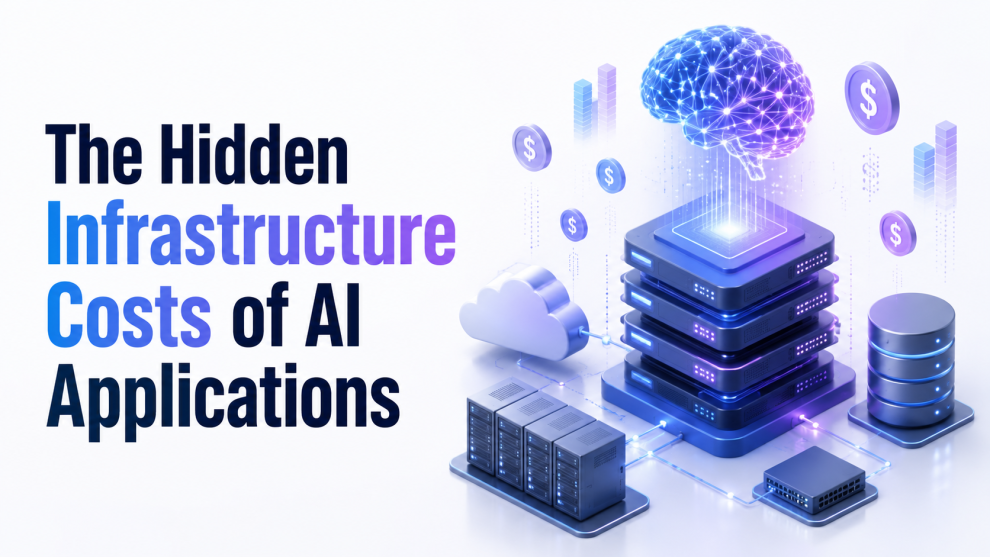

Enterprise AI conversations still focus heavily on model capabilities, copilots, automation, and faster product delivery. But inside large engineering organizations, another conversation has become far more urgent: infrastructure economics.
Across North America, enterprise technology leaders are discovering that AI projects rarely fail because the models are weak. Most struggle because the operational costs expand faster than expected after production rollout.
The issue is not limited to GPU pricing. Infrastructure complexity around AI applications now touches nearly every layer of the modern technology stack. Cloud consumption rises unpredictably. Storage costs multiply through vector databases and retrieval systems. Inference latency affects customer experience targets. Platform teams inherit entirely new observability responsibilities. Security and governance workloads grow alongside adoption.
This shift is becoming visible across industries. According to Gartner, worldwide AI software spending is expected to continue accelerating through 2026 as enterprises move from experimentation into scaled deployment. At the same time, IDC research continues to show rising enterprise investment in AI infrastructure, particularly around accelerated computing, cloud environments, and data operations.
For large organizations managing billions in revenue, the challenge is no longer whether AI can create value. The challenge is whether the infrastructure supporting AI applications can remain financially sustainable while still meeting performance expectations.
That distinction matters for engineering leaders responsible for platform reliability, digital product velocity, and operational efficiency targets.
The Compute Problem Is Larger Than Most Enterprises Expected
Many enterprise teams initially budget AI initiatives around training costs. In practice, inference becomes the larger long term expense.
Once AI features move into customer facing products, usage patterns change dramatically. A chatbot used by 500 internal employees behaves very differently from an AI assistant integrated into a consumer platform serving millions of interactions every week.
Inference workloads introduce continuous compute demand. Latency expectations also become stricter. Customers expect AI systems to respond instantly across mobile apps, web platforms, internal dashboards, and support channels.
This creates infrastructure pressure in several areas:
- GPU utilization inefficiencies
- Autoscaling unpredictability
- Higher networking and bandwidth consumption
- Multi region deployment requirements
- Expensive fallback and redundancy systems
Many organizations underestimate how quickly these layers compound operational costs.
OpenAI, Anthropic, Google, and Microsoft continue investing heavily in optimized inference infrastructure because the economics of serving AI at scale remain difficult even for hyperscalers. Enterprise teams operating on conventional cloud architectures often discover that their environments were never designed for sustained AI inference traffic.
The result is growing tension between platform engineering teams and finance stakeholders. Product groups push for broader AI adoption while infrastructure teams attempt to control escalating cloud spend.
This is especially visible in organizations deploying retrieval augmented generation systems. Vector search, context injection, and semantic retrieval workflows create additional latency and compute overhead that traditional SaaS architectures never had to manage.
Companies like GeekyAnts, Accenture, and Thoughtworks are increasingly working with enterprises on AI architecture modernization because many existing backend systems cannot efficiently support production scale AI workloads without significant redesign.
Data Infrastructure Quietly Becomes the Bigger Expense
While GPU discussions dominate headlines, many enterprises experience their fastest infrastructure growth through data systems.
AI applications depend on constant data movement. Enterprises now manage ingestion pipelines, embedding workflows, vector indexing, fine tuning datasets, governance layers, and real time synchronization across multiple environments.
Every new AI capability increases storage and orchestration requirements.
This creates a difficult operational reality for large enterprises already managing fragmented data ecosystems. Legacy systems, multi cloud environments, and regional compliance obligations make AI infrastructure significantly harder to standardize.
Engineering leaders are also confronting a newer problem: duplicated infrastructure.
Many business units independently launch AI pilots using separate vendors, isolated vector databases, and disconnected orchestration tools. Over time, organizations accumulate overlapping infrastructure layers that increase costs without improving outcomes.
The hidden expense often appears in three places:
First, enterprises pay for duplicated data processing pipelines across departments.
Second, retrieval systems continuously reprocess documents, embeddings, and metadata.
Third, observability tooling expands because AI systems require more monitoring than conventional applications.
Unlike traditional APIs, AI systems introduce probabilistic behavior. Performance cannot be measured through uptime alone. Teams now monitor hallucination rates, token consumption, response quality, latency drift, and model reliability.
That creates entirely new operational overhead for platform teams already stretched by cloud governance and cybersecurity responsibilities.
Reliability, Governance, and Compliance Add Another Layer
As AI applications become customer facing, infrastructure conversations increasingly involve legal, compliance, and risk management teams.
Highly regulated industries across healthcare, finance, insurance, and enterprise SaaS now require stronger controls around AI generated outputs, data residency, auditability, and model behavior.
This changes infrastructure planning significantly.
Organizations can no longer optimize purely for speed or experimentation. They must build AI systems that satisfy enterprise governance requirements from the beginning.
That often means:
- Regional infrastructure replication for compliance
- Expanded audit logging and monitoring
- Human review workflows for critical outputs
- Encryption and access controls across AI pipelines
- Vendor risk assessments for external model providers
These additions rarely appear in early AI business cases, but they become unavoidable during production deployment.
The operational impact is substantial. Security teams must now evaluate AI specific attack surfaces such as prompt injection vulnerabilities and data leakage risks. Infrastructure teams must design systems capable of scaling securely under unpredictable usage patterns.
Meanwhile, executives continue demanding measurable ROI from AI investments.
This combination explains why many enterprises are slowing aggressive AI rollouts in favor of more targeted deployments tied directly to operational metrics.
The market is shifting from experimentation toward infrastructure discipline.
What Enterprise Engineering Leaders Are Doing Differently in 2026
The organizations handling AI infrastructure most effectively are not necessarily building the largest models. They are controlling operational complexity earlier.
Several patterns are becoming common across large enterprises.
Teams are prioritizing smaller, specialized models instead of defaulting to massive general purpose systems for every workflow.
Platform engineering groups are building centralized AI infrastructure layers to prevent duplicated tooling across business units.
Organizations are investing more heavily in observability, governance automation, and inference optimization before expanding customer facing AI features.
There is also growing focus on hybrid AI architectures. Enterprises increasingly combine proprietary models, open source frameworks, and edge inference systems to reduce long term dependency on single providers.
This architectural shift reflects a broader realization inside enterprise technology leadership: AI is not simply another software feature.
It behaves more like a continuously operating infrastructure system that requires constant optimization across compute, storage, networking, governance, and reliability.
For decision makers managing digital transformation targets, this changes how AI success should be measured. The most important metric is no longer prototype speed. It is sustainable operational scalability.
That is where many enterprises now seek external consultation rather than pure implementation support. The challenge is rarely whether teams can launch AI features. The harder problem is designing infrastructure that remains financially and operationally viable two years later.
Firms such as GeekyAnts and other enterprise engineering partners are increasingly involved in these conversations because infrastructure strategy has become central to AI product success, especially for organizations balancing aggressive innovation goals with operational accountability.
The next phase of enterprise AI adoption will likely belong to companies that treat infrastructure efficiency as a competitive advantage rather than a backend concern.



Add Comment