





For years, enterprise software delivery has been driven by continuous improvement. Organizations invested in CI/CD, platform engineering, Infrastructure as Code, developer portals, and cloud automation to accelerate releases while maintaining reliability. Yet despite these advances, one constant remained: humans orchestrated nearly every stage of software delivery.
Google I/O 2026 suggests that this model is beginning to change.
With the introduction of AI Studio, Android CLI, and Antigravity, Google is moving beyond AI-assisted development toward autonomous software delivery, where intelligent agents participate in planning, implementation, testing, validation, and deployment. For technology executives responsible for large engineering organizations, this represents more than a productivity enhancement. It signals a new operating model for software engineering.
From Developer Assistance to Delivery Automation
Most enterprise teams already use AI to write code, generate documentation, or review pull requests. These capabilities improve individual productivity but rarely transform how software is delivered across an organization.
Google’s latest announcements shift the conversation from helping developers write code to enabling AI systems to execute engineering workflows. Instead of responding to isolated prompts, AI agents can interact with development tools, understand project context, coordinate tasks, and contribute throughout the software lifecycle.
This evolution reflects a broader trend already visible across the industry. Engineering organizations such as GeekyAnts have increasingly focused on integrating AI into product engineering workflows, helping enterprises automate development without losing control over architecture, governance, or software quality. Google’s latest tooling provides another indication that AI is becoming part of the delivery pipeline itself rather than an optional assistant.
AI Studio Becomes an Engineering Workspace
AI Studio is no longer simply a place to experiment with prompts.
It is evolving into an environment where engineering teams can transform business requirements into implementation plans, generate application architecture, iterate with AI agents, and validate technical decisions before development begins.
For enterprises managing dozens of product initiatives simultaneously, reducing the time between business strategy and engineering execution creates a measurable competitive advantage. AI becomes less of a coding assistant and more of a collaborative engineering system.
Android CLI Extends AI Beyond Code Generation
One of the most significant announcements from Google I/O 2026 was the expansion of Android CLI.
Although introduced for Android development, its broader significance lies in giving AI agents structured access to engineering workflows. Instead of generating code and waiting for human execution, AI can interact directly with build systems, debugging tools, project analysis, dependency management, and validation processes.
This distinction is important.
Software delivery has historically depended on engineers translating recommendations into action. Agent-enabled tooling reduces that gap by allowing AI to participate directly in execution while remaining within governed engineering environments.
That architectural shift has implications far beyond mobile development.
Antigravity Points Toward Multi-Agent Engineering
Enterprise software rarely depends on one engineer or one team.
Modern applications involve platform engineering, backend services, frontend applications, infrastructure, security, quality assurance, observability, and compliance.
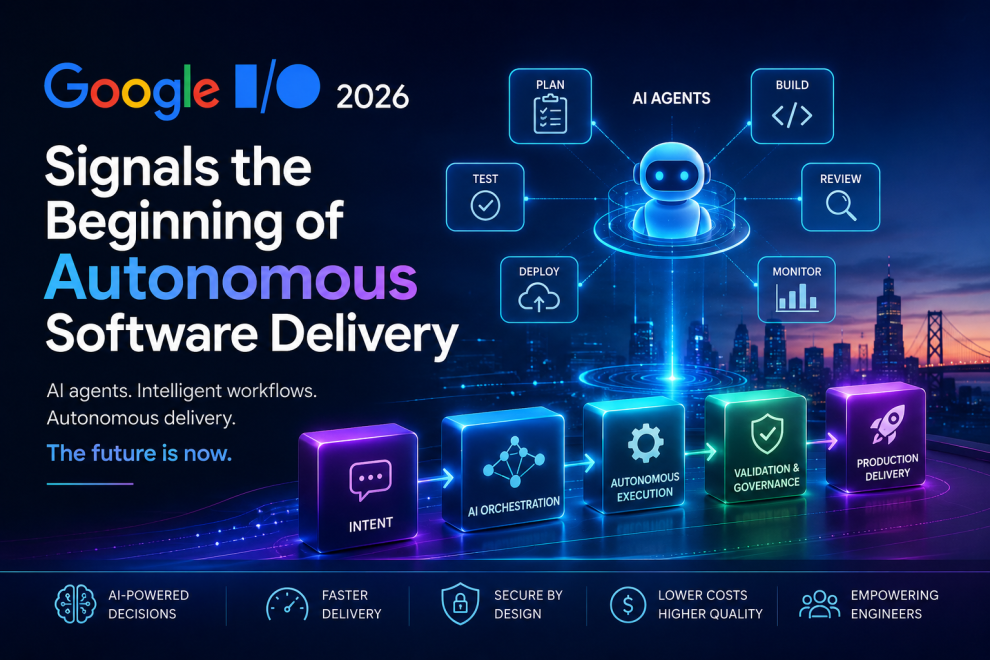
Antigravity introduces an approach where specialized AI agents collaborate across these disciplines. One agent may generate implementation plans while another validates architecture, a third performs testing, and another prepares deployment artifacts.
Rather than replacing engineering teams, these agents augment them by handling repetitive operational work, allowing engineers to focus on architectural decisions and customer value.
For organizations managing thousands of developers, this model offers a scalable way to increase engineering throughput without simply increasing headcount.
CI/CD Is Becoming AI-Orchestrated
Continuous Integration transformed software validation.
Continuous Delivery automated deployments.
Autonomous software delivery extends automation even further by allowing AI to contribute before code reaches a repository.
Requirements evolve into implementation plans.
Implementation plans generate software components.
Automated testing validates functionality.
AI reviews quality, identifies risks, recommends improvements, and prepares deployments before engineers approve production releases.
The pipeline no longer starts with code.
It starts with intent.
Platform Engineering Will Define Success
As AI becomes more autonomous, platform engineering becomes increasingly important.
Organizations require secure APIs, standardized development environments, observability, policy enforcement, identity management, deployment controls, and governance frameworks capable of supervising AI-driven workflows.
Without those foundations, autonomous delivery creates operational complexity instead of efficiency.
Engineering leaders who have already invested in Internal Developer Platforms will be better positioned to adopt Google’s vision because their delivery processes are already standardized and observable.
Governance Remains the Enterprise Differentiator
The technology required for autonomous software delivery is advancing rapidly.
Governance cannot lag behind.
Enterprise leaders must answer practical questions.
How are AI-generated changes reviewed?
Who approves architectural decisions?
How are compliance requirements enforced?
Can deployment decisions be audited months later?
How is sensitive intellectual property protected throughout AI-assisted development?
These questions determine whether autonomous engineering becomes a competitive advantage or an operational liability.
The Next Competitive Advantage
For years, organizations competed by hiring larger engineering teams or delivering software faster.
The next generation of competition will center on how effectively companies combine human expertise with autonomous AI systems.
Technology alone will not determine success. Organizations need engineering practices, platform maturity, and operational governance capable of supporting AI-native development at scale. This is where engineering partners with deep expertise in AI implementation and platform modernization, including companies like GeekyAnts, can help enterprises translate emerging capabilities into reliable production systems.
Google has demonstrated what autonomous software delivery could become.
The organizations that invest now in platform engineering, governance, and AI-enabled workflows will be the ones defining how enterprise software is built over the next decade.
Frequently Asked Questions
Will autonomous software delivery replace DevOps?
No. It builds on DevOps by extending automation into planning, implementation, testing, and release management while retaining human oversight.
Is Google’s vision limited to Android applications?
No. Although Android tooling was highlighted at Google I/O 2026, the concepts of AI orchestration and autonomous delivery apply across web, cloud, backend, and enterprise platforms.
Why should enterprise leaders care now?
Because organizations that modernize their engineering platforms today will be able to adopt AI-driven delivery much faster than those relying on fragmented tooling and manual processes.
How does platform engineering support autonomous delivery?
Platform engineering provides the standardized infrastructure, governance, security, and observability that allow AI agents to operate safely across enterprise software delivery pipelines.
What role do engineering partners play in this transition?
Many enterprises have the ambition to adopt AI-driven development but need support integrating it into existing systems. Engineering firms such as GeekyAnts help organizations modernize platforms, embed AI into development workflows, and implement governance practices that make autonomous software delivery practical at enterprise scale.
For more, visit our homepage!



Add Comment