






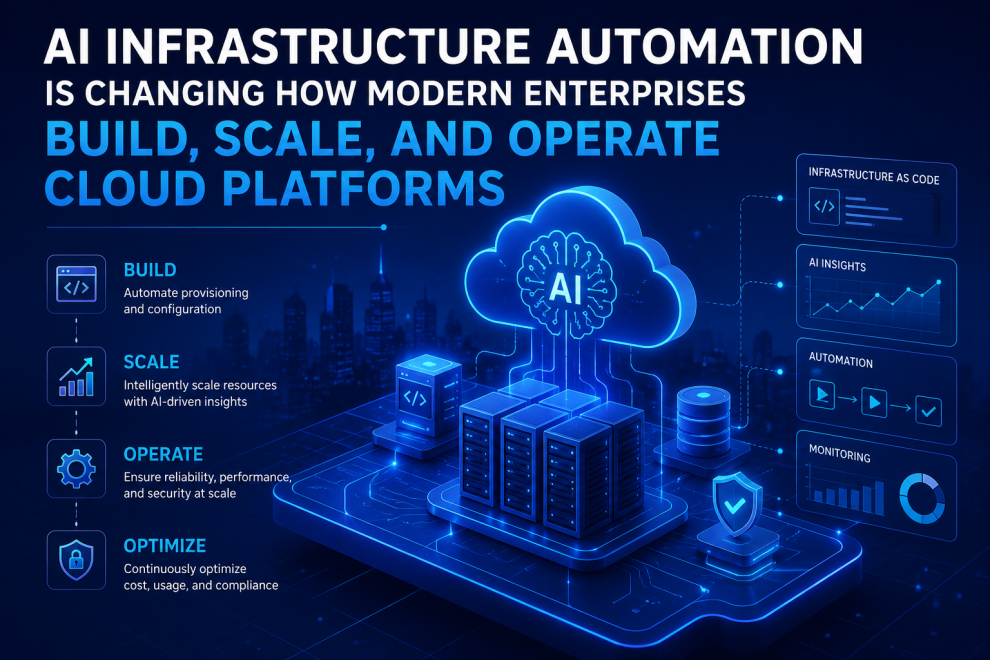

Enterprise cloud infrastructure has reached a point where traditional automation alone is no longer enough. Infrastructure as Code, CI/CD pipelines, and Kubernetes orchestration solved many deployment challenges over the past decade, but they also created new operational complexity. Large organizations now manage thousands of cloud resources across multiple regions, providers, and environments while supporting AI workloads, real-time applications, strict compliance requirements, and rising customer expectations.
For engineering leaders at enterprises with 5,000 to more than 100,000 employees and annual revenues ranging from $500 million to tens of billions of dollars, the challenge is no longer simply deploying infrastructure faster. The focus has shifted toward operating cloud platforms intelligently, reducing operational overhead, improving resilience, and enabling engineering teams to spend more time delivering business value instead of responding to infrastructure incidents.
This is where AI infrastructure automation is beginning to reshape enterprise operations.
Industry analysts continue to identify AI-assisted operations and platform engineering among the fastest-growing priorities for enterprise technology organizations. Gartner has consistently highlighted AI-driven automation and platform engineering as major strategic trends, while the Cloud Native Computing Foundation’s annual surveys continue to show growing Kubernetes adoption alongside increasing operational complexity. Rather than replacing DevOps teams, AI is emerging as an operational layer that helps engineering organizations make better decisions faster.
Enterprise Infrastructure Has Become Too Complex for Manual Operations
Most large organizations no longer operate from a single cloud or a single deployment model. Multi-cloud strategies, hybrid environments, edge computing, SaaS integrations, AI platforms, and hundreds of microservices have dramatically expanded the operational surface area.
Engineering leaders often discover that their teams spend an increasing amount of time investigating alerts, managing infrastructure drift, optimizing cloud costs, and troubleshooting deployments instead of improving developer productivity or customer experience.
The issue is not a lack of automation. Many organizations already automate deployments, provisioning, scaling, and configuration management. The challenge is that these automations are frequently isolated, rule-based, and reactive.
AI infrastructure automation introduces a different operating model.
Instead of executing predefined scripts, AI systems analyze telemetry across infrastructure, application performance, deployment history, logs, and cloud metrics to identify patterns, predict failures, recommend remediation, and in some cases execute approved corrective actions automatically.
This shift enables operations teams to move beyond responding to incidents toward preventing them before users experience service degradation.
For enterprises operating globally, even a small improvement in incident detection or deployment reliability can translate into millions of dollars in avoided downtime and significantly higher engineering productivity.
AI Is Becoming an Operational Intelligence Layer
The biggest misconception surrounding AI infrastructure automation is that it simply generates infrastructure code or creates Terraform templates.
Its real value lies much deeper.
Modern AI platforms can correlate information across infrastructure components that humans would struggle to analyze quickly. Instead of reviewing thousands of monitoring events manually, engineering teams receive prioritized recommendations based on historical behavior, deployment patterns, and infrastructure health.
Some of the highest-impact enterprise use cases include:
- Predictive infrastructure failure detection before outages occur.
- Intelligent capacity planning based on historical workload behavior.
- Automated cloud cost optimization recommendations.
- AI-assisted incident investigation using observability data.
- Infrastructure drift detection across multiple cloud providers.
- Automated compliance validation during infrastructure changes.
These capabilities are particularly valuable as organizations expand AI workloads, which often introduce dynamic GPU infrastructure, specialized networking requirements, and rapidly changing compute demands.
According to Flexera’s recent State of the Cloud research, managing cloud spend remains one of the top concerns for enterprise organizations, while operational complexity continues to increase as cloud adoption matures. AI-powered infrastructure automation directly addresses both challenges by helping engineering teams make faster and more informed operational decisions.
Successful Organizations Combine AI with Platform Engineering
Technology leaders increasingly recognize that AI alone does not improve infrastructure operations.
Organizations that see meaningful results typically build on strong platform engineering foundations that standardize deployment workflows, infrastructure governance, security controls, and developer experiences.
Three characteristics consistently distinguish successful enterprise implementations:
- Unified observability. AI systems require high-quality telemetry from infrastructure, applications, networks, and security platforms. Without comprehensive visibility, recommendations become inconsistent and difficult to trust.
- Governance before autonomy. Enterprise organizations rarely allow unrestricted AI-driven infrastructure changes. Approval workflows, policy enforcement, audit trails, and human oversight remain essential, particularly in regulated industries such as healthcare, financial services, and insurance.
- Incremental automation. High-performing engineering organizations generally begin with AI-assisted recommendations before enabling autonomous remediation for well-defined operational scenarios.
This measured approach builds confidence while reducing operational risk.
Platform engineering also plays a critical role by providing reusable infrastructure templates, standardized deployment paths, and self-service capabilities that AI systems can safely optimize without introducing unnecessary variability.
Rather than replacing platform teams, AI enables them to scale their expertise across hundreds or thousands of engineering teams.
The Future Is Autonomous Operations, Not Autonomous Decision-Making
Enterprise cloud operations are steadily moving toward greater autonomy, but fully autonomous infrastructure remains unlikely for most large organizations in the near term.
Engineering executives continue to prioritize governance, compliance, cybersecurity, and operational accountability. AI will increasingly automate repetitive operational tasks while humans retain responsibility for architectural decisions, business priorities, and risk management.
Over the next several years, engineering organizations are expected to see AI handling larger portions of incident response, infrastructure optimization, deployment validation, capacity forecasting, and operational reporting.
This evolution will likely redefine DevOps roles rather than eliminate them. Engineers will spend less time manually operating infrastructure and more time designing resilient platforms, improving developer productivity, strengthening security, and delivering customer-facing innovation.
For enterprise leaders evaluating AI infrastructure automation initiatives, the most important question is no longer whether AI should be introduced into cloud operations. The real question is whether existing infrastructure, governance models, and platform architecture are prepared to support it at production scale.
Organizations that begin modernizing today will be better positioned to handle increasingly complex AI applications, distributed cloud environments, and continuously evolving customer expectations.
Many engineering teams are already seeking experienced partners that understand both AI implementation and enterprise platform engineering. Companies such as GeekyAnts have increasingly worked with enterprises on modern cloud platforms, platform engineering initiatives, and AI-enabled digital products, helping organizations move beyond isolated automation toward scalable production-ready systems.
For engineering leaders planning their next platform modernization initiative, a practical infrastructure assessment often provides the clearest starting point. Evaluating existing automation maturity, operational bottlenecks, governance processes, and AI readiness can reveal opportunities that deliver measurable improvements long before large-scale transformation programs begin.
For more, visit our homepage!



Add Comment