








Enterprise IT has reached an inflection point.
For years, organizations invested heavily in cloud migration, DevOps, Kubernetes, observability platforms, and automation tools with the expectation that these technologies would simplify operations. Instead, many large enterprises have discovered a new challenge. While so
ftware delivery has accelerated, operational complexity has grown even faster.
A modern enterprise may operate thousands of applications across multiple cloud providers, on-premises infrastructure, edge environments, AI services, and hundreds of interconnected microservices. Every second, these systems generate millions of logs, metrics, traces, security events, and performance alerts.
The result is not a lack of operational visibility. It is an overwhelming amount of operational data.
Engineering teams are expected to identify production issues faster, reduce downtime, optimize cloud spending, improve customer experiences, and support increasingly sophisticated AI-powered applications. Yet many organizations continue relying on operational models designed for infrastructure that existed a decade ago.
This is precisely why AIOps has become one of the most significant enterprise technology investments in 2026.
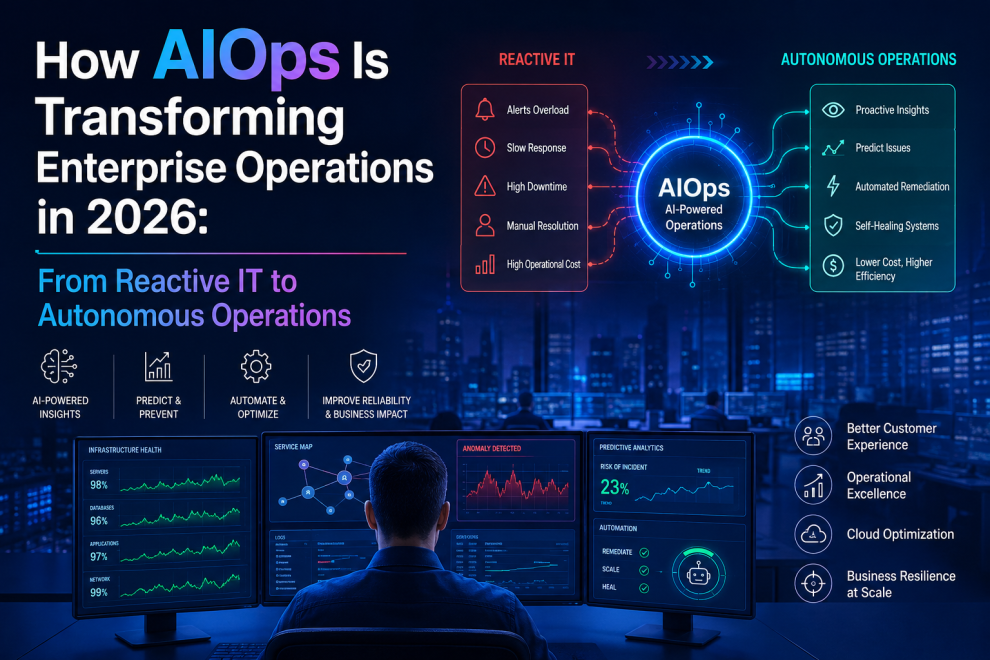
Rather than reacting to incidents after customers experience disruptions, organizations are using artificial intelligence to predict failures, automate operational decisions, identify root causes, and gradually build autonomous infrastructure capable of resolving routine issues without human intervention.
For engineering executives, AIOps is no longer simply another monitoring tool. It is becoming a strategic capability that influences operational resilience, customer satisfaction, engineering productivity, and business continuity.
Why Traditional Enterprise Operations Are Reaching Their Limits
Enterprise operations have always been about maintaining stability while supporting business growth.
The difference today is scale.
A customer purchasing a product through a mobile application may trigger authentication services, recommendation engines, inventory systems, payment gateways, fraud detection models, shipping APIs, customer analytics platforms, and dozens of backend services before the transaction is complete.
Each interaction produces operational telemetry.
Every deployment introduces new variables.
Every infrastructure change creates additional dependencies.
While modern observability platforms successfully collect this information, they rarely explain what it means.
When an incident occurs, operations teams often receive hundreds or even thousands of alerts within minutes. Many alerts describe symptoms rather than the actual problem. Engineers spend valuable time investigating infrastructure components that appear unhealthy, only to discover the root cause exists somewhere entirely different.
The challenge is no longer collecting operational data.
The challenge is interpreting it quickly enough to prevent customer impact.
This shift has fundamentally changed how enterprise leaders think about IT operations.
Understanding AIOps Beyond the Buzzword
Artificial Intelligence for IT Operations, commonly known as AIOps, combines machine learning, advanced analytics, automation, and operational data to improve the way enterprise infrastructure is monitored and managed.
Unlike traditional monitoring systems that operate primarily through predefined thresholds, AIOps platforms continuously learn how enterprise environments behave under normal operating conditions.
They recognize relationships between infrastructure components, applications, cloud services, deployments, and user behavior.
More importantly, they identify anomalies that humans might never notice.
Imagine an online banking platform experiencing slightly increased database latency.
Traditional monitoring may simply report higher response times once predefined thresholds are exceeded.
An AIOps platform approaches the problem differently.
It correlates infrastructure metrics with deployment history, application traces, network traffic, cloud resource utilization, historical incidents, and customer behavior. Within seconds, it can determine whether the latency is likely caused by a recent software deployment, unusual customer activity, infrastructure misconfiguration, or resource exhaustion.
Instead of presenting operations teams with hundreds of disconnected alerts, AIOps delivers contextual intelligence.
That distinction represents one of the biggest operational shifts in modern enterprise technology.
Why Enterprises Are Investing in AIOps
The business case for AIOps extends well beyond IT.
Downtime has become significantly more expensive.
According to various industry studies, large enterprises can lose hundreds of thousands—or even millions—of dollars for every hour that mission-critical systems remain unavailable. Financial losses are only part of the equation.
Poor operational performance also affects customer trust, employee productivity, regulatory compliance, and brand reputation.
For organizations competing primarily through digital experiences, operational reliability has become a business differentiator.
Executives increasingly recognize that reducing incident resolution times by even a small percentage can create measurable financial value.
Similarly, optimizing cloud infrastructure through intelligent automation can reduce unnecessary operational expenses while improving application performance.
These outcomes explain why AIOps is now being discussed not only by infrastructure teams but also by CIOs, CTOs, Chief Digital Officers, and executive leadership.
From Monitoring to Operational Intelligence
Traditional monitoring answers one question.
What happened?
Observability expands that conversation.
Why did it happen?
AIOps introduces an entirely new perspective.
What is likely to happen next, and what should we do about it?
This predictive capability changes the role of enterprise operations.
Instead of functioning primarily as incident responders, operations teams begin acting as strategic decision-makers supported by continuous AI-driven analysis.
Machine learning models continuously evaluate operational patterns across infrastructure, applications, databases, cloud services, and network environments.
Small deviations that would normally go unnoticed become early warning indicators.
A gradual increase in memory consumption combined with slower database queries and increased API latency may indicate an application memory leak several hours before customers experience failures.
This allows engineering teams to intervene proactively instead of reacting during production incidents.
For organizations operating globally across multiple regions and time zones, that proactive capability represents a significant competitive advantage.
Intelligent Event Correlation Reduces Operational Noise
Alert fatigue has become one of the most persistent challenges in enterprise operations.
Large organizations frequently receive thousands of alerts every day.
Many describe identical symptoms.
Others represent secondary effects rather than primary failures.
Without intelligent correlation, operations teams investigate individual alerts independently, often duplicating effort while valuable time is lost.
AIOps dramatically improves this process.
Instead of treating every event separately, machine learning algorithms analyze relationships between alerts, infrastructure dependencies, deployment activities, application performance, and historical incident patterns.
Multiple notifications generated from the same infrastructure failure are automatically grouped into a single operational event.
Engineers receive a unified incident view rather than dozens of disconnected alerts.
The impact extends beyond operational efficiency.
Fewer false positives mean engineers spend less time responding to unnecessary incidents and more time improving platform reliability.
Predictive Incident Detection Changes the Economics of Downtime
One of the defining characteristics of mature AIOps platforms is predictive analytics.
Traditional monitoring systems detect failures after predefined thresholds have already been exceeded.
By that stage, customers are often experiencing degraded performance.
AIOps identifies emerging operational risks much earlier.
By continuously comparing real-time telemetry with historical operational behavior, AI models recognize subtle changes that frequently precede larger incidents.
These changes may include unusual traffic patterns, increasing response times, infrastructure resource anomalies, unexpected deployment behavior, or application dependency failures.
Instead of waiting until systems fail, engineering teams receive actionable insights while there is still time to prevent disruption.
For industries such as financial services, healthcare, retail, logistics, and telecommunications, where uninterrupted availability directly affects revenue and customer trust, predictive operations have become increasingly valuable.
Automated Root Cause Analysis
Finding the source of an enterprise incident often requires significantly more effort than resolving it.
Modern applications rarely fail because of a single isolated component.
Failures typically propagate across interconnected services.
A customer-facing application may appear unhealthy because of a slow database query.
The database slowdown may result from excessive infrastructure utilization.
That infrastructure issue may originate from a deployment introduced several hours earlier.
Tracing these relationships manually consumes valuable engineering time.
AIOps accelerates investigation by automatically building dependency maps across applications, infrastructure, cloud resources, deployment events, and operational telemetry.
Instead of asking engineers to search through dashboards, AI highlights the most probable root cause along with supporting evidence.
Incident investigations that previously required hours can often be reduced to minutes.
That acceleration improves operational efficiency while allowing engineering organizations to restore business services more quickly.
Frequently Asked Questions (FAQs)
1. What is AIOps, and how does it work?
AIOps (Artificial Intelligence for IT Operations) uses AI, machine learning, and advanced analytics to process operational data from logs, metrics, events, and traces. It helps enterprises detect anomalies, correlate events, identify root causes, and automate incident response, enabling faster and more reliable IT operations.
2. How is AIOps different from traditional IT monitoring?
Traditional monitoring alerts teams after predefined thresholds are crossed, often generating large volumes of disconnected alerts. AIOps goes further by analyzing patterns across multiple systems, predicting incidents before they occur, reducing alert noise, and providing contextual insights that accelerate troubleshooting.
3. What are the key benefits of implementing AIOps?
Organizations adopting AIOps can reduce mean time to detect (MTTD) and mean time to resolve (MTTR), improve system reliability, minimize downtime, optimize cloud infrastructure costs, automate repetitive operational tasks, and enhance overall customer experience through proactive incident management.
4. Which industries benefit the most from AIOps?
AIOps is valuable across industries with complex digital infrastructure, including financial services, healthcare, retail, telecommunications, manufacturing, logistics, and SaaS. Any enterprise managing distributed applications, cloud-native environments, or mission-critical systems can benefit from intelligent IT operations.
5. Can AIOps replace DevOps or Site Reliability Engineering (SRE) teams?
No. AIOps is designed to augment DevOps and SRE teams, not replace them. It automates repetitive operational tasks, provides intelligent recommendations, and speeds up incident resolution, allowing engineers to focus on architecture, innovation, reliability, and continuous improvement.
6. What role does AIOps play in cloud-native environments?
Cloud-native environments generate massive volumes of operational data across containers, Kubernetes clusters, microservices, and multi-cloud platforms. AIOps helps manage this complexity by correlating telemetry, identifying anomalies, automating remediation, and improving observability across distributed systems.
7. What challenges should enterprises consider before adopting AIOps?
Successful AIOps implementation requires high-quality operational data, strong observability practices, well-defined governance, and integration across monitoring tools. Organizations should also establish clear automation policies and ensure engineering teams trust AI-assisted recommendations before enabling autonomous actions.
8. What is the future of AIOps?
The future of AIOps lies in autonomous operations, where AI continuously monitors infrastructure, predicts failures, performs root cause analysis, and automatically resolves routine incidents with minimal human intervention. As AI capabilities mature, AIOps is expected to become a core component of enterprise platform engineering and digital transformation strategies.
For more, visit our homepage !


Add Comment