








Kubernetes has become the standard for orchestrating modern applications, but the conversation has shifted. Most enterprise engineering leaders are no longer asking whether they should adopt Kubernetes. They’re asking how they should operate it.
For organizations running hundreds of microservices, supporting multiple product teams, and delivering software across regions, the decision often comes down to two paths: adopting Amazon Elastic Kubernetes Service (Amazon EKS) or managing Kubernetes entirely on their own.
At first glance, self-managed Kubernetes appears to offer maximum flexibility and complete control. Amazon EKS, on the other hand, promises a managed control plane and tighter integration with the AWS ecosystem. However, the real decision is less about features and more about operational complexity, engineering capacity, governance, and long-term scalability.
For engineering executives responsible for platform reliability and developer productivity, choosing the wrong operating model can create years of technical debt.
Why This Decision Matters More Than Ever
Enterprise platforms have become significantly more complex over the past few years.
Applications now rely on AI services, event-driven architectures, distributed APIs, edge deployments, and increasingly stringent security requirements. Kubernetes remains the foundation for many of these systems, but operating Kubernetes at enterprise scale requires much more than deploying clusters.
Platform teams are expected to deliver:
- High availability across regions
- Consistent deployment pipelines
- Enterprise security controls
- Infrastructure automation
- Cost optimization
- Compliance readiness
- Developer self-service
The operational model you choose directly impacts how effectively your engineering organization can deliver these capabilities.
Understanding Amazon EKS
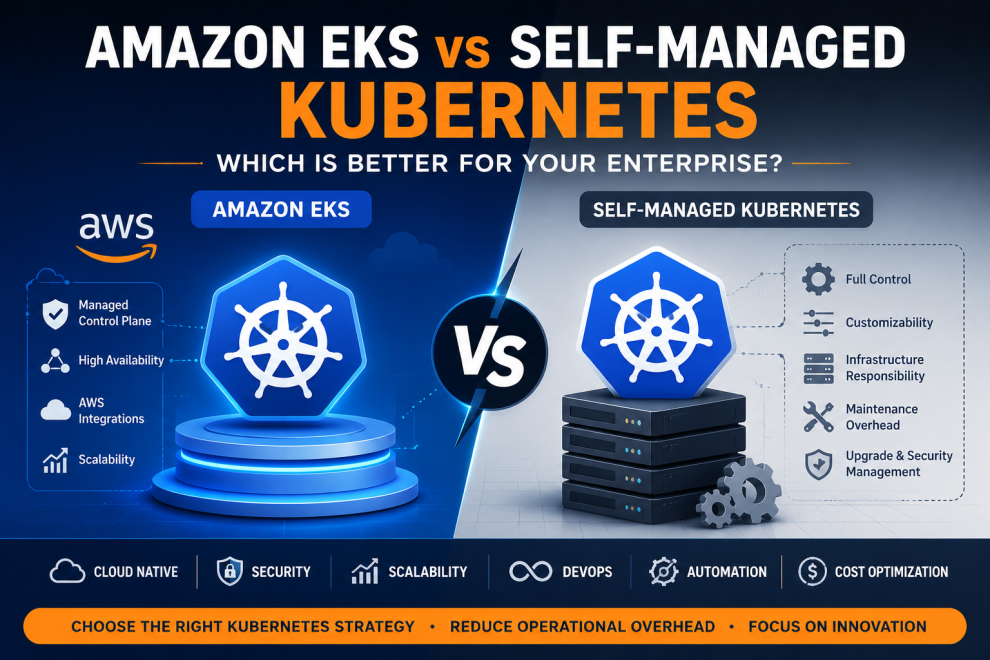
Amazon EKS is AWS’s managed Kubernetes service. AWS operates the Kubernetes control plane while engineering teams retain responsibility for worker nodes, applications, networking, storage, and security policies.
This division of responsibilities significantly reduces operational burden without sacrificing compatibility with upstream Kubernetes.
For organizations already invested in AWS, EKS integrates naturally with services such as IAM, CloudWatch, Application Load Balancer, Auto Scaling, EBS, EFS, and AWS networking capabilities.
Rather than spending engineering effort maintaining control plane availability, teams can focus on improving developer experience and accelerating application delivery.
What Self-Managed Kubernetes Really Means
Running Kubernetes yourself provides maximum flexibility.
Engineering teams choose their infrastructure, configure the control plane, perform upgrades, manage etcd backups, handle certificate rotation, maintain networking components, secure every layer of the platform, and troubleshoot infrastructure failures.
This approach is common among organizations with unique compliance requirements, specialized networking architectures, or hybrid and multi-cloud strategies.
However, full control also means full operational responsibility.
Every Kubernetes version upgrade becomes your responsibility.
Every security vulnerability becomes your responsibility.
Every failed control plane component becomes your responsibility.
The question is whether those responsibilities create competitive advantage or simply consume valuable engineering capacity.
Comparing the Two Approaches
Operational Overhead
This is where the largest difference appears.
Self-managed Kubernetes requires dedicated platform engineers to maintain cluster health, manage upgrades, replace failed components, and continuously optimize infrastructure.
Amazon EKS removes much of this burden by operating the Kubernetes control plane as a managed service.
For enterprises operating dozens or hundreds of clusters, reducing operational overhead often translates directly into improved engineering productivity.
Security and Governance
Security is frequently cited as a reason to self-manage Kubernetes.
In practice, both models can achieve enterprise-grade security.
The difference lies in where operational responsibility resides.
With Amazon EKS, AWS manages the security of the control plane while customers remain responsible for workloads, IAM permissions, networking, and runtime protection.
Self-managed Kubernetes requires engineering teams to secure every layer themselves, including API servers, etcd, certificates, admission controllers, and infrastructure components.
Organizations with mature security operations can certainly manage these responsibilities effectively, but doing so requires significant expertise.
Upgrades and Maintenance
Kubernetes evolves rapidly.
Major releases introduce new APIs, deprecate existing functionality, and require careful planning.
Self-managed clusters require engineering teams to plan, test, validate, and execute every upgrade.
Amazon EKS simplifies much of this process by providing managed control plane upgrades and compatibility guidance.
This becomes increasingly valuable as the number of clusters grows across environments and business units.
Scalability
Both approaches scale effectively.
The difference lies in operational efficiency.
Amazon EKS benefits from AWS-native integrations for node provisioning, managed networking, load balancing, and storage services.
Self-managed Kubernetes offers greater architectural flexibility but often requires additional engineering investment to achieve the same operational maturity.
For organizations experiencing rapid growth, reducing operational friction often becomes more valuable than maximizing infrastructure customization.
Cost Beyond Infrastructure
Infrastructure pricing rarely tells the whole story.
Many organizations compare only compute costs while overlooking engineering costs.
Running self-managed Kubernetes requires highly skilled platform engineers responsible for upgrades, monitoring, incident response, disaster recovery planning, security maintenance, and infrastructure automation.
These hidden operational costs frequently exceed infrastructure savings.
Amazon EKS introduces service fees but often reduces overall platform costs by allowing engineering teams to focus on delivering customer-facing capabilities instead of maintaining infrastructure.
For enterprise leaders, total cost of ownership should include both cloud spend and engineering effort.
Developer Experience
One of the strongest arguments for managed Kubernetes is developer productivity.
Platform engineering has shifted focus toward enabling developers through standardized deployment workflows, self-service infrastructure, reusable templates, and automated guardrails.
Amazon EKS integrates well with modern platform engineering practices because operational consistency becomes easier to achieve across environments.
Developers spend less time troubleshooting infrastructure differences and more time building products.
When Self-Managed Kubernetes Makes Sense
Despite the advantages of Amazon EKS, self-managed Kubernetes remains the right choice in certain scenarios.
Organizations with strict regulatory requirements, specialized networking constraints, sovereign cloud mandates, or large hybrid deployments may require capabilities that extend beyond managed Kubernetes offerings.
Companies building highly customized Kubernetes platforms may also benefit from maintaining complete infrastructure control.
However, these situations represent a relatively small percentage of enterprise deployments.
When Amazon EKS Is the Better Choice
For most enterprises operating primarily on AWS, Amazon EKS provides a stronger balance between operational simplicity and platform flexibility.
It enables engineering organizations to:
- Reduce infrastructure maintenance
- Improve platform reliability
- Standardize deployments
- Accelerate application delivery
- Strengthen security posture
- Simplify Kubernetes lifecycle management
- Scale platform operations efficiently
These advantages become increasingly important as organizations expand their cloud footprint and adopt AI-powered applications, data platforms, and distributed architectures.
Looking Beyond Technology
The Kubernetes decision is ultimately an organizational decision rather than a purely technical one.
Executive leadership should ask:
- Does operating Kubernetes create competitive differentiation?
- Are platform engineers spending time on innovation or infrastructure maintenance?
- Can managed services improve developer velocity?
- Is engineering capacity being invested where it generates business value?
The answers often point toward managed platforms.
Reducing undifferentiated operational work allows engineering organizations to focus on customer experiences, digital transformation initiatives, and product innovation.
Final Thoughts
Amazon EKS and self-managed Kubernetes are both mature, production-ready solutions. The right choice depends less on Kubernetes itself and more on your organization’s operational priorities.
For most large enterprises running workloads on AWS, Amazon EKS offers the best balance of scalability, security, operational efficiency, and long-term maintainability. Self-managed Kubernetes remains valuable for organizations with highly specialized infrastructure requirements, but it also demands a significant investment in platform expertise.
Many enterprise engineering teams partner with experienced cloud and platform engineering firms to evaluate these trade-offs before committing to a long-term Kubernetes strategy. Teams such as GeekyAnts, with experience in cloud-native architecture, DevOps modernization, and enterprise platform engineering, often help organizations assess existing infrastructure, design scalable Kubernetes platforms, and implement production-ready deployment practices that align with business goals rather than infrastructure complexity.
The most successful platform strategies are not defined by how much infrastructure an organization manages itself. They are defined by how effectively engineering teams can deliver secure, reliable, and scalable digital products while enabling developers to innovate faster.
Frequently Asked Questions (FAQs)
1. What is the difference between Amazon EKS and self-managed Kubernetes?
Amazon EKS is a managed Kubernetes service where AWS handles the control plane, while self-managed Kubernetes requires your team to deploy, maintain, and upgrade the entire Kubernetes infrastructure.
2. Is Amazon EKS better than self-managed Kubernetes?
For most organizations already running workloads on AWS, Amazon EKS is the better choice because it reduces operational overhead, simplifies upgrades, and integrates with AWS services. Self-managed Kubernetes is better suited for organizations that need complete control or have specialized infrastructure requirements.
3. Is Amazon EKS more cost-effective than self-managed Kubernetes?
While Amazon EKS includes a management fee, it can reduce the total cost of ownership by minimizing infrastructure maintenance, upgrades, and operational effort. Self-managed Kubernetes may have lower infrastructure costs but often requires larger platform engineering teams.
4. When should an enterprise choose self-managed Kubernetes?
Self-managed Kubernetes is ideal for enterprises with strict compliance requirements, hybrid or multi-cloud strategies, highly customized networking, or workloads that require complete control over the Kubernetes control plane.
5. Does Amazon EKS support enterprise-scale applications?
Yes. Amazon EKS is designed to run production workloads at scale and supports high availability, auto scaling, security integrations, and multi-region deployments for enterprise applications.
6. Which is easier to maintain: Amazon EKS or self-managed Kubernetes?
Amazon EKS is significantly easier to maintain because AWS manages the Kubernetes control plane, version updates, and high availability, allowing engineering teams to focus on application development instead of infrastructure management.
7. Can I migrate from self-managed Kubernetes to Amazon EKS?
Yes. Many organizations migrate from self-managed Kubernetes to Amazon EKS to reduce operational complexity. The migration typically involves moving workloads, networking configurations, storage, and CI/CD pipelines while minimizing downtime.
8. Is Amazon EKS suitable for DevOps and Platform Engineering teams?
Absolutely. Amazon EKS integrates well with modern DevOps and Platform Engineering practices by supporting Infrastructure as Code, GitOps, automated CI/CD pipelines, observability, and self-service developer platforms.
For more, visit our homepage!



Add Comment