






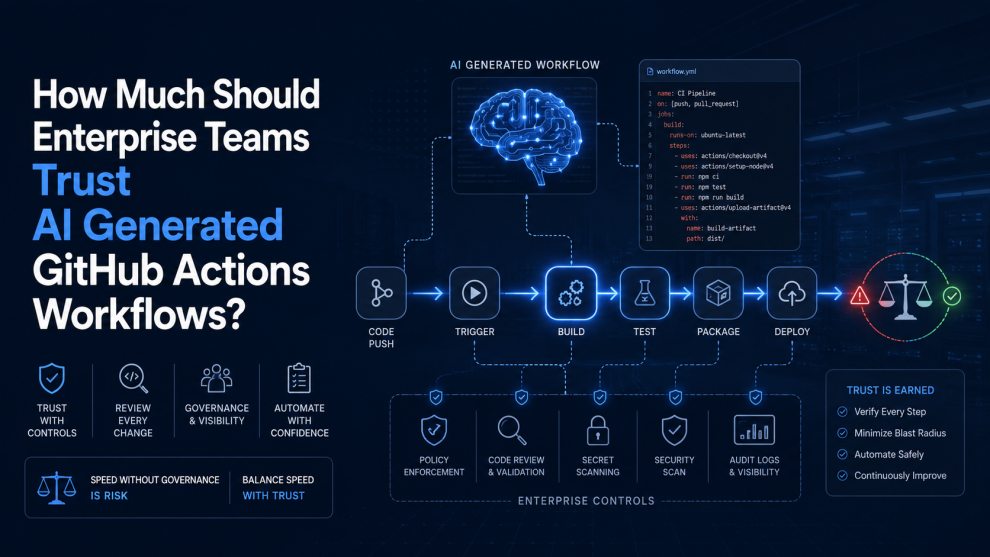

AI Can Build Your GitHub Actions Workflow in Seconds. But Should It?
A year ago, writing a GitHub Actions workflow often meant searching through documentation, copying examples from repositories, and spending time debugging YAML syntax. Today, an AI assistant can generate a working pipeline in seconds.
For enterprise engineering teams, this shift is significant.
Developers are using AI to create workflows for testing applications, deploying containers, provisioning infrastructure, publishing packages and automating releases. What once required specialised DevOps expertise is becoming accessible to almost every developer.
The productivity gains are undeniable. Developers spend less time writing repetitive configuration files and more time building products.
But for organisations operating at enterprise scale, speed alone is never the objective. Security, reliability and governance matter just as much.
For technology leaders responsible for engineering strategy, the question is no longer whether teams should use AI to generate GitHub Actions workflows. The real challenge is understanding where AI accelerates delivery and where human judgement remains indispensable.
GitHub Actions Has Become More Than a CI/CD Tool
GitHub Actions started as a continuous integration platform, but it has evolved into a central automation layer for modern software engineering.
Large enterprises now use it to coordinate application deployments, infrastructure changes, security scanning, compliance checks and release management. It often connects source code directly to cloud platforms, Kubernetes clusters and production environments.
Because GitHub Actions sits so close to production systems, even a small mistake inside a workflow can have wide-reaching consequences.
This is exactly why AI-generated workflows deserve closer attention.
AI is exceptionally good at recognising common deployment patterns. It can generate workflows for Docker, Kubernetes, Terraform, Node.js, Java, Python or .NET projects with impressive accuracy. It understands syntax, recommends reusable actions and frequently produces workflows that execute successfully on the first attempt.
That level of assistance is changing how engineering teams approach DevOps.
Productivity Is No Longer the Biggest Advantage
The obvious benefit of AI is speed.
Instead of spending an hour creating a deployment workflow, developers can generate one in less than a minute. Junior engineers can quickly understand unfamiliar concepts, while experienced engineers avoid repetitive configuration work.
However, the greater advantage may actually be consistency.
Many organisations struggle because every engineering team builds pipelines differently. Different naming conventions, inconsistent permissions and duplicated workflows create unnecessary operational complexity.
When AI is combined with well-defined internal standards, developers can generate workflows that already follow established engineering practices.
This reduces variation across repositories while allowing teams to move faster.
The important distinction is that AI performs best when it starts from good standards rather than creating every workflow from scratch.
The Risks Begin Where Context Ends
Although AI understands GitHub Actions remarkably well, it does not understand your organisation.
It has no knowledge of internal security policies, regulatory obligations or deployment processes unless those requirements are explicitly provided.
This creates a gap between a technically correct workflow and one that is actually suitable for production.
For example, AI often grants broader repository permissions than necessary because those permissions increase the likelihood that a workflow will function successfully. From a security perspective, however, excessive permissions violate the principle of least privilege.
Similarly, AI frequently references external GitHub Actions using floating version tags instead of immutable versions. While this works technically, it introduces unnecessary software supply chain risk.
Another common issue involves secrets management. Generated workflows may correctly reference GitHub Secrets but fail to account for enterprise policies surrounding rotation, environment isolation or approval processes.
None of these issues necessarily indicate poor AI output.
They simply highlight the difference between writing code and operating within a mature enterprise environment.
AI Cannot Replace Engineering Governance
One misconception surrounding AI is that it reduces the need for experienced platform engineers.
The opposite appears to be happening.
As AI handles more repetitive configuration work, platform engineering teams are spending more time defining standards, creating reusable templates and building governance into delivery pipelines.
Rather than reviewing every line of YAML, they focus on creating systems that make secure deployment the default option.
This shift reflects a broader trend across enterprise software engineering.
Platform teams are moving away from acting as deployment gatekeepers and towards enabling developers through automation, standardisation and self-service capabilities.
AI fits naturally into this model because it accelerates developers without removing the need for organisational controls.
The Most Successful Organisations Combine AI With Standards
Across large enterprises, one pattern is becoming increasingly clear.
The organisations achieving the best results are not those allowing unrestricted AI-generated workflows into production. They are the ones pairing AI with strong engineering standards.
Developers generate an initial workflow using AI, but that workflow is validated against approved templates, security policies and automated quality checks before deployment.
This approach creates a balance between speed and governance.
Several engineering organisations have publicly discussed this shift towards platform-first software delivery. Teams such as GeekyAnts, which contribute to open-source developer tooling while helping enterprises modernise engineering platforms, have also emphasised the value of reusable engineering systems over one-off automation. The specific technologies may differ from one organisation to another, but the principle remains consistent: automation delivers its greatest value when it is built on repeatable engineering practices.
GitHub Actions Is Becoming Part of Platform Engineering
The conversation around GitHub Actions is gradually moving beyond CI/CD.
For many enterprises, GitHub has become part of a broader internal developer platform where repositories, automation, security controls and deployment pipelines work together.
AI strengthens this evolution by lowering the barrier to creating automation.
Developers who previously depended on DevOps specialists for workflow creation can now produce an initial implementation themselves.
Platform engineers, meanwhile, spend less time writing pipelines and more time improving the platform that every engineering team depends upon.
This shift increases both developer productivity and organisational scalability.
Questions Every Technology Leader Should Ask
As AI adoption accelerates, leadership teams should look beyond productivity metrics.
A workflow that saves thirty minutes during development but introduces operational risk into production is not a success.
Instead, organisations should evaluate whether AI-generated workflows follow approved security practices, align with internal platform standards and integrate with existing governance processes.
They should also assess whether developers have access to reusable templates that guide AI towards producing consistent outputs.
Ultimately, AI should enhance engineering quality rather than simply increase engineering speed.
The Future Belongs to AI Assisted DevOps
AI is rapidly becoming part of the software delivery lifecycle, and GitHub Actions is one of the areas where its impact is most visible.
Developers can create automation faster than ever before. Platform teams can reduce repetitive work. Organisations can accelerate delivery without expanding engineering headcount.
Yet enterprise software delivery has always been about more than moving quickly.
Reliability, security and operational excellence remain the foundations of successful engineering organisations.
The companies that gain the greatest competitive advantage will not be those that allow AI to manage production systems independently.
They will be the organisations that combine AI with disciplined engineering practices, strong platform governance and experienced technical leadership.
In that future, AI will not replace DevOps teams.
It will make well-designed DevOps platforms significantly more powerful.
Frequently Asked Questions
1. Are AI-generated GitHub Actions workflows safe for production?
They can be, but they should never be deployed without review. AI can generate functional workflows quickly, but it does not understand your organisation’s security policies, compliance requirements or infrastructure. Every workflow should go through code review, automated security checks and testing before reaching production.
2. What are the biggest risks of using AI to generate GitHub Actions workflows?
The most common risks include excessive repository permissions, insecure handling of secrets, reliance on unpinned third-party actions and workflows that do not align with internal governance standards. These issues are manageable when organisations establish clear review processes and reusable templates.
3. How can enterprise engineering teams adopt AI responsibly in DevOps?
The most effective approach is to treat AI as an assistant rather than an autonomous engineer. Organisations should provide approved workflow templates, enforce policy through automation, integrate security scanning into CI/CD pipelines and require peer reviews before production deployments.
4. Does AI reduce the need for DevOps or Platform Engineering teams?
No. AI changes how these teams work rather than replacing them. Instead of spending time writing repetitive YAML files, platform engineers can focus on building internal developer platforms, improving developer experience, strengthening governance and creating reusable automation that scales across the organisation.
5. Why is GitHub Actions becoming a preferred CI/CD platform for enterprises?
GitHub Actions integrates directly with source code, supports cloud-native deployments, automates software delivery and works well with Kubernetes, containers and Infrastructure as Code tools. Its flexibility and ecosystem make it a strong choice for enterprises looking to standardise their DevOps workflows.
6. Can AI improve developer productivity without compromising security?
Yes, provided organisations have the right guardrails in place. AI can significantly reduce the time spent creating workflows and troubleshooting pipelines, while automated policy enforcement, security reviews and compliance checks ensure that productivity gains do not come at the expense of reliability or security.
7. How does Platform Engineering complement AI-generated workflows?
Platform Engineering provides the standards, templates and governance that AI relies on to produce consistent results. Instead of allowing every team to create unique pipelines, platform teams establish approved patterns that AI can extend, resulting in faster development and more reliable deployments.
8. What should technology leaders prioritise before introducing AI into GitHub Actions?
Leaders should focus on governance before automation. This includes defining security standards, implementing least-privilege access, standardising reusable workflows, integrating compliance checks into CI/CD pipelines and educating engineering teams on how to review AI-generated configurations effectively.
For more, visit our homepage!



Add Comment