






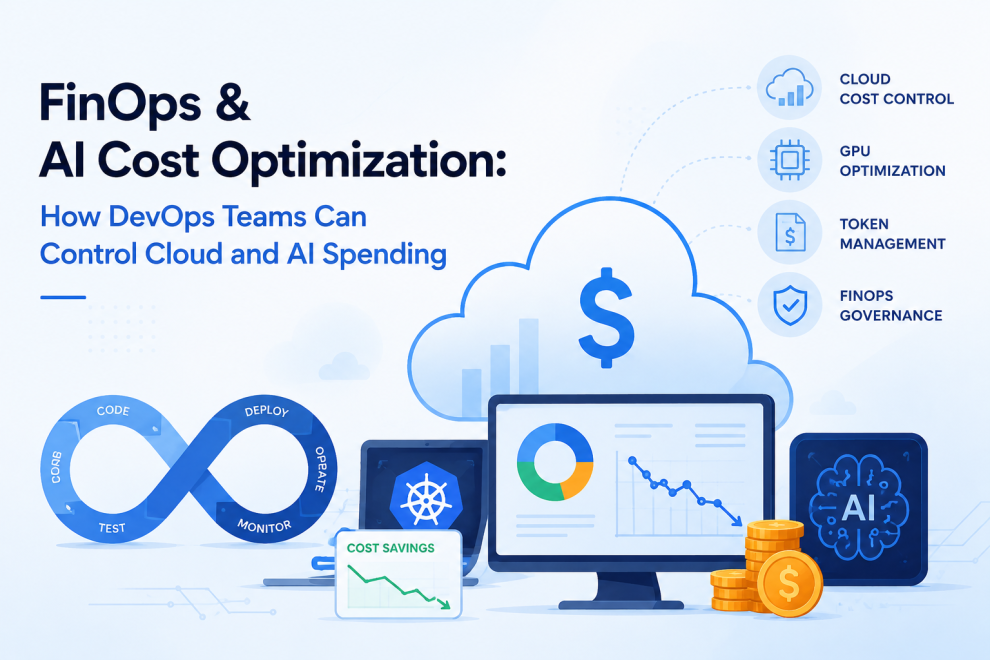

AI has changed the economics of cloud infrastructure.
For years, DevOps teams focused on availability, scalability, deployment speed, and infrastructure efficiency. Now they are increasingly responsible for another critical metric: how much every workload actually costs to run.
The rise of generative AI has made this problem significantly harder. GPU-intensive workloads, large language models, high-volume inference, vector databases, data pipelines, and AI-powered applications can create unpredictable infrastructure bills.
A system can be technically efficient while still being financially inefficient.
This is where FinOps and AI cost optimization are becoming important areas for DevOps and platform engineering teams.
The goal is not simply to reduce cloud spending. It is to understand where infrastructure and AI resources are being consumed, connect costs to workloads and teams, and establish controls that allow organizations to scale AI without losing financial visibility.
Why FinOps Is Becoming a DevOps Concern
Cloud infrastructure made it possible for engineering teams to provision resources quickly.
Containers can be deployed in minutes. Kubernetes clusters can scale automatically. Cloud GPUs can be provisioned when demand increases. AI APIs can be integrated without maintaining model infrastructure internally.
The same flexibility can create unexpected costs.
A Kubernetes workload may continuously consume resources that are not being used efficiently. An AI application may send unnecessarily large prompts to an expensive model. A GPU instance may remain active even when utilization is low.
Without proper visibility, these costs can remain hidden inside large monthly cloud invoices.
FinOps brings financial accountability into the engineering lifecycle by connecting infrastructure decisions with their economic impact.
For DevOps teams, this means cost needs to become another operational metric alongside CPU utilization, latency, availability, and deployment frequency.
AI Has Introduced New Cost Variables
Traditional cloud optimization often focuses on resources such as compute, storage, networking, and databases.
AI introduces additional variables.
Large language model applications can generate costs based on tokens, requests, context length, model selection, and inference frequency.
GPU-based workloads introduce another layer of complexity because accelerators are significantly more expensive than conventional compute resources.
A seemingly small architectural decision can therefore have a major impact at scale.
For example, an AI application that sends a large context window with every request may work perfectly during testing. Once thousands of users interact with it, the accumulated token consumption can become substantial.
This is why AI cost optimization needs to happen at the application and infrastructure levels simultaneously.
The First Step Is Cost Visibility
Teams cannot optimize what they cannot measure.
A useful FinOps strategy begins with understanding where cloud and AI resources are being consumed.
DevOps teams should be able to answer questions such as:
Which applications are generating the highest infrastructure costs?
Which Kubernetes workloads consume the most resources?
Which teams or environments are responsible for the largest spend?
How much does an individual AI workflow cost?
Which models are being used most frequently?
How much GPU capacity is actually being utilized?
Are development and testing environments running expensive resources unnecessarily?
Without this level of visibility, cost optimization often becomes a guessing exercise.
Kubernetes Cost Allocation Matters
Kubernetes makes infrastructure highly dynamic, which can make cost attribution difficult.
A single cluster may support multiple teams, applications, namespaces, environments, and workloads. The cloud provider invoice may show the cost of the underlying infrastructure, but that does not automatically explain which workloads caused the spend.
Tools such as OpenCost can help Kubernetes teams understand and allocate infrastructure costs across workloads.
This gives platform teams a better view of resource consumption and helps connect Kubernetes usage with organizational ownership.
For example, instead of simply seeing that a Kubernetes cluster costs a certain amount each month, teams can analyze how that cost is distributed across namespaces, deployments, workloads, and teams.
That information can make optimization decisions much more actionable.
AI Requires Application-Level Cost Tracking
Infrastructure-level monitoring is not enough for AI applications.
A DevOps team might know how much a service costs to run but still have limited visibility into the cost of individual AI operations.
Consider an AI customer support application.
The total infrastructure cost may include:
- Model inference
- API requests
- Token consumption
- GPU compute
- Vector database queries
- Storage
- Data processing
- Observability
- Network traffic
Understanding these components makes it possible to calculate the cost of individual workflows.
Teams can then ask a more useful question:
How much does it cost to resolve one customer request using this AI workflow?
That metric can be more valuable than looking at the monthly cloud bill alone.
Optimizing GPU Utilization
GPU infrastructure can become one of the largest expenses in AI workloads.
The problem is not always the price of the GPU itself. It is often underutilization.
A GPU running at low utilization still incurs infrastructure costs.
DevOps and platform teams can improve efficiency by analyzing workload patterns, scheduling jobs more effectively, selecting appropriate instance types, and scaling resources according to actual demand.
Batch workloads may have different requirements from real-time inference.
Development environments may not require the same GPU capacity as production.
Model training and inference should also be evaluated separately because their utilization patterns can be very different.
The objective is to match GPU capacity with actual workload requirements rather than simply provisioning the largest available resources.
Controlling LLM Token Costs
AI cost optimization also requires attention to application architecture.
Token consumption can increase rapidly when applications send unnecessarily large prompts or repeatedly include the same context.
Teams can optimize this by controlling context size, improving retrieval strategies, selecting appropriate models, caching repeated responses where appropriate, and routing workloads according to complexity.
Not every request needs the most expensive model.
A simple classification or summarization task may be handled by a smaller model, while a complex reasoning workflow may justify a more capable model.
This creates an opportunity for model routing based on workload requirements.
The result can be a more balanced architecture where cost and performance are considered together.
Governance Needs to Be Built Into AI Platforms
Cost controls are more effective when they are automated.
Instead of waiting until the end of the month to discover unexpected spending, organizations can introduce policies that monitor and control resource usage.
Examples include budget thresholds, usage alerts, GPU limits, model-specific spending limits, environment restrictions, and automated shutdown policies for non-production resources.
Organizations can also establish policies around which models different applications are allowed to use.
For example, a low-risk internal workflow might be restricted to lower-cost models, while a customer-facing application can use a more capable model when the additional performance justifies the expense.
This turns cost management from a reactive financial exercise into an engineering control.
FinOps and DevOps Need to Work Together
FinOps cannot operate independently from engineering.
Finance teams can identify overall spending, but DevOps and platform teams understand why resources are being consumed.
Similarly, engineers can optimize infrastructure, but without financial visibility they may not know which optimizations have the greatest organizational impact.
A mature FinOps strategy therefore creates collaboration between engineering, finance, product, and leadership.
For DevOps teams, this can mean introducing cost information directly into engineering workflows.
Cost can become part of infrastructure reviews, architecture decisions, deployment processes, and performance dashboards.
The earlier cost enters the development lifecycle, the easier it is to control.
Cost Optimization Should Not Mean Cutting Everything
Aggressive cost reduction can create another problem.
Reducing infrastructure spending without considering performance can result in slower applications, poor user experiences, or unreliable workloads.
The objective should therefore be cost efficiency rather than cost reduction at any cost.
A cheaper infrastructure configuration is not necessarily better if it increases latency or causes service failures.
Similarly, using a cheaper AI model may reduce token spending but produce lower-quality results that require additional processing or human intervention.
The right question is:
What is the lowest sustainable cost for the required level of performance, reliability, and AI quality?
Building a FinOps-Aware DevOps Pipeline
FinOps becomes significantly more powerful when integrated into the existing DevOps lifecycle.
Infrastructure-as-code can include resource policies and cost controls.
CI/CD pipelines can flag infrastructure changes that introduce significant cost increases.
Kubernetes platforms can track workload-level spending.
Observability platforms can correlate resource usage with application performance.
AI platforms can track model usage and token consumption.
Dashboards can provide engineering leaders with a real-time view of infrastructure economics.
This creates a continuous feedback loop:
Deploy → Measure → Attribute → Optimize → Govern → Repeat
Instead of treating cloud cost as a monthly report, organizations can make it part of everyday engineering operations.
Where AI Cost Optimization Is Heading
The next phase of FinOps is likely to become increasingly automated.
AI platforms can analyze usage patterns, identify inefficient workloads, recommend infrastructure changes, and detect unusual spending.
DevOps teams can combine these capabilities with policy engines and infrastructure automation to create systems that respond to cost anomalies automatically.
For example, an organization could detect an unexpected increase in GPU usage, identify the workload responsible, determine whether the increase is legitimate, and trigger an appropriate policy or alert.
This moves FinOps closer to an operational discipline rather than a reporting function.
Building Cost-Aware AI Infrastructure
For organizations adopting AI at scale, cost optimization needs to be considered from the beginning rather than after infrastructure bills become a problem.
This means designing applications with model selection, token usage, retrieval strategies, GPU utilization, infrastructure scaling, observability, and governance in mind.
Engineering teams working with AI application development partners such as GeekyAnts can incorporate these considerations into the architecture itself, particularly when AI applications need to connect model usage, automation, cloud infrastructure, and production workflows.
The objective is not simply to build an AI application that works.
It is to build one that remains observable, scalable, and economically sustainable as usage grows.
The New Role of DevOps in AI Economics
AI is changing what operational excellence means.
Availability and performance still matter, but they are no longer the only metrics that engineering leaders need to monitor.
Cloud spend, GPU utilization, token consumption, model efficiency, and workload-level costs are becoming part of the operational picture.
FinOps gives DevOps teams the framework to understand those economics.
Tools such as OpenCost, Kubernetes cost allocation, cloud-native monitoring, usage policies, and AI-specific cost controls can help organizations build greater visibility into their infrastructure.
The organizations that approach AI cost optimization early will be better positioned to scale AI workloads without allowing infrastructure spending to grow unchecked.
The future of DevOps is not just about deploying faster. It is about deploying efficiently, operating intelligently, and understanding the cost of every workload that reaches production.
For more, visit our homepage!



Add Comment