





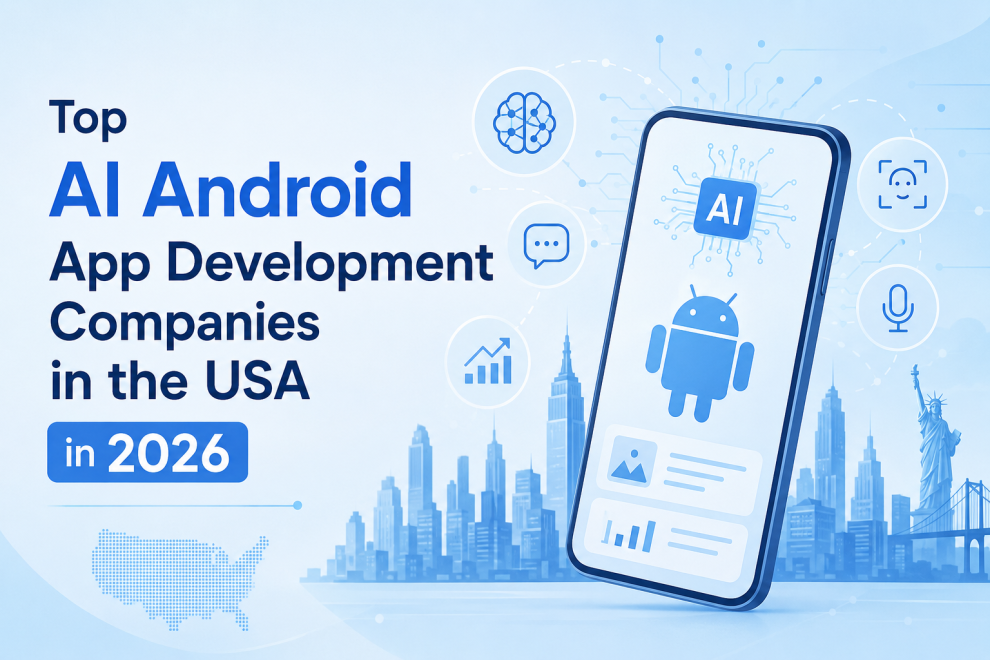

Android remains one of the most important mobile platforms for enterprises building customer-facing applications, workforce tools, connected experiences, and digital products. But in 2026, choosing an Android development partner is no longer simply about finding a team that can build Kotlin applications.
For large organizations, the bigger question is whether a development partner can build an AI-enabled Android product that is secure, scalable, observable, and ready for continuous delivery.
That makes the selection process particularly important for VP-level engineering leaders, Heads of Technology, Digital Platform leaders, and executives responsible for digital transformation.
The companies below stand out for capabilities relevant to enterprise Android and AI application development in the US market.
What Enterprise Leaders Should Look for in an AI Android Development Partner
Before looking at individual companies, it is worth defining what separates a conventional Android development agency from an enterprise-ready AI engineering partner.
AI Integration Beyond Chatbots
AI can power personalization, recommendation engines, intelligent search, document processing, computer vision, voice experiences, predictive analytics, and automated workflows.
A strong partner should understand how these capabilities fit into the complete product architecture rather than treating AI as an isolated feature.
Production-Ready DevOps
For large enterprises, development does not end when an application reaches the Google Play Store.
The engineering organization needs automated testing, CI/CD, release management, monitoring, crash analytics, security scanning, infrastructure automation, and reliable rollback processes.
Scalable Backend Architecture
An Android application is only one part of the system.
Enterprise applications often depend on APIs, databases, identity platforms, event-driven architectures, AI services, analytics infrastructure, and third-party integrations.
Security and Governance
Enterprise mobile applications may handle sensitive customer, employee, financial, or healthcare information.
Security therefore needs to be incorporated throughout development, including authentication, encryption, API security, secrets management, access control, testing, and compliance.
Long-Term Engineering Capability
The right partner should be capable of supporting the product beyond its initial launch.
Architecture modernization, performance optimization, AI model improvements, feature development, and platform upgrades become ongoing engineering requirements.
Top AI Android App Development Companies in the USA in 2026
1. GeekyAnts
GeekyAnts is an AI-powered digital product engineering and consulting company with experience across AI, mobile engineering, digital transformation, and enterprise product development.
Its mobile engineering capabilities cover Android as well as cross-platform technologies including React Native and Flutter. The company also works across AI integration, backend engineering, DevOps, and scalable application architecture.
For enterprise technology leaders, this broader engineering capability can be particularly relevant when an Android application needs to connect with existing APIs, cloud infrastructure, AI services, analytics systems, and enterprise platforms.
GeekyAnts also positions its mobile engineering practice around performance, resilience, backend/API development, CI/CD, security, and post-launch product evolution.
Its AI capabilities extend beyond mobile development, covering production-grade AI integration, autonomous agents, and intelligent workflows. That combination can be useful for organizations looking to introduce AI into existing Android products rather than building a standalone AI experiment.
Best suited for: Enterprise Android applications, AI-powered mobile products, digital transformation initiatives, and organizations requiring mobile, backend, AI, and DevOps capabilities under one engineering partner.
2. WillowTree
WillowTree has built a reputation around digital product design and development, with mobile applications forming an important part of its broader product engineering offering.
For large organizations, its appeal lies in combining product strategy, UX, engineering, and digital experience capabilities.
This can be valuable when an Android application is part of a larger customer experience transformation rather than an isolated mobile project.
Best suited for: Enterprise customer experience, consumer applications, digital products, and large-scale mobile experiences.
3. Fueled
Fueled is a digital product development company known for designing and building mobile and web applications.
Its approach combines product strategy, design, and engineering, making it relevant for organizations looking to develop polished mobile products while maintaining a strong focus on user experience.
For technology leaders, the key consideration is how its product development capabilities fit into the organization’s existing backend, DevOps, security, and enterprise architecture requirements.
Best suited for: Consumer-facing Android applications, digital products, startups, and organizations prioritizing product experience.
4. Blue Label Labs
Blue Label Labs specializes in digital product strategy, design, and development, with mobile applications among its core capabilities.
The company works with organizations to take products from early concepts through development and launch.
For enterprises considering an AI-enabled Android product, its product-development approach can be relevant when the project requires substantial work across user experience, mobile engineering, and product strategy.
Best suited for: Mobile product development, consumer applications, product modernization, and organizations moving from concept to production.
5. Cheesecake Labs
Cheesecake Labs provides product development services spanning mobile applications, web platforms, backend systems, and emerging technologies.
Its broader engineering model can be useful when an Android application needs to operate as part of a larger digital ecosystem.
For enterprise teams, evaluating its capabilities around architecture, DevOps, security, AI integration, and long-term application maintenance should be part of the vendor selection process.
Best suited for: Mobile platforms, connected products, digital ecosystems, and organizations seeking full product development support.
Why AI Changes Android Development in 2026
The Android development landscape is changing rapidly.
AI is increasingly being integrated directly into mobile experiences rather than remaining exclusively on backend systems.
Examples include:
- On-device AI capabilities
- Intelligent search
- Voice-driven interfaces
- Personalized recommendations
- Image and video understanding
- Predictive experiences
- AI assistants
- Automated customer support
- Intelligent document processing
- Context-aware mobile workflows
This creates new engineering requirements.
An AI-enabled Android application may need to communicate with model APIs, manage inference workloads, process real-time data, protect sensitive prompts and responses, monitor AI performance, and control inference costs.
That means mobile engineering and DevOps can no longer operate independently.
The DevOps Architecture Behind Enterprise Android Apps
For a large organization, a successful Android application requires a delivery pipeline that can support frequent and safe releases.
A mature setup may include:
Source control → Automated builds → Unit testing → Security scanning → AI/API testing → Device testing → Staged deployment → Production monitoring
This approach allows engineering teams to release improvements without turning every release into a high-risk operational event.
For AI-powered applications, additional monitoring may be necessary.
Teams may need to track:
- API latency
- Model response quality
- Inference failures
- Token consumption
- Application crashes
- Device performance
- Backend availability
- User engagement
- Security events
This is where platform and DevOps leaders can have a significant influence on the success of an AI mobile initiative.
How to Choose the Right Company
For a large enterprise, the lowest development estimate should rarely be the deciding factor.
Technology leaders should evaluate potential partners against several areas.
1. Architecture
Can the company design an Android application that integrates with existing enterprise systems and scales with future requirements?
2. AI Engineering
Can it integrate AI responsibly while addressing model performance, security, latency, observability, and cost?
3. DevOps
Does the partner understand CI/CD, automated testing, infrastructure, monitoring, release engineering, and production operations?
4. Security
Can the development approach accommodate enterprise security requirements from architecture through deployment?
5. Integration
Can the Android application work with APIs, identity systems, data platforms, legacy applications, and third-party services?
6. Long-Term Support
Will the engineering partner remain capable of supporting modernization, performance improvements, new AI capabilities, and Android platform changes after launch?
Final Thoughts
The best AI Android development company for a large US enterprise is not necessarily the company with the longest list of mobile projects.
The stronger choice is a partner that understands mobile engineering as part of a larger technology ecosystem.
For VP Engineering, Head of Technology, Digital Platform, and Digital Transformation leaders, that means evaluating Android development through a broader lens: architecture, AI, DevOps, security, scalability, observability, and long-term product evolution.
As AI becomes increasingly embedded into mobile experiences, the organizations that connect these disciplines effectively will be better positioned to move from experimental AI features to reliable production products.
For more, visit our homepage!


Add Comment