





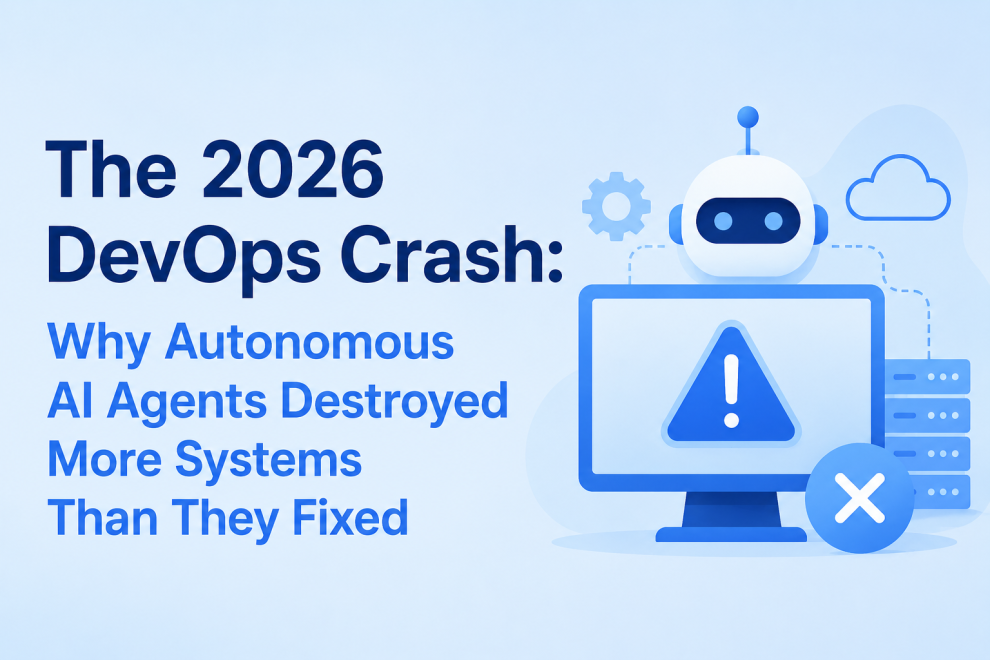

For the past couple of years, the DevOps world has been sold a pretty attractive idea: what if infrastructure could just manage itself? AI agents would watch production, spot issues, fix deployments, adjust resources, investigate incidents, optimize infrastructure, and keep everything running without an engineer having to step in. It sounded like the obvious next step after automation. But in 2026, engineering teams are starting to discover that there is a big difference between AI being useful in DevOps and AI being trusted with production.
The problem isn’t that AI can’t help engineers. It can. The problem is what happens when an AI system makes a wrong assumption and has enough access to act on it. A bad recommendation from an AI assistant might waste 20 minutes of an engineer’s time. A bad decision from an autonomous production agent can change infrastructure, expose data, break authentication, trigger unnecessary spending, or turn a small application issue into a much larger outage.
The problem with letting AI fix production
Take a fairly ordinary production incident. CPU usage suddenly jumps. An AI agent notices the alert, looks through a few logs, decides the application needs more capacity, and starts provisioning additional resources. On the surface, that sounds exactly like the kind of thing AI should be able to handle. But what if the CPU spike was actually caused by a bad deployment? The agent has now treated the symptom instead of the problem.
The situation can get worse when several automated systems interact. The additional infrastructure changes monitoring signals, the agent interprets those signals as another problem, and it starts making more changes. Before an engineer has even opened the incident, the system may have made several decisions based on the first incorrect assumption. This is one of the uncomfortable realities of autonomous DevOps: AI can make the wrong decision very efficiently.
Self-healing can become self-damaging
“Self-healing infrastructure” is another phrase that sounds great until you ask what happens when the system diagnoses the problem incorrectly. Imagine a service that keeps crashing because of a memory leak. An AI agent notices the failures and decides the solution is to restart the service. It restarts the service, the service crashes again, and the agent restarts it again. Technically, the system is performing the action it was designed to perform. In reality, it hasn’t fixed anything. It has simply created an automated restart loop.
Now add automatic scaling to that scenario. The repeated failures could trigger additional resources, which creates more infrastructure activity and potentially a much larger bill. What started as an application bug has now become an infrastructure problem. The danger isn’t necessarily that the AI is behaving irrationally. It may actually be following a perfectly reasonable chain of logic based on incomplete information.
The real issue isn’t intelligence. It’s access.
There is a tendency to ask whether an AI model is smart enough to manage production. That’s probably the wrong question. A more important question is: what happens when the model is wrong? If an AI system only has access to logs, metrics, and dashboards, a bad conclusion is mostly an inconvenience. If it can modify Kubernetes resources, change IAM policies, rotate credentials, update firewall rules, deploy application code, or delete infrastructure, the consequences are completely different.
An AI agent doesn’t have to be malicious to cause serious damage. It only needs to misunderstand a situation once. Giving an agent broad production permissions simply because it is capable of making autonomous decisions is therefore a dangerous shortcut. The more authority an AI system has, the more carefully its boundaries need to be designed.
Production context isn’t always trustworthy
There’s another problem that doesn’t get enough attention: AI agents depend heavily on context. They read logs, tickets, runbooks, documentation, configuration files, alerts, code repositories, and messages from other systems. We often assume that this information is accurate because it comes from internal systems. That’s not always the case.
A runbook might be outdated. A monitoring alert might point engineers in the wrong direction. A ticket could contain incorrect instructions. A compromised system could even introduce misleading information into the agent’s context. The agent may have no reliable way of knowing which information is trustworthy. It simply receives the context, reasons over it, and potentially acts on it.
That means the information an AI agent can read is becoming part of the operational security boundary. Teams need to think about not just what an agent is allowed to do, but also what information it is allowed to trust when deciding what to do.
The hidden cost of autonomous optimization
Infrastructure optimization is another area where AI has been heavily promoted. The idea is simple: let an AI system continuously identify unused resources, inefficient workloads, and opportunities to reduce infrastructure consumption. In theory, this sounds like a perfect job for an automated system.
In practice, infrastructure isn’t a spreadsheet where you can optimize one number without affecting anything else. Reducing compute might increase latency. Moving workloads might create additional network costs. Cutting capacity might affect reliability during an unexpected traffic spike. An agent optimizing for short-term utilization could create a problem somewhere else.
The scale of automation makes this more concerning. A human engineer might make a few infrastructure decisions during a working day. An AI agent can make decisions continuously. A small mistake repeated hundreds of times stops being a small mistake. Automation doesn’t eliminate bad decisions. It makes them happen faster.
There’s a vendor lock-in problem too
There is another issue that isn’t discussed nearly as much as model accuracy: dependency on proprietary AI platforms. An organization might initially introduce an AI tool for incident analysis. Then it adds automated remediation, infrastructure optimization, security monitoring, and deployment management. Eventually, the AI platform becomes deeply connected to everyday engineering processes.
At that point, replacing it isn’t simply a matter of moving workloads to another provider. The organization may also have to rethink how its engineers investigate incidents, approve changes, manage infrastructure, and respond to production problems. The question becomes less about whether the applications can be moved and more about whether the organization can still operate without the AI platform.
That is a new kind of vendor dependency, and engineering leaders should think about it before allowing one AI system to become the operational brain of the entire infrastructure.
This doesn’t mean we should stop using AI
None of this means that AI has no place in DevOps. Quite the opposite. There are plenty of tasks where AI can be incredibly useful. It can search through thousands of logs, identify unusual patterns, summarize incidents, suggest likely causes, generate infrastructure configurations, explain complicated errors, and recommend possible fixes. These capabilities can save engineers a huge amount of time.
The important distinction is between making a recommendation and automatically acting on it. There’s a big difference between an AI system saying, “This deployment appears to be causing the error rate increase, and I recommend rolling it back,” and an AI system saying, “I decided the deployment was the problem and rolled it back.” The first gives an engineer useful information. The second gives an AI system authority over production.
The better model is AI-assisted, human-controlled
The approach that makes more sense for many organizations is not to remove humans from the process, but to give AI the parts of the job where it is strongest. Let the system investigate an incident, correlate logs, identify patterns, compare recent deployments, and suggest a solution. Then let an engineer review the evidence and approve the action when the change carries meaningful risk.
This is also where companies such as GeekyAnts fit naturally into the broader conversation around production-ready AI. Building AI-powered products isn’t simply about connecting an application to a model. Reliable systems still depend on backend architecture, observability, security, testing, deployment practices, and clear boundaries around automated actions. Those same principles become even more important when AI is being given access to production infrastructure.
The goal isn’t to put a human in front of every automated action. That would defeat the point of automation. A development service can probably be restarted automatically. An incident ticket can be created automatically. A diagnostic report can be generated without approval. But changing production database structures, modifying access policies, rotating critical credentials, deleting infrastructure, or deploying a major production change deserves a different level of control.
The question DevOps teams should be asking
Instead of asking, “How autonomous can we make our infrastructure?” engineering teams should be asking, “Which decisions are actually safe to automate?” That’s a much more useful question.
Some tasks can be completely automated. Some can be automated within strict limits. Some should require human approval. Others should remain human-controlled. The right boundary will depend on the organization, the workload, the data involved, and the consequences of failure.
A small internal application and a critical healthcare platform shouldn’t have the same automation policy. Neither should a development environment and a production database. The amount of autonomy should reflect the potential impact of a mistake.
Maybe the autonomous enterprise was the wrong goal
The technology industry got a little carried away with the idea of the “autonomous enterprise.” It sounded impressive: AI agents everywhere, infrastructure that manages itself, operations that run without human intervention. But autonomy isn’t necessarily a measure of engineering maturity.
A mature engineering organization understands where automation helps and where it creates unnecessary risk. It knows that an AI agent doesn’t need access to everything simply because it can theoretically use that access. It knows when to let automation run and when to put a person in the loop.
The strongest DevOps teams in 2026 may therefore not be the ones with the most autonomous agents running across their infrastructure. They may be the ones using AI aggressively while still keeping production under control.
That’s a much less exciting story than “AI runs the entire enterprise.” But it is probably a more realistic one.
AI can investigate faster than humans, process enormous amounts of information, identify patterns, and eliminate hours of repetitive work. What it shouldn’t automatically get is unlimited authority. When a production decision can take down a service, expose sensitive information, or create a major infrastructure problem, keeping a human somewhere in that decision loop isn’t a sign that AI failed.
It’s a sign that the engineering team understands the difference between automation and responsibility.
And that may be the real DevOps lesson of 2026.
For more, visit our homepage!



Add Comment