






How enterprise engineering leaders can scale AI-powered development without compromising security, governance, or developer experience
AI is changing software development faster than most enterprise technology organizations expected. Developers can generate code, create tests, draft infrastructure, analyze incidents, write documentation, and interact with technical systems using natural language. But for organizations with thousands of engineers, AI adoption creates a challenge that goes beyond productivity: How can an enterprise scale AI-assisted development without losing control of its engineering environment?
For a company with 5,000, 20,000, or even 100,000+ employees, giving individual teams complete freedom to select AI models, coding assistants, frameworks, APIs, and development workflows can quickly lead to fragmentation. Different teams may adopt different models, duplicate internal solutions, introduce unapproved dependencies, or use AI services without sufficient visibility into data and security implications. The answer is not to slow down AI adoption. It is to create an environment where developers can move quickly while the organization maintains appropriate guardrails. This is where AI-native Internal Developer Platforms, or IDPs, are becoming increasingly important.
The IDP Is Becoming an Intelligent Engineering Layer
Traditional Internal Developer Platforms were created to reduce infrastructure complexity. They gave developers access to service catalogs, reusable templates, CI/CD pipelines, environments, deployment workflows, observability, and infrastructure automation. Their purpose was straightforward: allow engineering teams to build and deploy software without needing to understand every underlying infrastructure component.
AI changes that role.
Developers can now generate application code, infrastructure configurations, test cases, API integrations, documentation, and deployment workflows with minimal manual effort. The platform is therefore no longer just helping developers deploy applications. It can influence how those applications are designed, implemented, tested, secured, and operated.
An AI-native IDP can become an intelligent layer between developer intent and enterprise technology. A developer might describe the application they want to create, and the platform could recommend an approved architecture, generate a project structure, connect approved services, configure security controls, create deployment workflows, and validate the resulting implementation.
The developer still makes the important decisions. The platform simply removes much of the repetitive work around them.
The Rise of Enterprise AI Sprawl
AI makes experimentation incredibly easy. That is one of its greatest advantages, but it can also become one of the biggest challenges for enterprise technology leaders.
Imagine an organization with 10,000 developers. One team adopts one AI model. Another chooses a different provider. A third creates an internal agent using an open-source framework. Another team builds its own retrieval system. Before long, the organization may have dozens of AI implementations solving similar problems with different technologies.
This creates AI sprawl.
The problem is not that developers are experimenting. Innovation should be encouraged. The problem is that experimentation without shared platform capabilities can create duplicated costs, inconsistent security controls, difficult maintenance, and limited organizational visibility.
An AI-native IDP provides a middle ground. Developers can experiment, but they do so within an environment that provides approved models, reusable components, standard workflows, security controls, and governance mechanisms.
Governance Should Not Feel Like a Roadblock
Enterprise governance often becomes unpopular when it exists as a separate process.
If developers need to submit a request every time they want to use a new model, connect an API, deploy a service, or introduce an AI framework, governance becomes friction. When friction becomes excessive, teams may start finding ways around the official process.
AI governance needs to move closer to the developer workflow.
An AI-native IDP can automatically determine whether a model is approved, whether certain data can be processed by that model, whether an infrastructure configuration meets organizational requirements, and whether an application satisfies required security checks.
Instead of relying entirely on policies written in documents, organizations can turn those policies into automated controls.
The principle is simple: make the secure and compliant path the easiest path.
What Makes an IDP Truly AI-Native?
Adding an AI chatbot to an existing developer portal does not make the platform AI-native.
A genuinely AI-native IDP should be capable of assisting developers throughout the software delivery lifecycle.
A developer could describe an application in natural language. The platform could understand the requirement and recommend an architecture based on approved organizational patterns. It could generate the initial project structure, configure authentication, connect approved APIs, add observability, create tests, establish CI/CD workflows, and prepare the application for deployment.
The key difference is context.
A generic AI assistant might generate technically valid code. An AI-native IDP should generate code that fits the organization’s technology environment.
That distinction becomes critical when operating at enterprise scale.
Building an AI Control Plane
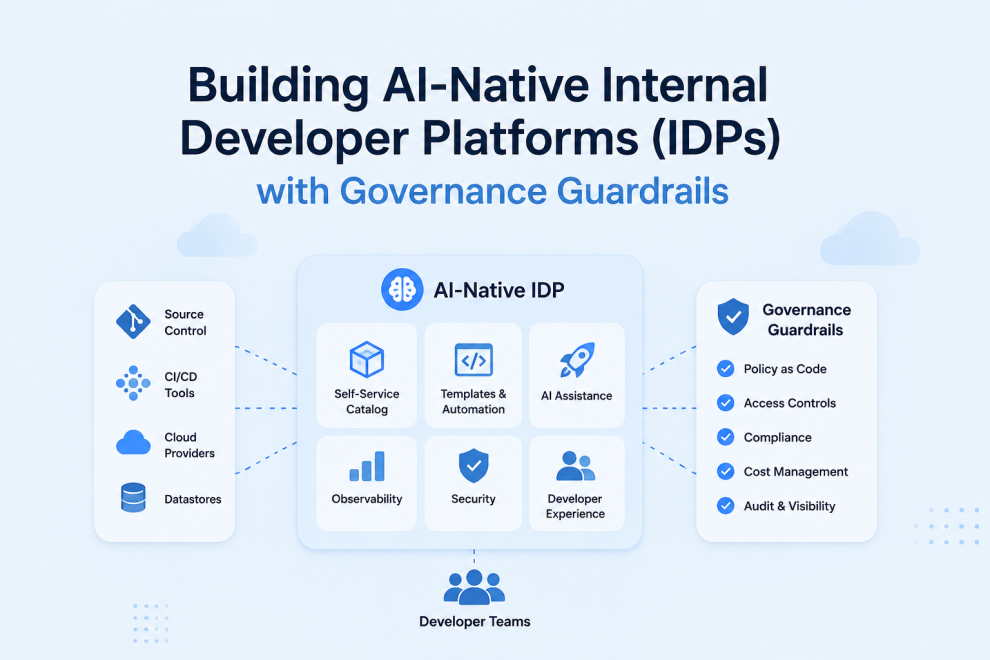
One way to think about an AI-native IDP is as an AI control plane for engineering.
An AI gateway can centralize access to approved models and provide authentication, routing, rate limiting, monitoring, and policy enforcement. This reduces the need for individual applications to establish uncontrolled connections with different AI providers.
A model catalog can give developers access to approved models and explain their capabilities, supported use cases, performance characteristics, and usage considerations.
An AI-assisted scaffolding system can generate standardized application foundations using approved architecture patterns and reusable components.
An automated validation layer can inspect AI-generated code, dependencies, infrastructure configurations, and security settings before an application moves further through the delivery pipeline.
An enterprise-aware developer assistant can help developers access internal documentation, APIs, architecture standards, service catalogs, and engineering guidelines through natural language.
Together, these capabilities transform the IDP from a collection of developer tools into a central engineering control plane.
Enterprise AI Needs Organizational Context
Modern AI assistants are increasingly capable of understanding programming languages, frameworks, and common software architectures.
But enterprise development has another requirement: context.
Developers need answers that reflect their organization’s specific technology environment.
That environment may include internal APIs, approved libraries, authentication patterns, architecture standards, security policies, reusable components, deployment processes, technical documentation, and service ownership information.
Enterprise knowledge retrieval can connect AI capabilities to this information.
Instead of asking, “How do I build this API?” a developer could ask, “How should I build this API using our approved architecture, authentication, and observability patterns?”
The second question produces a much more useful result because the AI is operating within the organization’s engineering context.
The Platform Team Becomes an AI Enabler
AI-native IDPs also change the role of platform engineering teams.
Platform teams have traditionally focused on infrastructure, developer tooling, reliability, deployment automation, and observability. With AI becoming part of everyday software development, their responsibilities increasingly include model access, AI infrastructure, data controls, policy enforcement, AI observability, evaluation, and usage governance.
This does not mean platform engineers need to become AI researchers.
Their role is to create an environment in which AI can be adopted safely, consistently, and efficiently.
That makes the platform team a critical connection point between developer productivity and enterprise governance.
Developer Experience Still Determines Adoption
Enterprise leaders should be careful not to overcorrect.
It is possible to create so many AI controls that developers find the platform more difficult to use than the tools outside it.
When that happens, teams will naturally look for alternatives.
An effective AI-native IDP should therefore make complexity invisible wherever possible. Developers should see approved model options instead of complicated approval processes. They should receive secure defaults instead of manually configuring every security requirement. They should get observability and deployment automation as part of the standard workflow rather than setting everything up independently.
This leads to a powerful platform principle:
Governance should be invisible when everything is compliant and highly visible when something needs attention.
The platform should guide developers without constantly interrupting them.
Measuring Whether the Platform Is Working
Technology leaders also need a way to determine whether an AI-native IDP is delivering meaningful results.
Useful measurements can include developer adoption, time to first deployment, golden-path adoption, deployment frequency, policy compliance, security findings, developer satisfaction, AI usage patterns, and time saved on repetitive engineering activities.
However, AI usage should not become the primary success metric.
Generating millions of AI interactions does not necessarily mean an organization is becoming more productive.
The better question is:
Is AI helping engineering teams deliver better software faster while reducing security, operational, and compliance risk?
That is the outcome that matters.
Start With High-Value Golden Paths
A large enterprise does not need to transform every engineering workflow at once.
A more practical approach is to identify a few high-value golden paths and make them excellent.
These could include creating a secure API, launching a customer-facing application, deploying a microservice, building an internal AI application, or creating an AI-powered workflow.
Each golden path can combine approved architecture, reusable components, automated testing, security controls, observability, deployment automation, and AI assistance.
Once developers experience a platform that genuinely removes repetitive work, adoption becomes much easier.
Where Technology Partners Fit Into the Picture
Building an AI-native IDP requires more than implementing an AI assistant. It involves connecting application development, AI capabilities, platform engineering, automation, security, and enterprise workflows into one coherent experience.
This is where technology partners such as GeekyAnts can contribute. With experience across AI solutions, application development, modern engineering frameworks, and digital product development, GeekyAnts can support organizations looking to integrate AI capabilities into existing technology environments.
The important part is not simply adding another AI tool to the technology stack. The larger opportunity is creating a developer environment where AI capabilities, enterprise architecture, automation, security, and governance work together as part of the same workflow.
The Bigger Enterprise Opportunity
For organizations with thousands or tens of thousands of engineers, AI adoption cannot depend entirely on individual teams making disconnected technology decisions.
An AI-native IDP can provide a scalable operating model by bringing AI assistance, developer experience, automation, security, observability, and governance into the same engineering workflow.
The objective is not to restrict developers from experimenting with AI.
It is to give them an environment where they can experiment safely, build faster, reuse proven patterns, and remain aligned with enterprise standards.
The next phase of enterprise AI will not simply be about giving developers more powerful models or better coding assistants.
It will be about building the engineering platform that makes responsible AI adoption scalable.
The organizations that get this right will create more than faster development teams. They will create an engineering environment where innovation and governance reinforce each other instead of competing with each other.
For more, visit our homepage!




Add Comment