




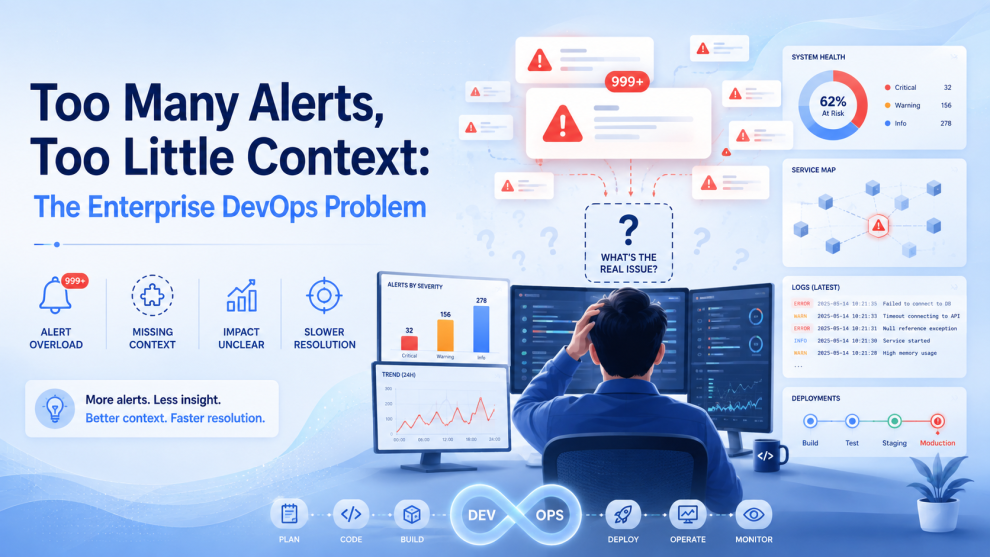

Modern DevOps has solved one of software engineering’s biggest historical problems: getting code into production reliably and repeatedly. But at enterprise scale, another problem is becoming harder to ignore. Engineering teams now have more operational data than they can realistically process.
Every deployment generates signals. Every service produces logs and metrics. Monitoring platforms trigger alerts. CI/CD systems record changes. Incident tools track failures. Teams discuss problems across Slack, tickets, documentation, and internal platforms.
For a company running hundreds or thousands of services, visibility is no longer the challenge. Context is.
The Enterprise Signal Problem
Consider a large retailer releasing an update to its checkout API. The deployment succeeds, automated tests pass, and infrastructure health looks normal. Twenty minutes later, checkout latency starts increasing in one region. A downstream inventory service begins timing out, an engineer reports customer complaints in a team channel, and an existing ticket mentions a similar dependency problem.
The information exists across five different systems.
The engineering team still has to connect the dots.
This is becoming one of the defining problems of enterprise DevOps: organizations have invested heavily in observability, but the signals generated by those systems often remain fragmented.
A monitoring platform can tell you that latency increased. A deployment platform can tell you that a new version was released. An incident platform can tell you that someone opened an issue. None of these facts alone explains what is happening.
The real value appears when they are connected.
More Monitoring Does Not Always Mean More Visibility
Large enterprises often respond to operational complexity by adding more monitoring.
That sounds logical. More telemetry should mean better visibility.
But there is a limit.
When engineers receive hundreds of alerts every day, the problem changes from missing information to filtering information. Alerts that repeatedly turn out to be harmless begin to lose their urgency. Important signals can become indistinguishable from routine noise.
This is why the next stage of DevOps maturity cannot simply be about collecting more data.
It has to be about understanding the data already being collected.
Instead of asking, “What alerts do we have?” technology leaders should increasingly ask, “Which signals indicate a meaningful change in system behavior?”
From Observability to Operational Context
Traditional observability answers an important question: What is happening?
Enterprise DevOps increasingly needs to answer three questions:
What changed?
Why might it be happening?
What should we do next?
Imagine a platform reporting that API latency increased by 18%.
That is useful.
Now imagine the platform explaining that latency increased eight minutes after a specific deployment, the affected API depends on another service experiencing elevated response times, and the responsible team already has an open ticket related to that dependency.
That is significantly more actionable.
The difference is not additional monitoring.
It is contextual intelligence.
Where AI Fits Into Modern DevOps
AI has an interesting role to play here, particularly because the information needed to understand an incident is often spread across systems.
An AI-powered operational layer can potentially correlate deployment activity, telemetry, incidents, tickets, service ownership, and engineering conversations.
Instead of showing ten unrelated events, it can help form a single operational narrative:
A deployment occurred. Shortly afterward, latency increased. A dependent service began timing out. Customers started reporting slower transactions. The affected service belongs to a specific engineering team.
That summary can save engineers from manually moving between dashboards, ticketing systems, logs, and chat channels.
The important distinction is that AI does not need to replace the engineer.
A stronger enterprise model is:
AI detects. AI correlates. AI recommends. Humans approve.
This approach can introduce meaningful automation while keeping consequential production decisions under human control.
Platform Engineering Is Becoming the Connection Layer
Platform engineering is often associated with developer portals, infrastructure provisioning, Kubernetes, CI/CD templates, and standardized engineering workflows.
The role is expanding.
For large organizations, an internal platform can also become the place where operational context is brought together.
An engineer should ideally be able to see a service’s current deployment, dependencies, ownership, health signals, recent incidents, and relevant changes without searching across multiple systems.
This is particularly important when organizations have thousands of engineers working across independent teams.
The objective is not to create another dashboard.
It is to create a shared operational context.
The Ownership Problem
Another overlooked source of DevOps friction is ownership.
A production problem may involve an application team, platform team, database team, security team, and an external provider. Determining which team should investigate can take longer than identifying the initial symptom.
For enterprise organizations, ownership information should therefore be treated as operational data.
When a critical signal appears, teams should be able to understand not only what is happening but also:
- Which service is affected?
- Which team owns it?
- What changed recently?
- Which dependencies are involved?
- Are there existing incidents or tickets?
- Has a similar issue occurred before?
The faster teams can answer those questions, the faster they can move from investigation to resolution.
DevOps Metrics Need a New Layer
DORA metrics remain useful for understanding software delivery performance. But large enterprises also need to understand the quality of their operational decision-making.
Useful measures include signal-to-action time, alert relevance, change-impact detection, ownership resolution time, and recurring incident reduction.
For example, if an organization deploys thousands of changes every month but takes hours to determine which deployment caused a production problem, deployment speed alone is not enough.
The better question becomes:
How quickly can the organization understand the consequences of change?
That is a more strategic DevOps metric for large engineering organizations.
What Engineering Leaders Should Do
The answer is not necessarily another monitoring platform or another AI experiment.
Start by mapping the existing signal ecosystem.
Identify where deployment data lives, where incidents are recorded, where ownership information is maintained, where operational telemetry originates, and where engineers discuss emerging problems.
Then look for opportunities to connect those signals.
This is also where engineering organizations can evaluate AI execution and signal-intelligence approaches such as GeekyAnts’ AI Signal Bot, which is designed to identify tasks, deadlines, blockers, risks, and ownership signals from everyday team conversations and help turn them into structured actions across project-management workflows.
The broader lesson is more important than any individual tool: enterprise DevOps needs to connect technical signals with human context.
The Future Is Not More Alerts
The DevOps stack has become extremely good at telling engineering teams that something happened.
The next generation needs to become better at explaining why it matters.
For a large enterprise, the goal should not be to eliminate every alert or automate every production decision. It should be to reduce the amount of cognitive effort required to understand complex systems.
The evolution looks something like this:
Monitoring → Observability → Correlation → Context → Decision Support → Intelligent Action
That shift will become increasingly important as enterprises operate more services, deploy more frequently, and introduce AI into production environments.
The organizations that succeed will not necessarily be the ones collecting the most signals.
They will be the ones that can turn thousands of fragmented signals into a few clear decisions.
Because in modern DevOps, the biggest problem is no longer seeing everything.
It is knowing what actually matters.
For more, visit our homepage!


Add Comment