





AI has fundamentally changed how quickly software can move from an idea to a working product. A development team can now generate interfaces, APIs, integrations, tests, and application logic in a fraction of the time traditional development often required.
For enterprise technology leaders, however, faster development creates a different question.
Can AI-generated software actually survive production?
For organizations with thousands of employees, complex technology ecosystems, large customer bases, strict security requirements, and significant operational dependencies, a working prototype is only an early milestone. The real challenge begins when that software needs to become reliable, secure, scalable, observable, and maintainable.
AI has accelerated code generation. It has not removed the engineering discipline required to operate software at enterprise scale.
The Gap Between “It Works” and “It’s Ready”
AI can make the first version of an application surprisingly easy to produce.
A product team can describe a feature, generate a user interface, connect an API, create database logic, and demonstrate the workflow within days. That speed creates enormous opportunities for organizations trying to modernize products or experiment with new digital experiences.
But prototypes operate under very different conditions from production systems.
A prototype might rely on simplified authentication, limited testing, manual deployments, temporary infrastructure, or assumptions about how users will behave.
Production exposes those assumptions.
Traffic increases. Data becomes more complex. Dependencies fail. Security threats appear. Integrations behave unpredictably. Costs change. Users discover workflows that developers never anticipated.
This is where the distinction between AI-generated code and production-ready software becomes critical.
The challenge is no longer simply generating software.
It is engineering everything required to make that software dependable.
AI Generates Code. Engineering Creates Confidence.
AI coding tools are extremely effective at accelerating implementation. They can generate repetitive code, suggest solutions, refactor existing components, create tests, and help developers work through unfamiliar technologies.
What they cannot automatically provide is complete organizational context.
Enterprise applications operate within existing architectures, security policies, data environments, infrastructure standards, compliance requirements, internal platforms, and legacy systems.
A technically valid piece of generated code can still be completely wrong for the environment in which it needs to operate.
That is why AI-assisted development requires experienced engineering oversight.
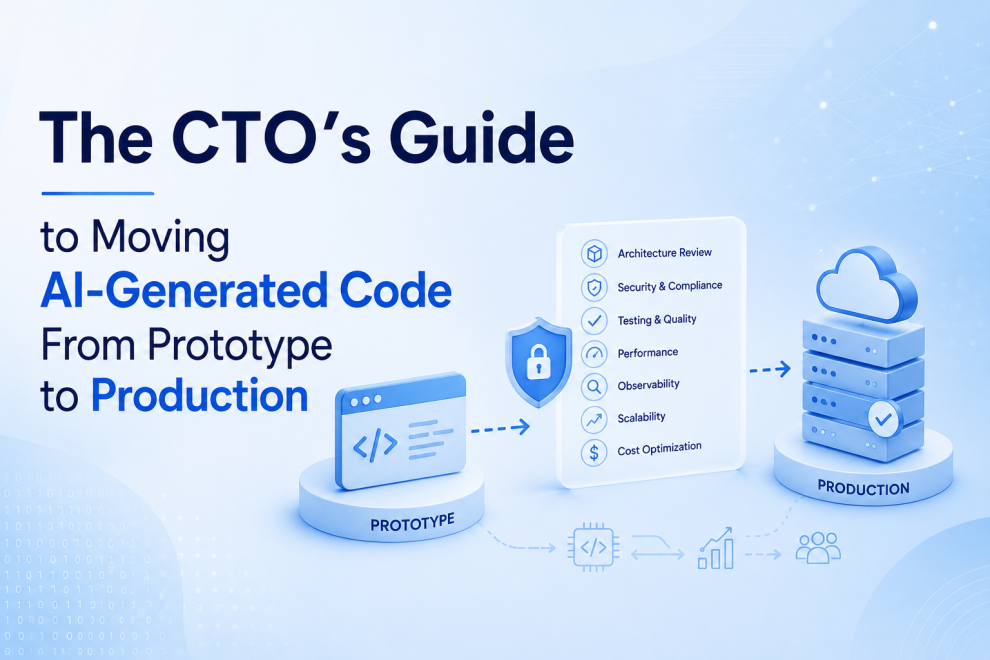
Architecture needs to be reviewed. Security needs to be validated. Performance needs to be tested. Dependencies need to be assessed. Infrastructure needs to be designed. Observability needs to be built in.
The value of AI is not diminished by this process.
In fact, the opposite is true.
The stronger the engineering foundation, the more safely an organization can take advantage of AI’s development speed.
Production Readiness Starts With Architecture
One of the easiest mistakes to make with AI-assisted development is accepting the first architecture that produces a working result.
Enterprise architecture is rarely about whether something can work.
It is about whether it can continue working as requirements, users, integrations, and organizational complexity increase.
Questions around service boundaries, data ownership, communication patterns, failure handling, authentication, infrastructure, and integration strategies need to be considered before the application becomes difficult to change.
An AI-generated application may be perfectly functional while still having architectural decisions that create problems six months later.
For a large technology organization, that technical debt can spread across teams and platforms quickly.
Architecture review therefore becomes one of the most important stages between AI-assisted development and production deployment.
Security Cannot Be an Afterthought
AI-generated code should be treated with the same security discipline as any other code.
Authentication, authorization, secrets management, dependency vulnerabilities, API exposure, data access, logging, and sensitive information handling all require deliberate validation.
The risk becomes even more significant when AI applications interact with enterprise data or external services.
A system may function exactly as designed while exposing information through an overly permissive API or poorly controlled workflow.
Security needs to be integrated into the development and delivery process rather than introduced as a final approval step.
For organizations operating at scale, the cost of discovering a security weakness after deployment can be dramatically higher than addressing it during development.
Performance Has to Be Tested Before Users Find the Limits
A prototype can perform well with a handful of users.
That tells an engineering team very little about how the system will behave under real production conditions.
Enterprise applications need to be evaluated against realistic traffic, concurrency, data volumes, external dependencies, and failure scenarios.
AI-enabled applications introduce additional considerations because model calls, retrieval systems, external APIs, and data processing can create unpredictable latency.
A feature that feels instant during development may become frustrating when thousands of requests arrive simultaneously.
Performance engineering therefore needs to be part of the path to production, not something that begins after users complain.
Observability Turns Production Into a Feedback System
Production software cannot simply be deployed and forgotten.
Engineering teams need visibility into how systems behave after release.
Logs, metrics, traces, alerts, dashboards, and meaningful application signals allow teams to understand whether a service is healthy and why something is going wrong.
This becomes particularly important for AI-enabled applications.
A request may technically succeed while the application is becoming slower, consuming more resources, generating higher model costs, or producing lower-quality results.
Without observability, these problems can remain invisible until they become expensive.
With strong observability, production becomes a source of continuous engineering feedback.
Faster Development Makes CI/CD More Important
AI can increase the volume and speed of software changes entering an engineering organization.
That makes automated delivery controls more important, not less.
Testing, security scanning, dependency analysis, infrastructure validation, integration testing, performance checks, deployment controls, and rollback mechanisms help organizations take advantage of AI-assisted development without allowing quality to deteriorate.
The goal is not to slow developers down.
The goal is to create enough automation that developers can move faster without increasing production risk at the same rate.
This is where platform engineering becomes particularly valuable.
Standardized deployment environments, reusable infrastructure, security controls, observability capabilities, and automated pipelines give product teams a reliable path from development to production.
The Economics of AI Need Engineering Attention
AI applications introduce another layer that traditional software teams did not always have to consider at the same level: model consumption.
An application can be technically successful while becoming financially difficult to operate.
Model selection, inference frequency, token consumption, retrieval architecture, caching, data processing, and third-party services can all influence the cost of running an AI-enabled workflow.
At enterprise scale, small inefficiencies can become significant.
Engineering teams therefore need visibility into how AI is being used and what each workflow costs to operate.
This makes AI economics an architecture concern rather than simply an infrastructure billing concern.
The right model is not always the most powerful model. The right architecture is the one that provides the required outcome at a sustainable level of performance, reliability, and cost.
The Delivery Partnership Is Changing
Traditional technology partnerships often focused on development capacity.
AI changes that model.
When software can be generated faster, the differentiator is no longer simply how many developers can be assigned to a project.
The more important capability is whether the delivery team can take AI-generated work through the entire engineering lifecycle.
That means understanding architecture, security, quality, infrastructure, deployment, observability, and ongoing operations.
This is also where an AI-native delivery partnership becomes different from simply using AI coding tools.
GeekyAnts describes this approach around turning AI-generated software into production-ready systems by combining AI acceleration with the engineering practices required for reliable delivery.
The important part is the engineering layer surrounding AI.
That is what turns a promising prototype into something an enterprise organization can actually operate.
What Enterprise Technology Leaders Should Evaluate
When evaluating an AI delivery partner, the conversation should move beyond whether the team can build an application.
The more important question is whether they understand the environment in which the application will operate.
Can they work with an existing enterprise architecture?
Can they integrate with internal platforms and legacy systems?
Can they address security and compliance requirements?
Can they build automated testing and deployment pipelines?
Can they establish meaningful observability?
Can they optimize performance and infrastructure costs?
Can they remain involved after the application reaches production?
These questions reveal whether a partner is focused on producing code or delivering software that can operate successfully.
A Better Path From Prototype to Production
Enterprise teams do not necessarily need to begin with a large transformation program.
A focused production-readiness initiative can provide a much clearer picture.
The first stage is understanding the existing application. Teams examine the architecture, codebase, infrastructure, security posture, integrations, data flows, and product requirements.
The second stage is engineering the gaps. Architecture is strengthened, testing is expanded, security controls are introduced, infrastructure is automated, and observability is established.
The final stage is validation. The application is exposed to realistic performance, reliability, security, and operational scenarios before it becomes a critical production dependency.
The outcome should not simply be a more polished demonstration.
It should be evidence that the system is ready for real-world conditions.
The Metrics That Matter Now
AI changes what engineering productivity looks like.
Lines of code are becoming an increasingly weak measurement when AI can generate implementation at a scale that was previously impractical.
Enterprise leaders should instead look at outcomes such as deployment frequency, change failure rate, recovery time, production defects, application availability, performance, security findings, infrastructure consumption, AI costs, and time from approved requirement to production.
These metrics answer a more important question:
Is AI helping the organization deliver better software faster without increasing operational risk?
That is the real measure of AI-assisted engineering.
The New Definition of Speed
The fastest engineering organization will not necessarily be the one that generates the most code.
It will be the organization that can move from idea to production quickly without creating a larger reliability, security, or maintenance problem along the way.
AI has already compressed the time required to build software.
The next competitive advantage will come from mastering everything that happens after the code is generated.
Architecture creates the foundation. Security creates trust. Platform engineering creates consistency. Testing creates confidence. Observability creates visibility. Strong delivery practices connect everything together.
The future is not AI replacing engineering.
It is AI making engineering more capable.
AI can generate the starting point. Enterprise engineering determines whether that starting point is ready for production.
For more, visit our homepage!


Add Comment