






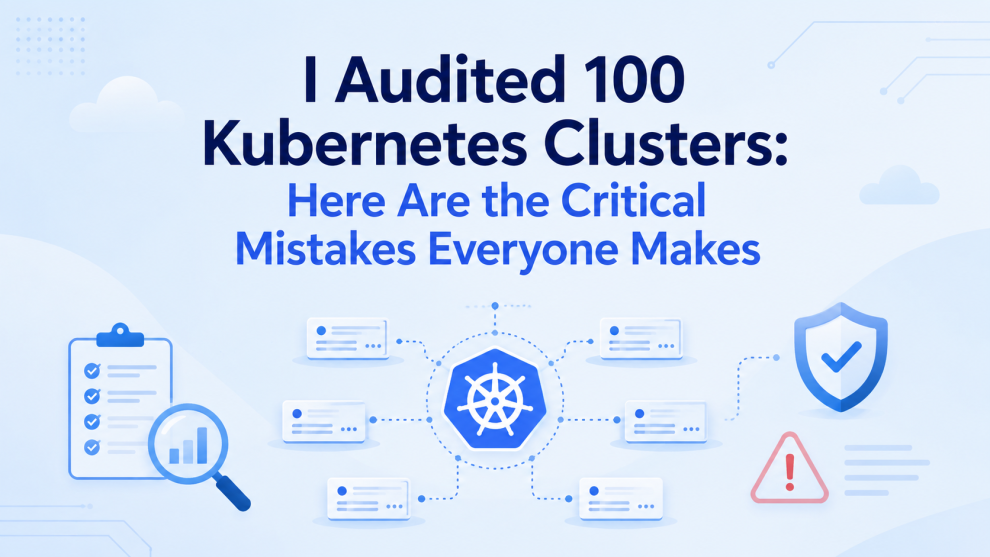

Kubernetes has become the default platform for running modern applications at scale. For large enterprises, however, adopting Kubernetes is only the beginning. The real challenge is operating clusters that remain secure, observable, cost-efficient, resilient, and manageable as teams, workloads, and infrastructure grow.
After reviewing Kubernetes environments across different stages of maturity, one pattern becomes clear: most serious problems are not caused by Kubernetes itself. They come from architectural shortcuts, weak operational practices, incomplete governance, and decisions that worked for a small deployment but fail at enterprise scale.
For engineering leaders managing thousands of developers, hundreds of services, and infrastructure distributed across multiple environments, these mistakes can become expensive very quickly.
1. Treating Kubernetes as an Infrastructure Project Instead of a Platform
One of the most common mistakes is viewing Kubernetes as something the infrastructure team deploys and then hands over to application teams.
That model rarely works at enterprise scale.
Kubernetes becomes a platform layer connecting application development, infrastructure, security, observability, deployment automation, and compliance. If each team interacts with clusters differently, operational complexity grows rapidly.
A mature platform should provide standardized paths for deploying services, managing configurations, handling secrets, monitoring workloads, enforcing policies, and responding to failures.
The goal should not be giving every engineering team unrestricted access to Kubernetes. The goal should be giving them a reliable platform that abstracts unnecessary complexity while preserving the controls engineering leadership requires.
2. Running Production Workloads Without Resource Governance
CPU and memory requests and limits are often treated as configuration details. At scale, they become capacity-management controls.
A workload without properly defined requests can make scheduling unpredictable. Excessive requests can create artificial capacity shortages, while poorly configured limits can cause throttling or out-of-memory events.
The problem becomes more significant when hundreds or thousands of workloads share clusters.
Engineering teams should establish resource policies based on workload characteristics and continuously compare requested resources against actual utilization. Vertical Pod Autoscaler recommendations, historical metrics, workload profiling, and capacity planning can help identify significant gaps.
For large organizations, resource governance should be part of the platform engineering model rather than an occasional optimization exercise.
3. Assuming High Availability Because There Are Multiple Pods
Multiple replicas do not automatically create a highly available application.
I have seen deployments with several replicas that still had a single point of failure because all pods were scheduled onto the same node or availability zone.
Kubernetes provides powerful scheduling primitives, but reliability depends on how they are configured.
Production workloads should consider topology spread constraints, pod anti-affinity where appropriate, disruption budgets, multiple availability zones, resilient storage, and appropriate ingress architecture.
There is an important distinction between having replicas and having failure-domain diversity.
If every replica disappears when one node or zone fails, the application was never truly resilient.
4. Ignoring Kubernetes Network Boundaries
Flat network access is another recurring enterprise problem.
A compromised workload should not automatically be able to communicate with every other workload in the cluster. Yet many environments rely heavily on default networking behavior.
Network policies can establish explicit communication boundaries between workloads and namespaces. Depending on the architecture, organizations may also need service mesh controls, ingress policies, egress restrictions, and identity-aware communication.
This becomes especially important for regulated or highly sensitive workloads where lateral movement needs to be tightly controlled.
Security should not begin at the cluster perimeter. It needs to exist between workloads as well.
5. Treating Secrets Like Normal Configuration
Putting sensitive credentials into Kubernetes manifests, repositories, CI/CD variables, or improperly protected ConfigMaps creates unnecessary exposure.
Kubernetes Secrets provide a mechanism for handling sensitive configuration, but simply using the Secret object does not constitute a complete secrets-management strategy.
Enterprise environments should consider centralized secrets management, encryption at rest, controlled access, rotation, audit trails, and short-lived credentials where possible.
The objective is to make credentials difficult to expose and easier to rotate, rather than simply moving them from one configuration file to another.
6. Building Monitoring Without Building Observability
A dashboard showing CPU utilization is not observability.
Large Kubernetes environments require visibility across infrastructure, workloads, applications, and user-facing services.
Metrics can tell you that latency increased. Logs may help explain what happened. Distributed traces can show where latency entered a request path.
The real value comes from correlating these signals.
For platform leaders, observability should connect Kubernetes health with application-level service indicators. A cluster can be completely healthy while an important customer-facing API is failing.
That is why enterprise observability needs to move beyond node dashboards toward service-level objectives, dependency mapping, distributed tracing, meaningful alerts, and actionable telemetry.
7. Creating Alert Fatigue Instead of Incident Signals
Another common problem is alerting on everything.
When engineers receive hundreds of alerts that do not require action, the alerts that actually matter become easier to miss.
A mature alerting strategy should answer a simple question: What should an engineer do when this alert fires?
Alerts should be tied to meaningful symptoms and service objectives rather than every metric crossing an arbitrary threshold.
For example, sustained customer-facing latency may deserve immediate attention. A short CPU spike on a non-critical workload may not.
The distinction matters enormously when teams are responsible for large fleets of services.
8. Scaling Pods Without Scaling Dependencies
Horizontal Pod Autoscaling is useful, but adding more application replicas cannot solve every bottleneck.
An application may scale from 10 to 100 pods while its database remains limited to a fixed connection pool. A service may create additional consumers while a downstream API imposes strict rate limits.
This creates a classic distributed-systems problem: the application scales faster than its dependencies.
Before enabling aggressive autoscaling, engineering teams should understand database capacity, queue throughput, external API limits, connection pools, cache behavior, and downstream service constraints.
Autoscaling should be based on the capacity of the entire service chain, not just the workload running inside Kubernetes.
9. Underestimating Cluster Upgrade Complexity
Kubernetes upgrades are not simply version changes.
Large environments may contain admission controllers, operators, CRDs, ingress controllers, storage integrations, service meshes, observability agents, security tooling, and cloud-provider dependencies.
An upgrade can expose compatibility issues that were invisible during normal operation.
A disciplined upgrade strategy includes version compatibility testing, staged environments, automated validation, rollback planning, and clear ownership for cluster dependencies.
Platform teams should treat Kubernetes upgrades as repeatable engineering processes rather than occasional infrastructure events.
10. Giving Developers Too Much Kubernetes Complexity
One of the most overlooked problems is exposing application developers to too many infrastructure decisions.
If every developer needs to understand node pools, affinity rules, ingress configuration, storage classes, autoscaling, security policies, and deployment mechanics just to ship a service, the platform is transferring infrastructure complexity to the application team.
Internal developer platforms can provide standardized templates and workflows that hide unnecessary complexity.
This is where platform engineering becomes strategic. The objective is not simply to operate Kubernetes. It is to create a paved road for engineering teams.
Organizations such as GeekyAnts approach modern application engineering with this broader perspective, where cloud-native architecture, automation, and application delivery need to work together rather than exist as isolated technical initiatives.
11. Failing to Control Kubernetes Cost
Kubernetes can improve infrastructure efficiency, but it can also make resource waste difficult to see.
Unused workloads, oversized requests, idle environments, inefficient node pools, excessive replicas, and poorly configured autoscaling can quietly increase infrastructure spend.
The challenge is particularly significant for enterprises operating multiple clusters across regions and environments.
Cost optimization should therefore be connected to workload ownership. Teams need visibility into what resources they consume and why.
The question is not simply, “How much does Kubernetes cost?”
It is, “Which workloads are consuming capacity, what business capability do they support, and is that capacity justified?”
12. Making Every Cluster Different
One of the strongest indicators of operational maturity is consistency.
When every Kubernetes cluster has different versions, policies, networking configurations, observability agents, deployment processes, and security controls, platform operations become difficult to scale.
Standardization does not mean every workload must be identical. It means the foundational layer should have predictable patterns.
For large enterprises, cluster configuration should increasingly become declarative, version-controlled, automated, and auditable.
Infrastructure as Code and GitOps approaches can help establish that consistency while providing an operational history of changes.
What I Would Fix First
If I inherited a Kubernetes environment with dozens or hundreds of clusters, I would not begin by redesigning everything.
I would first establish a baseline.
That means understanding cluster versions, workload distribution, resource utilization, availability architecture, network policies, identity and access controls, secrets management, observability coverage, upgrade processes, backup strategies, and cost allocation.
Then I would classify problems according to risk.
A production workload with inadequate failure isolation is more urgent than an inefficient development namespace. A cluster with uncontrolled administrative access deserves attention before a minor resource optimization.
The objective is to reduce operational risk systematically rather than create another large Kubernetes migration project.
The Enterprise Kubernetes Lesson
After looking across Kubernetes environments, the biggest lesson is that Kubernetes maturity is not measured by how sophisticated the YAML looks.
It is measured by how reliably an organization can operate software at scale.
Can teams deploy without creating infrastructure tickets?
Can platform engineers understand failures across hundreds of services?
Can security teams enforce controls consistently?
Can engineering leaders understand capacity and infrastructure efficiency?
Can the organization upgrade clusters without turning every release into an incident?
And can the platform continue working as the organization adds more teams, services, regions, and customers?
Those are the questions that matter.
Kubernetes is exceptionally powerful, but it does not remove operational complexity. It changes where that complexity lives. The enterprises that succeed with Kubernetes are the ones that turn that complexity into standardized platforms, automated controls, measurable reliability, and clear ownership.
FAQs
How many Kubernetes clusters should an enterprise operate?
There is no universal number. Cluster count should reflect security boundaries, availability requirements, organizational structure, geographic distribution, regulatory requirements, and workload isolation. Too few clusters can create large blast radiuses, while too many can create unnecessary operational overhead.
What is the biggest Kubernetes mistake enterprises make?
One of the biggest mistakes is adopting Kubernetes without building the surrounding platform capabilities. Cluster management, security, observability, deployment automation, governance, and developer experience need to evolve together.
Are Kubernetes resource requests and limits really necessary?
For production environments, they are an important part of predictable scheduling and capacity management. Poorly configured values can create either resource waste or workload instability, so they should be continuously reviewed against actual utilization.
How can enterprises reduce Kubernetes operational complexity?
Standardization, automation, GitOps, internal developer platforms, centralized observability, policy enforcement, and reusable deployment patterns can significantly reduce the number of decisions individual application teams need to make.
Is Kubernetes automatically highly available?
No. Kubernetes provides mechanisms for building highly available systems, but the application architecture and cluster configuration determine whether workloads can actually tolerate node, zone, component, or dependency failures.
What should engineering leaders audit first?
Start with production risk: access controls, workload availability, resource governance, networking, secrets, observability, backups, upgrade readiness, and dependency resilience. Once those areas are understood, cost and developer-experience optimization can follow.
What does Kubernetes maturity look like at enterprise scale?
Enterprise Kubernetes maturity means the platform is predictable, automated, observable, secure, and scalable. Developers have a clear deployment path, platform teams have operational control, and engineering leadership can measure reliability, capacity, risk, and cost without relying on manual investigation.
For more, visit our homepage!



Add Comment