




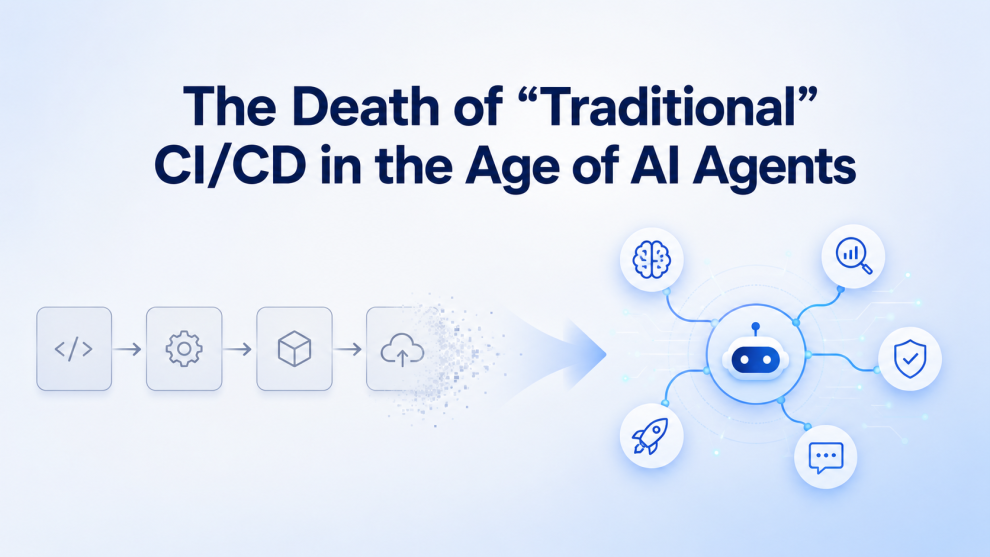

For years, CI/CD has followed a predictable model: developers write code, reviewers approve changes, automated systems validate them, and deployment pipelines move approved software toward production. AI agents are challenging that model. They can now interpret requirements, modify repositories, generate tests, investigate failures, prepare pull requests and participate in delivery workflows. The important change is not simply adding AI to CI/CD. It is that AI agents are becoming active participants in the software delivery lifecycle. For VP-level engineering, platform and digital leaders managing large technology environments, this changes what the delivery platform needs to accomplish.
CI/CD Was Built for a Human-Led Development Model
Traditional CI/CD was designed around human bottlenecks. A developer makes a change, pushes a commit, triggers a build, waits for automated tests, resolves failures and eventually gets approval. Automation handles repetitive execution while humans remain responsible for most code creation and decisions.
AI agents disrupt this sequence. A single request can result in an agent inspecting a repository, modifying multiple files, generating tests, running validation, fixing failures and preparing a pull request. The amount of software change entering the pipeline can therefore increase significantly.
That creates a new bottleneck. The question is no longer simply whether the pipeline can process changes quickly. The bigger question is whether the organization can validate, govern and understand changes at the same speed they are being generated.
The Pipeline Is Becoming a Control Plane
The modern CI/CD platform is increasingly becoming a control plane for autonomous software delivery. When an AI agent creates a change, the platform needs to understand what that agent is authorized to modify, which repositories it can access, what dependencies it can introduce, which tests are required and which environments it can target.
This becomes especially important for organizations supporting thousands of repositories, multiple product teams and different levels of application criticality. A generic automation account with broad permissions is difficult to govern when autonomous agents become part of the engineering ecosystem.
The delivery platform needs policy-aware execution. Agents should be able to move quickly inside clearly defined boundaries while the platform continuously enforces those boundaries.
Pull Requests Are Becoming Evidence Packages
The traditional pull request was designed for human-to-human collaboration. A developer explains a change, reviewers inspect the code and automated checks provide supporting evidence.
With agentic development, that interaction becomes richer. One agent may implement a feature while another reviews the implementation. A security agent can inspect dependencies, a testing agent can evaluate coverage and a policy agent can determine whether organizational requirements have been satisfied.
The human reviewer can then focus on decisions that genuinely require human judgment: architecture, product intent, unusual risk and exceptions.
This does not eliminate code review. It changes what humans need to review. Instead of manually inspecting every routine modification, engineers can increasingly examine why the system believes a change is safe and investigate areas where automated confidence is low.
Faster Code Generation Makes Deterministic Controls More Important
AI-generated code can be produced rapidly, but speed does not guarantee correctness. Agents can misunderstand requirements, select unsuitable dependencies, introduce subtle regressions or make changes outside the intended scope.
That is why established engineering controls remain essential. Automated tests, static analysis, dependency scanning, reproducible builds, version control, deployment policies and rollback mechanisms become more important as the volume of machine-generated code increases.
The future is not AI replacing CI/CD. It is AI operating inside a more intelligent and policy-driven CI/CD environment.
An agent can determine how to solve a problem. The delivery platform should determine whether the resulting change satisfies the technical and operational conditions required for release.
The New Question Is “Can We Trust This Change?”
A traditional pipeline often asks whether a build passed and whether deployment completed successfully. An AI-native delivery platform needs to evaluate a broader set of signals.
Was the requested behavior implemented correctly? Did the change introduce a security weakness? Were unexpected dependencies added? Could the modification affect performance or reliability? Did the agent stay within its authorized scope? Which model and tools contributed to the change? Can the organization reproduce what happened? Can the change be reversed quickly?
These questions create the concept of change evidence.
For large engineering organizations, every significant machine-generated change may require an evidence trail showing how it was created, what validations were performed and why the system allowed it to progress.
Agent Identity Needs to Become Part of the Architecture
An AI agent should not simply inherit unrestricted permissions from a developer or operate through a generic automation account. Agent identity should become a first-class component of the engineering architecture.
A coding agent might be allowed to modify development repositories. A testing agent could execute validation workflows. A security agent could inspect source code and dependencies. A deployment agent could release only to explicitly approved environments.
Each agent has a defined role and limited authority.
This makes autonomy measurable and controllable. It also improves auditability. When a production incident occurs, engineering teams can determine which autonomous actor initiated the change, what it was permitted to do and which policies were applied.
Observability Must Include the Agent
Application observability tells teams what happened inside an application. CI/CD observability tells them what happened during a build or deployment. Agentic development introduces another requirement: understanding what the agent did before the deployment happened.
Organizations may need to track the task that initiated the agent, instructions provided to it, repositories inspected, tools invoked, files modified, tests executed, failures encountered and automated decisions made along the way.
This information becomes extremely valuable during incident investigation. If a production issue appears after an AI-generated change, engineers should not have to reconstruct the agent’s behavior from scattered logs. The delivery platform should provide a clear chain from request to agent activity to code change to validation to deployment.
CI/CD Is Moving From a Pipeline to a Feedback Loop
Traditional delivery is largely linear. Code moves through stages until it reaches production.
Agentic engineering creates the possibility of a closed-loop system. Production telemetry detects abnormal behavior. An incident agent investigates the signal. A diagnostic agent identifies a likely cause. A coding agent proposes a remediation. Testing and security agents validate the change. The delivery system releases it progressively, and production telemetry determines whether the remediation worked.
If the expected result does not occur, the system can stop the rollout, trigger a rollback or escalate to an engineer.
This is fundamentally different from simply moving code from development toward production. The engineering system continuously connects observation, reasoning, modification, validation and deployment.
What Engineering Leaders Should Change Now
Organizations do not need to abandon their existing CI/CD platforms to prepare for agentic development. A practical approach is to introduce autonomy gradually, beginning with lower-risk workflows such as test generation, dependency analysis, documentation updates, static-analysis remediation, code modernization and pull-request preparation.
As confidence increases, organizations can expand agent permissions while strengthening policy enforcement, automated validation, observability and rollback capabilities.
The objective should not be maximum autonomy. It should be maximum useful autonomy within clearly defined risk boundaries.
Platform teams should also standardize these controls rather than forcing every application team to build its own agent permissions, validation policies and deployment mechanisms. A consistent internal platform can make autonomous development easier to scale while maintaining organizational control.
The move toward agentic software delivery creates a broader engineering challenge: organizations need to integrate AI capabilities with application architecture, testing, automation and production delivery rather than treating AI as an isolated experiment. This is where GeekyAnts can fit naturally into the conversation, with work spanning AI applications, product engineering and modern application development. For technology leaders evaluating engineering partners, the important consideration is not simply whether a team can demonstrate an AI agent. The stronger question is whether that capability can be integrated with existing engineering practices, security requirements, delivery processes and operational constraints.
Traditional CI/CD Is Not Disappearing. Its Assumptions Are.
The core principles of continuous integration and continuous delivery remain relevant. What is changing is who creates software changes and how quickly those changes can appear.
The old model assumed humans were the primary source of change and automation moved those changes efficiently. The emerging model includes autonomous agents as software-producing actors.
That requires a different delivery architecture: stronger identity controls, richer evidence, deterministic validation, policy-driven deployment, agent observability and rapid recovery mechanisms.
The organizations that benefit most from AI-assisted engineering will not necessarily be those that give agents the greatest freedom. They will be the organizations that create the strongest systems around that freedom.
AI can accelerate software creation. Modern CI/CD must evolve to make that acceleration safe, observable and repeatable.
That is the real story behind the death of “traditional” CI/CD.
FAQs
Is traditional CI/CD really dying?
Not entirely. Continuous integration and continuous delivery remain essential. What is changing is the architecture surrounding them as AI agents become active participants in development and release workflows.
Will AI agents replace DevOps teams?
AI agents are more likely to change DevOps responsibilities than eliminate them. Platform and DevOps teams will increasingly focus on automation frameworks, policies, agent permissions, observability, reliability and guardrails for autonomous workflows.
Should AI agents be allowed to deploy directly to production?
Only under clearly defined conditions. Low-risk changes may eventually support highly automated deployment, while high-impact changes should retain stronger validation, progressive rollout and human approval mechanisms.
Why does agent identity matter in CI/CD?
An agent may have access to repositories, development environments or deployment systems. Explicit identity and permissions prevent excessive privileges and create an auditable record of which autonomous actor performed each action.
What is agent observability?
Agent observability provides visibility into how an AI system performed a task. It can include the request, instructions, tools used, repositories accessed, modifications made, tests executed and decisions taken before a change reaches production.
How can large organizations start adopting agentic CI/CD?
Begin with controlled, low-risk workflows such as testing, code analysis, documentation, dependency remediation and pull-request preparation. Establish identity, validation, policy and observability controls first, then gradually increase autonomy as confidence grows.
What is the biggest risk of AI-native software delivery?
Increasing the volume of software changes without improving validation and operational controls. If agents can produce changes faster than the organization can evaluate and recover from them, delivery speed can become a reliability problem rather than an advantage.
For more, visit our homepage!



Add Comment