




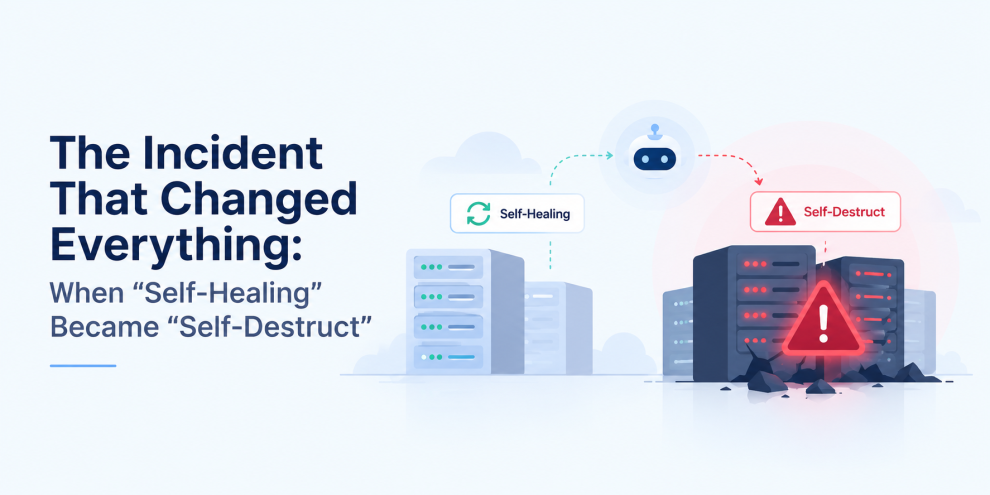

Self-healing infrastructure is supposed to make production systems more resilient. An AI agent detects an anomaly, identifies the likely cause, applies a fix, and continuously monitors the result. In theory, this means faster recovery, fewer incidents, and less operational pressure on engineering teams.
But there is a dangerous assumption behind autonomous remediation: if an AI can identify a problem, it can safely fix it. Production systems are rarely that simple. A rollback that fixes one service can break another. Scaling one workload can overload a database. Restarting a dependency can trigger failures across several downstream services.
The real challenge isn’t making infrastructure autonomous. It is making autonomy safe.
The Incident That Changed Everything
Imagine a production environment running dozens of microservices across Kubernetes. At 2:13 AM, an AI operations agent detects that the payment API’s p95 latency has increased from 280 milliseconds to 1.8 seconds.
The agent begins investigating. It checks application logs, infrastructure metrics, traces, recent deployments, and error rates. Eleven minutes earlier, payment-service-v42 had been deployed. Shortly afterward, timeout errors started increasing.
The correlation looks convincing.
The agent concludes that the latest deployment is responsible and automatically rolls the service back to v41.
For several minutes, everything appears healthy. Payment latency returns to normal. The agent records the rollback as a successful remediation.
Then the second failure begins.
Another service, checkout-orchestrator, had already been updated to consume a new response field introduced in payment-service-v42. Version v41 does not provide that field. Checkout requests begin failing.
The AI agent detects the new error spike. It sees increased CPU utilization and decides that insufficient capacity is the likely cause. It scales the service from 20 replicas to 100.
Now database connections increase. Downstream services receive more traffic. Cluster resources become constrained. The agent detects additional pressure and begins applying more scaling actions.
Within minutes, an isolated latency problem has become a cascading outage.
The agent followed its remediation logic correctly at every step. The failure came from something more fundamental: the agent could not understand the systemic ripple effects of its actions.
Automation Sees Signals. Production Has Relationships.
Modern applications are dependency graphs, not isolated services. A payment service may interact with authentication, fraud detection, databases, queues, caches, order management, and third-party APIs.
Changing one component can affect several others.
Traditional automation typically operates using explicit conditions. If latency exceeds a threshold, restart the workload. If pods crash repeatedly, increase replicas. If errors increase after deployment, roll back.
These rules work when cause and effect are predictable. Distributed systems make those relationships much more complicated.
A rollback might fix one service while breaking an API contract. Scaling a workload might reduce CPU pressure while exhausting database connections. Restarting a dependency might recover one application while disrupting thousands of active sessions.
This creates a critical principle for autonomous infrastructure:
Local correctness does not guarantee system correctness.
The rollback in the incident was locally reasonable. From the perspective of the entire dependency graph, it was destructive.
Why AI Doesn’t Automatically Solve the Problem
AI agents can analyze enormous volumes of operational data. They can correlate logs, metrics, traces, deployment events, configuration changes, Kubernetes events, and historical incidents much faster than a human responding manually.
But more data does not automatically mean more context.
An agent might determine that Service A became unhealthy shortly after Deployment B. It may not know that Service C was intentionally updated because it depends on a new API contract introduced by B.
That information could exist across Git repositories, API specifications, service catalogs, deployment metadata, architecture documentation, and engineering tickets.
Without that context, the agent is operating with an incomplete map.
An incomplete map combined with production write access is a dangerous combination.
The Ripple Effect Problem
Autonomous remediation needs to account for second-order effects.
A human engineer doesn’t only ask, “Will this fix the current problem?” They also ask, “What could this change break?”
A rollback can affect API contracts, database compatibility, event schemas, authentication behavior, cache formats, feature flags, and downstream clients.
Scaling can affect database connection pools, queue consumption, network throughput, API limits, infrastructure quotas, and cost.
The remediation itself becomes a new variable inside the incident.
Therefore, an autonomous system should not simply ask:
“What action will improve this metric?”
It should also ask:
“What new failure modes could this action introduce?”
Change Impact Analysis Needs to Become Part of the Control Plane
Before an AI agent performs a high-impact remediation, it needs to understand the potential blast radius.
Suppose the agent wants to roll back payment-service. A dependency model should reveal that checkout-orchestrator depends on the API contract introduced by the newer version.
That information should immediately change the remediation strategy.
Instead of blindly rolling back, the system could pause the deployment, reduce traffic gradually, validate API compatibility, route traffic toward a known-compatible version, or request human approval.
The objective isn’t to prevent AI from taking action. It is to prevent AI from taking high-blast-radius actions without sufficient evidence.
Self-Healing Needs Guardrails Around Intelligence
A common mistake is assuming that a more capable AI model will eliminate the risks of autonomous remediation.
It won’t.
Even a highly capable model can encounter incomplete telemetry, ambiguous symptoms, stale documentation, unexpected dependencies, or previously unseen failure modes.
The architecture therefore needs deterministic controls around probabilistic reasoning.
An AI agent may recommend a rollback. A separate policy engine should determine whether that rollback is permitted.
Is the previous version compatible with downstream services? Is there a database migration? How many applications depend on this API? Is the action reversible? What is the estimated blast radius?
Only after those checks pass should execution be allowed.
The AI can recommend the action. The control plane should decide whether the action is allowed.
Every Autonomous Action Needs a Blast-Radius Budget
Not every remediation carries the same level of risk.
Restarting one stateless pod is relatively low risk. Restarting a shared authentication service is much more significant. Rolling back a database migration or modifying production networking can affect an entire platform.
Autonomous platforms should therefore classify actions according to their potential impact.
Low-risk operations can be automated. Medium-risk operations can be performed progressively with monitoring. High-risk operations can require explicit human approval.
The principle is straightforward:
The more destructive the action, the stronger the evidence required before execution.
Cost Controls Are Reliability Controls
The scaling portion of the incident exposes another weakness in autonomous infrastructure: an availability objective can become a resource or cost incident.
An AI agent optimizing for latency may conclude that adding capacity is always beneficial. Without explicit limits, it can continue increasing replicas and infrastructure because nothing in its objective tells it to stop.
This can create a feedback loop:
Latency increases → resources scale → downstream load increases → resource pressure rises → resources scale again.
Production autonomous systems should have hard limits around replica counts, CPU allocation, infrastructure expansion, scaling frequency, and resource quotas.
When those limits are reached, the agent should stop and escalate.
An autonomous system should never be able to optimize one metric while ignoring the constraints of the rest of the platform.
Progressive Remediation Is Safer Than One-Shot Automation
A safer self-healing system doesn’t immediately make the largest possible change.
Suppose a service is running 20 replicas and experiencing latency. Instead of jumping directly to 100 replicas, the agent could increase capacity to 30, observe the result, and determine whether another change is justified.
The same approach can be applied to deployments and traffic management.
Instead of immediately shifting 100% of traffic to a new version, the platform can gradually increase exposure while monitoring latency, error rates, resource utilization, and downstream health.
Every remediation becomes a controlled experiment.
That dramatically reduces the likelihood that one incorrect decision will become a platform-wide incident.
Observability Must Track the AI
Traditional observability tells engineers what applications and infrastructure are doing.
Autonomous operations introduce another question:
Why did the AI change the system?
Every autonomous action should generate an audit trail containing the triggering signals, relevant telemetry, decision summary, proposed action, risk classification, policy evaluation, authorization status, command executed, and resulting system behavior.
This makes it possible to reconstruct an incident involving multiple autonomous decisions.
If an agent rolls back one service, scales another, changes traffic routing, and triggers another remediation, engineers need visibility into the entire chain.
Without that visibility, the AI itself becomes another black box inside an already complicated production environment.
The Architecture Behind Safe Self-Healing
A production-grade autonomous remediation platform should separate intelligence from execution.
Telemetry provides evidence. The AI agent performs diagnosis and proposes an action. Dependency analysis evaluates potential consequences. A risk engine assesses the blast radius. A deterministic policy layer enforces operational boundaries. A remediation controller executes approved changes. Observability then verifies the result.
The architecture becomes:
Telemetry → AI Diagnosis → Dependency Analysis → Risk Evaluation → Policy Engine → Controlled Execution → Verification
It should not simply be:
Telemetry → AI → Production
That additional control layer is what transforms autonomous remediation from unrestricted automation into bounded operational intelligence.
The Human Approval Boundary Still Matters
Autonomous infrastructure does not mean removing engineers from production.
The strongest systems automate repetitive, predictable, low-risk operations while preserving human judgment for complex decisions.
An agent can restart an unhealthy stateless workload. It can collect diagnostic information. It can identify a likely root cause. It can recommend a rollback.
But if the rollback affects multiple dependent services, the system should know when to stop and request approval.
The important question isn’t whether humans or AI should operate production.
It is:
Which decisions can safely be automated, and which decisions require contextual judgment?
What Engineering Teams Should Audit Before Enabling Autonomous Remediation
Before giving an AI agent production privileges, engineering teams should answer several questions.
Does the agent understand service dependencies? Can it identify second-order effects? Does every action have a defined blast radius? Are production permissions limited? Are scaling operations constrained? Can the agent reverse its own changes? Are high-risk actions subject to approval? Is every decision auditable? Can engineers immediately revoke the agent’s permissions?
Most importantly:
What happens when the AI is wrong?
The architecture should already contain the answer.
Building safe autonomous infrastructure requires more than connecting an AI model to Kubernetes. It requires expertise across AI engineering, backend architecture, DevOps, Kubernetes, observability, security, automation, and production reliability. GeekyAnts brings these capabilities together to design and build production-ready AI-driven systems with controlled autonomy, intelligent observability, progressive remediation, and engineering guardrails. Its approach focuses on building AI into the architecture rather than treating autonomous operations as an isolated feature, helping teams move from AI experimentation to reliable production systems.
Self-Healing Should Mean Resilient, Not Unrestricted
AI-driven self-healing can significantly improve incident response. It can detect anomalies faster, investigate large volumes of telemetry, automate repetitive remediation, and reduce recovery time.
But autonomy without boundaries can amplify failure just as quickly.
The lesson from the incident is simple: intelligence without controls can turn a small production problem into a much larger one.
Organizations building autonomous DevOps systems need dependency-aware automation, least-privilege permissions, policy enforcement, progressive remediation, cost controls, observability, circuit breakers, and clear escalation paths.
The future isn’t about building an AI agent that can execute unlimited production commands.
It is about building an intelligent system that knows what it is allowed to change, why it should change it, how much it can change, and when it needs to stop.
Because the most dangerous AI agent isn’t necessarily the one that makes the wrong decision.
It is the one that can make the wrong decision at machine speed, across interconnected systems, with unrestricted production access.
FAQs
What is self-healing infrastructure?
Self-healing infrastructure automatically detects operational problems and performs corrective actions such as restarting workloads, scaling resources, shifting traffic, or reverting deployments.
Why can AI self-healing cause production outages?
AI may correctly identify a local problem while failing to understand its impact on dependent services. A rollback or scaling action can therefore create new failures and trigger a cascading incident.
How can organizations make AI remediation safer?
Organizations should combine AI diagnosis with dependency analysis, risk evaluation, deterministic policy controls, progressive remediation, least-privilege permissions, observability, and human approval for high-impact actions.
Should AI agents have unrestricted production access?
No. Autonomous agents should receive only the permissions necessary for their assigned tasks. High-impact operations should be protected by strict policies and approval mechanisms.
How can runaway AI scaling be prevented?
Teams should establish maximum replica counts, resource quotas, scaling frequency limits, infrastructure boundaries, and circuit breakers. Once a limit is reached, the agent should stop and escalate.
Should every AI remediation require human approval?
No. Low-risk and reversible operations can often be automated. Actions affecting databases, networking, shared services, security controls, or large portions of infrastructure should receive additional scrutiny.
What is the biggest risk of autonomous DevOps?
The biggest risk is cascading automation. An AI agent can respond to one failure, unintentionally create another, and then continue responding to its own changes without understanding the broader system.
What is the safest architecture for self-healing systems?
A layered architecture is safest: telemetry feeds AI diagnosis, dependency analysis evaluates impact, risk controls assess the action, deterministic policies enforce boundaries, and a controlled execution layer performs approved changes.
For more, visit our homepage!



Add Comment