





AI agents are moving directly into production operations. They can inspect logs, restart services, modify configurations, trigger deployments, scale workloads, create infrastructure, and execute remediation actions without waiting for an engineer. That makes DevOps faster, but it also introduces a failure mode that traditional automation was never designed to handle: an autonomous system can make the wrong decision and execute it at machine speed.
A rogue agent does not necessarily need to be compromised. A bad tool implementation, prompt injection, incorrect context, runaway retry loop, or faulty reasoning can be enough to trigger destructive behavior. The real problem is not whether an AI agent can make a mistake. It is whether your infrastructure has a deterministic mechanism to stop that mistake before it spreads across production.
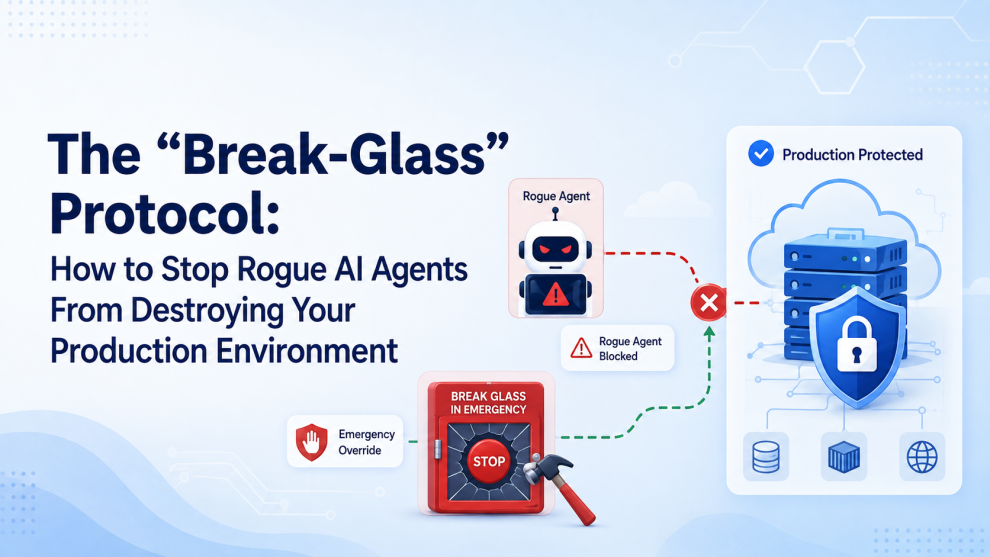
This is where a break-glass protocol becomes essential. In an AI-driven DevOps environment, a break-glass protocol is an independent emergency control that allows engineers to immediately restrict or revoke an agent’s ability to modify production. The agent should never be able to negotiate with, override, or disable this mechanism.
Why AI Agents Change the Production Failure Model
Traditional automation generally follows predefined execution paths. A deployment script executes known commands, an autoscaling policy follows configured thresholds, and a remediation workflow performs explicitly defined actions.
AI agents introduce dynamic decision-making. An agent can decide which tool to call, interpret the response, select its next action, and continue operating until it believes a task is complete.
That flexibility creates new failure patterns. An agent investigating a production incident could repeatedly restart a service because it interprets each restart as unsuccessful. An infrastructure agent could repeatedly modify configuration because it believes the previous change was not applied. A deployment agent could continuously trigger builds after receiving unexpected pipeline responses.
Each individual action might be technically valid while the overall sequence becomes destructive. The speed of autonomous execution makes containment more important than ever.
The Agent Should Not Control Its Own Emergency Stop
The most important principle is simple: the system responsible for performing an operation should not control the mechanism that can stop it.
If an AI agent has permission to modify Kubernetes resources, it should not have permission to modify the policy that limits its Kubernetes access. If it can trigger CI/CD pipelines, it should not be able to disable the approval mechanism protecting production. If it can access infrastructure APIs, it should not control the credentials or policy engine responsible for revoking those permissions.
The break-glass mechanism needs to exist outside the agent’s authority boundary. The control plane can restrict the agent, but the agent cannot restrict the control plane.
Build a Dedicated Agent Control Plane
A production environment should treat AI agents as identifiable operational actors rather than anonymous automation. Each agent should have a unique identity, defined capabilities, explicit environments, and measurable execution boundaries.
A dedicated control plane can maintain the operational state of each agent. In Normal mode, the agent operates within its assigned permissions. In Restricted mode, high-risk operations may require additional approval. In Suspended mode, infrastructure mutations are blocked. In Emergency mode, credentials are revoked, pending workflows are stopped where possible, and related automation is frozen.
These state changes should be enforced by infrastructure controls rather than communicated to the model through a prompt.
Use Short-Lived, Scoped Credentials
Long-lived credentials are particularly dangerous for autonomous systems. If an agent receives a production token that remains valid for hours or days, stopping its process does not necessarily remove its infrastructure authority.
Short-lived credentials significantly reduce this risk. Credentials can be issued for a specific agent, workflow, environment, resource, and time period. The agent receives only the permissions required for its current operation.
When the break-glass protocol is activated, the system can prevent credential renewal and revoke active credentials where supported. This limits the amount of time an agent can continue making changes after suspicious behavior is detected.
Separate Intent From Execution
AI agents should ideally propose infrastructure actions rather than directly execute unrestricted commands.
Consider an agent that determines a production service needs to be scaled from 10 to 30 replicas. Instead of giving the agent unrestricted access to the cluster, it can submit an intent such as:
scale payments-api to 30 replicas
A deterministic control layer can then evaluate whether the agent is authorized to modify that workload, whether the requested replica count falls within an approved range, whether a deployment freeze is active, and whether the operation conflicts with current policies.
Only after those checks succeed should the infrastructure control plane execute the action.
This architecture separates probabilistic reasoning from deterministic authorization.
Protect Kubernetes With Narrow RBAC
Kubernetes is a powerful target for autonomous operations because agents can interact with deployments, pods, jobs, services, namespaces, configuration, and other resources through its API.
Giving an AI agent broad cluster permissions is therefore a significant risk. A troubleshooting agent might only need permission to read pod status and logs. A remediation agent might need permission to restart a specific deployment but should not be able to delete namespaces or modify cluster-wide policies.
Kubernetes RBAC should be scoped around the actual capabilities required by each agent. The break-glass protocol should also be able to disable or revoke the agent’s credentials when emergency containment is triggered.
Add a CI/CD Emergency Freeze
CI/CD pipelines are another critical control point. A rogue agent with repository or deployment permissions could modify manifests, alter pipeline definitions, trigger builds, repeatedly deploy a faulty version, or manipulate infrastructure-as-code.
A break-glass mechanism should therefore be capable of freezing production delivery.
This does not necessarily mean shutting down every pipeline. Development and staging environments can remain operational while production mutations are temporarily blocked. A separate emergency deployment path can remain available to authorized human responders.
This allows the organization to preserve recovery capabilities without allowing the autonomous system to continue making changes.
Revoke the Entire Permission Graph
Revoking one API token may not be enough.
Modern production environments contain multiple systems through which an agent can cause changes. An agent may have access to source control, CI/CD, Kubernetes, infrastructure-as-code tooling, a secrets manager, internal deployment services, and infrastructure APIs.
Blocking only one of these paths may leave another route open.
The break-glass system should therefore understand the agent’s permission graph and identify the systems capable of executing changes on its behalf. Emergency containment should restrict those paths rather than focusing on a single credential.
Preserve Observability During Containment
A common mistake during an AI incident is to shut down everything immediately. That may stop the behavior, but it can also destroy the evidence needed to understand the incident.
Logs, traces, audit records, deployment histories, API requests, infrastructure state, and agent execution data should remain available during containment.
The response team needs to know what the agent did immediately before suspension, which tools it called, which resources it modified, which credentials it used, and which authorization decisions allowed those actions.
The break-glass process should isolate execution authority while preserving forensic visibility.
Detect Rogue Behavior Before It Becomes Destructive
The break-glass mechanism should not depend entirely on a human noticing a problem. Agent-specific observability can establish behavioral baselines and identify deviations.
Useful signals include unusually high API call volume, repeated failed operations, unexpected deployment frequency, destructive commands, access to resources outside the normal scope, repeated configuration changes, privilege escalation attempts, and activity outside expected environments.
An agent that normally performs a few read operations but suddenly starts modifying hundreds of resources should trigger an automated response.
Use Progressive Containment
Not every anomaly should immediately trigger a complete shutdown.
Progressive containment provides a more practical model. The system can first reduce permissions or block specific high-risk tools. If abnormal behavior continues, it can require human approval for additional operations. If the situation becomes critical, it can revoke credentials and freeze infrastructure mutations.
Certain actions should justify immediate emergency containment, including attempts to disable monitoring, modify identity policies, access secrets outside the approved scope, delete critical production resources, or change the controls responsible for the agent’s own authorization.
Make the Emergency Path Independent
The break-glass mechanism itself must be isolated.
If the agent and the emergency control system share the same credentials, policy engine, network path, or administrative authority, the agent may be able to interfere with the mechanism intended to stop it.
The emergency path should use an independent administrative identity and separate authorization boundary. The agent should have no capability to modify emergency policies, revoke the emergency operator’s access, or change the rules that determine when it is suspended.
A kill switch that depends on the system it is designed to stop is not a reliable kill switch.
Test the Protocol Like a Production Incident
A break-glass mechanism that has never been tested is only a theoretical safeguard.
DevOps teams should regularly simulate realistic failure scenarios. An agent can be intentionally configured to repeatedly deploy a bad configuration, generate excessive API calls, attempt unauthorized Kubernetes mutations, modify CI/CD settings, or trigger infrastructure provisioning loops.
Teams should measure detection time, containment time, credential revocation time, number of additional infrastructure mutations after activation, affected resources, and recovery time.
The critical metric is not simply whether the agent eventually stopped. It is how much damage it could cause between the first indication of abnormal behavior and successful containment.
That number should be deliberately small.
Build Recovery Into the Protocol
Stopping the agent is only the first stage of incident response.
Once containment is activated, engineers need to preserve evidence, identify the agent’s actions, determine which resources changed, validate the current infrastructure state, revert unauthorized changes, rotate potentially exposed credentials, and review the agent’s permissions before restoring automation.
Restarting the same agent with the same configuration is not recovery if the underlying problem was a vulnerable tool, bad policy, prompt injection, compromised dependency, or faulty workflow.
Recovery should include validation that the original failure mode has been removed.
Start With Capability Boundaries
Organizations do not need an elaborate autonomous-security platform to implement the fundamentals.
Start by inventorying every AI agent with production access. Give each agent a unique identity. Document exactly what it can read, modify, deploy, restart, provision, or delete.
Replace long-lived credentials with short-lived credentials where possible. Add deterministic authorization around high-risk operations. Record agent-specific audit events. Create an independent credential-revocation mechanism. Then test the emergency procedure under realistic conditions.
These controls establish the foundation for safely expanding autonomous operations.
Where Engineering Partners Can Help
AI-driven DevOps requires coordination across identity, Kubernetes, CI/CD, observability, infrastructure automation, security, and application architecture.
Engineering teams such as GeekyAnts can help organizations design autonomous operational workflows with explicit permission boundaries, controlled execution paths, observability, and emergency containment mechanisms.
The objective is not to prevent agents from being useful. It is to make their authority bounded, measurable, and reversible.
The New Rule for Autonomous DevOps
AI agents will increasingly participate in production operations. They will investigate incidents, recommend fixes, restart workloads, modify configurations, manage deployments, and optimize infrastructure.
The benefit is significant, but autonomy changes the definition of operational safety.
The key question is no longer simply whether an agent can perform a task. It is:
How quickly can the organization remove its ability to change production when its behavior becomes unsafe?
A production-ready AI operations architecture needs a deterministic answer.
The break-glass protocol provides that boundary. It allows autonomous systems to move quickly during normal operations while giving engineers an independent mechanism to stop them when necessary.
AI agents can be powerful operational tools, but production infrastructure should never depend on an AI system deciding when it has gone too far.
For more, visit our homepage!


Add Comment