





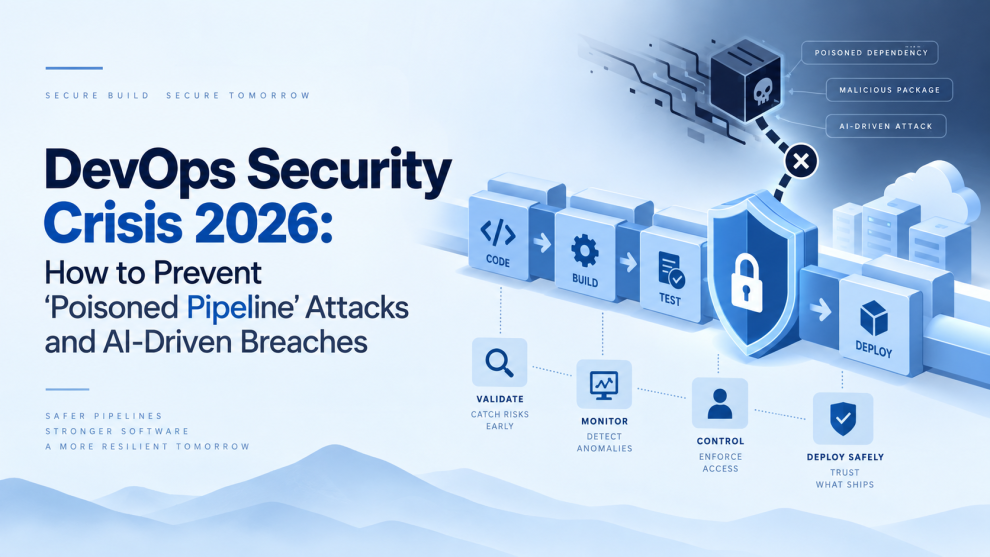

The modern software pipeline was built for speed. Code is committed, tests run automatically, artifacts are created, and deployments can reach production within minutes. But the same automation that makes DevOps efficient has created an increasingly valuable target for attackers. If someone compromises the pipeline, they may not need to attack the application directly. They can manipulate the process that builds and delivers it.
This is where the idea of a “poisoned pipeline” becomes important. An attacker can target source repositories, CI/CD workflows, build runners, dependencies, credentials, deployment configurations, or third-party tools and use that access to introduce something malicious into an otherwise legitimate software delivery process. The final application may still pass tests and appear completely normal.
In 2026, the risk is becoming more complicated because AI is now part of the development and DevOps workflow. AI tools can generate application code, infrastructure configurations, deployment scripts, workflow files, security fixes, and automation logic in seconds. That creates enormous productivity gains, but it also means insecure or incorrect changes can move through the delivery pipeline much faster.
The security question has therefore changed. It is no longer enough to ask whether the application is secure. DevOps teams also need to ask whether the path that builds and deploys the application can be trusted.
The Pipeline Is Now Part of the Attack Surface
A CI/CD pipeline is connected to almost everything that matters in modern software delivery. It may have access to source repositories, package registries, container images, deployment systems, secrets, infrastructure-as-code configurations, testing tools, and production resources.
Every connection introduces another trust relationship.
If an attacker compromises a workflow that has access to deployment credentials, the attacker may be able to reach production without exploiting a vulnerability in the application itself. If a build runner is compromised, malicious changes could potentially affect multiple projects. If a dependency is manipulated, the malicious component may be packaged into an otherwise trusted application.
This is why the pipeline cannot be treated as an internal automation layer that is automatically trustworthy. It is part of the software supply chain and needs its own security boundaries.
What Makes a Pipeline “Poisoned”?
A poisoned pipeline does not necessarily mean someone has completely taken over the CI/CD system. Sometimes the compromise is much smaller.
An attacker might modify a workflow, replace a dependency, compromise an external action, inject a malicious command into a build step, steal a deployment credential, or manipulate an artifact before it reaches production.
The dangerous part is that these changes can blend into normal automation.
A malicious package can look like a routine dependency update. A modified workflow can look like an ordinary configuration change. A compromised build runner can continue producing artifacts that appear legitimate.
This makes detection difficult because the attacker is abusing systems that developers already trust.
AI Is Changing the Speed of the Problem
AI-assisted development has introduced a new variable into DevOps security.
Developers can now generate an entire deployment workflow from a short prompt. They can ask an AI tool to write infrastructure configurations, create Dockerfiles, update dependencies, generate scripts, or suggest fixes for security findings.
That productivity is valuable, but generated output should never be treated as inherently safe.
AI does not automatically understand the permissions available to a pipeline, the sensitivity of a particular environment, or the consequences of exposing a credential. A generated workflow could unintentionally grant excessive permissions. A generated script could execute an unsafe command. An AI-suggested dependency could introduce an unnecessary supply-chain risk.
The bigger concern is automation.
When AI-generated changes are automatically committed, tested, approved, and deployed, an incorrect assumption can travel through the entire delivery process before a human has a chance to question it.
Least Privilege Needs to Apply to CI/CD
One of the strongest defenses against poisoned pipelines is also one of the oldest security principles: least privilege.
A workflow should have only the permissions it needs to complete its job.
A testing workflow should not automatically have production credentials. A build process should not have unrestricted access to deployment infrastructure. A pull-request workflow executing code from an untrusted branch should not receive the same privileges as a trusted production deployment.
This limits the blast radius when something goes wrong.
If an attacker compromises a low-privilege build process and that process cannot access production credentials or modify release artifacts, the compromise becomes much harder to turn into a major incident.
Pipeline permissions should therefore be reviewed with the same seriousness as application permissions.
Secrets Should Never Become Pipeline Shortcuts
CI/CD systems frequently handle highly sensitive credentials. Cloud keys, repository tokens, package-publishing credentials, signing keys, database credentials, and API keys can all appear somewhere in the delivery process.
Storing secrets in a dedicated secret-management system is important, but it is only the beginning.
The bigger question is who and what can access those secrets.
A secret that is technically protected but exposed to dozens of unnecessary workflows is still at risk. DevOps teams should reduce secret availability, limit the environments where credentials are usable, rotate sensitive credentials, and monitor unusual access.
The objective should be to make a stolen credential less useful, not simply harder to find.
Stop Trusting Moving Dependencies
Modern pipelines depend heavily on third-party actions, packages, images, plugins, and tools. That convenience can also become a supply-chain weakness.
A workflow that references a mutable version tag may receive different code later. A dependency that was safe when initially approved could be compromised before the next build.
Pinning important dependencies to known versions or immutable references helps reduce this uncertainty. Dependency scanning and controlled update processes add another layer of protection.
The goal is not to prevent updates. It is to ensure that updates happen intentionally and that teams know what changed.
Build Provenance Is Becoming More Important
Security teams increasingly need to answer a basic question after an incident: Where did this artifact actually come from?
Software provenance helps answer it.
SLSA defines provenance as verifiable information that can track an artifact through the software supply chain and describe where, when, and how it was produced. This gives teams a stronger basis for connecting a production artifact to its source, build process, dependencies, and builder.
Without that information, investigating a compromised artifact can become a forensic exercise based largely on assumptions.
With reliable provenance, teams have evidence.
SBOMs Are Helpful, But They Do Not Prove Trust
Software bills of materials provide valuable visibility into the components contained in an application. They can help teams identify outdated or vulnerable dependencies and understand what is included in a release.
But an SBOM does not automatically prove that the build itself was trustworthy.
Knowing what went into an artifact is different from knowing whether the artifact was produced through an uncompromised process.
That is why SBOMs, provenance, artifact integrity, dependency controls, and secure build environments should work together rather than being treated as interchangeable security measures.
Protect the Build Environment
Build runners are often overlooked because they are considered temporary infrastructure.
That assumption can be dangerous.
A compromised runner may have access to source code, environment variables, dependencies, credentials, artifacts, and internal systems. If the same runner is reused across multiple builds, persistence could potentially affect more than one application.
Ephemeral runners, isolation, restricted network access, minimal installed software, short-lived credentials, and controlled permissions can reduce this risk.
The build environment deserves security controls because the build environment has influence over what eventually reaches production.
Separate Development From Production Trust
A common mistake is allowing development, testing, building, and production deployment to operate with similar privileges.
They should not.
A development workflow should not automatically be able to modify production infrastructure. A test environment should not require unrestricted production access. A build process should not be trusted with every deployment capability simply because it is part of the same pipeline.
Separating these environments creates meaningful security boundaries.
If one layer is compromised, the attacker still has to cross another boundary before reaching something more valuable.
AI Agents Make This Even More Important
AI-generated code is only one part of the emerging challenge.
The next stage is AI systems that can actually perform DevOps tasks.
An AI agent may inspect incidents, modify configuration, create pull requests, update dependencies, restart services, change infrastructure, or trigger deployments.
At that point, the AI system is no longer simply an assistant. It becomes an actor inside the infrastructure.
That means it needs an identity, defined permissions, activity logging, boundaries, and clear rules about what it can change.
The important question is not whether an AI agent can perform an operation. The important question is whether it should be allowed to perform that operation without additional verification.
Not Every Automated Action Needs Human Approval
Completely manual DevOps is unrealistic at modern scale. But completely unrestricted automation is equally dangerous.
The better approach is to classify actions according to their potential impact.
Restarting a failed development container may require no approval. Updating a production configuration might require additional verification. Changing network policies, credentials, or critical infrastructure could require explicit human approval.
This creates a practical balance between speed and control.
Automation should handle repetitive, low-risk work while higher-impact decisions receive stronger safeguards.
Monitor the Pipeline Like You Monitor Production
A secure pipeline should not become invisible once it has been automated.
Teams need visibility into unusual workflow changes, unexpected dependencies, abnormal runner behavior, suspicious credential usage, unexpected artifact publishing, changes to deployment permissions, and unusual network activity.
A sudden change in how a build behaves can be just as important as an unusual request hitting a production API.
DevOps observability therefore needs to extend beyond application metrics and infrastructure health. The software delivery process itself needs to be observable.
Security Checks Should Happen Before Deployment
Security cannot be reduced to a single scan at the end of the pipeline.
Code should be checked for vulnerabilities and exposed credentials. Dependencies should be evaluated. Container images should be scanned. Infrastructure configurations should be reviewed. Generated artifacts should be validated. High-risk changes should receive additional scrutiny.
AI-generated changes should pass through exactly the same controls.
In fact, AI-assisted development makes these controls more important because the volume of generated code and configuration can increase significantly.
The objective is not to slow developers down with endless approvals. It is to create automated checks that catch predictable problems before they become production problems.
Where DevOps Security Becomes an Engineering Discipline
The strongest DevOps security programs do not treat security as something added after the pipeline has already been designed. Security becomes part of how the delivery system is architected.
Teams like GeekyAnts, Thoughtworks, and other engineering-led technology teams can take a practical approach by combining secure CI/CD practices, automation, observability, and controlled deployment processes rather than treating security as a separate final-stage activity.
The goal is not simply to add more security tools. It is to create a delivery workflow where permissions are controlled, changes are traceable, artifacts can be verified, and suspicious behavior can be detected quickly.
Build a Pipeline Security Baseline
DevOps teams do not need to redesign everything at once.
Start by understanding what the pipeline can currently do.
Review workflow permissions. Identify which pipelines can access secrets. Audit third-party actions and dependencies. Pin important dependencies. Check for exposed credentials. Review self-hosted runners. Separate production credentials from development workflows. Introduce artifact signing and provenance where appropriate. Monitor privileged actions.
Then test those controls.
A security policy that exists only in documentation is not a security control. The pipeline should behave securely even when someone makes a mistake or an attacker gains limited access.
The Future of DevOps Security Is About Verification
Software delivery is becoming faster and more automated. AI is accelerating development, infrastructure automation is accelerating provisioning, and CI/CD is accelerating deployment.
But speed creates a new security challenge.
The faster software moves, the less time there is to manually question every change.
That makes verification increasingly important.
Teams need to know where code came from, which dependencies were used, what process produced the artifact, which credentials were available, what changed, and why a release was allowed to reach production.
The future of DevOps security is therefore not about eliminating automation. It is about making automation trustworthy, observable, and verifiable.
The New DevOps Security Mindset
The poisoned pipeline problem ultimately comes down to trust.
If source repositories, dependencies, CI/CD workflows, build runners, AI-generated changes, and deployment systems are trusted without verification, an attacker only needs to compromise one of those trusted components.
The answer is not to stop using AI or automation.
The answer is to build stronger boundaries around them.
Least privilege, isolated build environments, dependency controls, protected secrets, artifact verification, provenance, monitoring, and carefully designed AI permissions can turn the pipeline from a hidden weakness into a controlled part of the security architecture.
In 2026, a secure DevOps pipeline is not simply one that runs successfully.
It is one where the team can explain what changed, where it came from, how it was built, what it touched, and why it was trusted enough to reach production.
Frequently Asked Questions
What is a poisoned CI/CD pipeline?
A poisoned CI/CD pipeline is a delivery pipeline that has been compromised so an attacker can introduce malicious code, dependencies, configurations, or commands into the build or deployment process.
How can DevOps teams prevent poisoned pipeline attacks?
Use least-privilege permissions, secure build runners, dependency controls, protected secrets, artifact verification, provenance, security scanning, workflow reviews, and continuous monitoring.
Why does AI increase DevOps security risks?
AI can generate code, infrastructure configurations, scripts, and workflow changes very quickly. Without proper validation, insecure changes can move through an automated pipeline faster than traditional review processes can catch them.
Should AI-generated code receive additional security checks?
AI-generated code should be treated like any other untrusted code and pass through testing, security scanning, dependency analysis, review, and policy validation before production deployment.
What is software build provenance?
Build provenance provides verifiable information about how a software artifact was produced, including details that can help trace it back through its build process and source.
Are SBOMs enough to secure the software supply chain?
No. SBOMs provide visibility into software components, but they do not by themselves prove that the build process or resulting artifact was trustworthy.
How should DevOps teams secure AI agents?
AI agents should have narrowly defined identities and permissions, strong authentication, action-level authorization, detailed logging, and additional approval requirements for high-impact operations.
What is the biggest DevOps security mistake in 2026?
Treating the CI/CD pipeline as a trusted internal system instead of recognizing it as a critical part of the software supply chain and production attack surface.
For more, visit our homepage!



Add Comment