





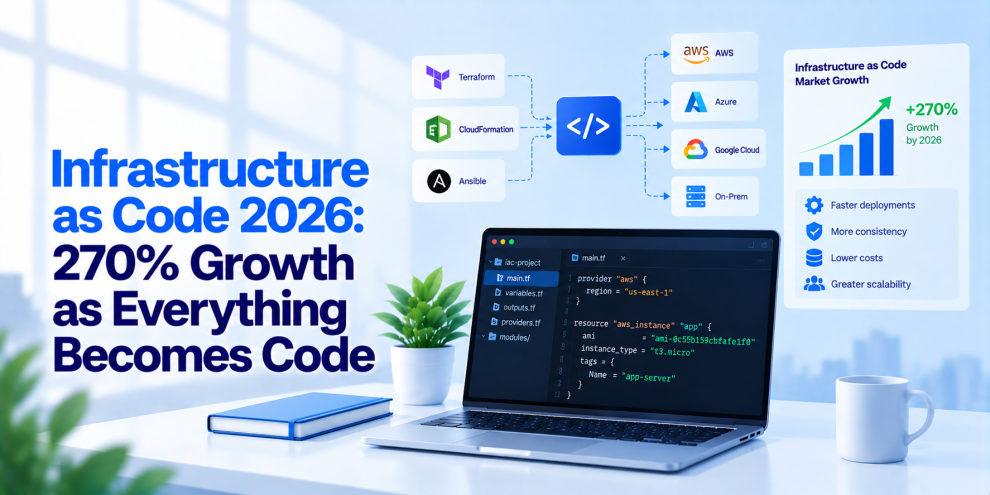

Infrastructure as Code (IaC) has become a foundational practice in modern DevOps. Instead of provisioning servers, configuring networks, and managing cloud resources manually, engineering teams define infrastructure through version-controlled files that can be reviewed, tested, and deployed through automated workflows. In 2026, this approach is expanding beyond basic cloud provisioning. Infrastructure policies, Kubernetes configurations, security controls, network rules, observability settings, and parts of the software delivery process are increasingly managed as code.
The result is a shift in how organizations build and operate technology platforms. Infrastructure is becoming more programmable, repeatable, and auditable. However, broader adoption also introduces new challenges, including configuration drift, excessive permissions, state management, dependency complexity, and the risk of deploying incorrect infrastructure changes at scale.
The opportunity is not simply to write more infrastructure code. It is to build infrastructure that is predictable, secure, and maintainable across increasingly complex environments.
Why Infrastructure as Code Matters More in 2026
Cloud environments have become too dynamic for manual infrastructure management to scale effectively. A modern application may depend on container clusters, managed databases, identity services, private networks, storage systems, monitoring platforms, and multiple deployment environments.
Creating and maintaining these resources manually increases the likelihood of inconsistencies. Development and production environments may differ, security settings may be applied unevenly, and undocumented changes can make incident investigations difficult.
IaC addresses these problems by defining infrastructure in machine-readable configuration files. Teams can use those definitions to create and update environments through repeatable processes.
For example, a team can define a Kubernetes cluster, network boundaries, database resources, monitoring integrations, and access policies in version-controlled files. The same configuration can then be applied consistently across approved environments, with environment-specific values managed separately.
This makes infrastructure changes easier to review and reproduce. It also allows infrastructure modifications to follow familiar software engineering practices such as pull requests, automated testing, approvals, and release tracking.
What Does “Everything Becomes Code” Actually Mean?
The expansion of IaC reflects a broader movement toward defining operational systems declaratively or programmatically.
Infrastructure provisioning is only one part of this transformation. Organizations are also managing other operational concerns through code and policy definitions.
Infrastructure as Code: Cloud resources, networks, storage, compute, and managed services are defined in configuration files.
Configuration as Code: Application settings, service configuration, and environment parameters are version-controlled and deployed consistently.
Policy as Code: Security and compliance requirements are expressed as rules that can be evaluated automatically.
GitOps: Desired infrastructure and application states are stored in version control and reconciled through automated controllers.
Observability as Code: Dashboards, alerts, monitoring rules, and service-level objectives can be defined and reviewed alongside application changes.
Security as Code: Security checks, identity restrictions, deployment policies, and infrastructure validation become part of automated delivery workflows.
Together, these practices reduce dependence on undocumented manual processes. They also make operational requirements easier to test, audit, and enforce across large engineering organizations.
The IaC Tools Shaping Modern DevOps
Different IaC tools address different requirements. The right choice depends on the cloud environment, infrastructure complexity, team experience, and need for portability.
Terraform and OpenTofu
Terraform remains a widely used option for provisioning cloud infrastructure through declarative configuration. It supports a broad ecosystem of providers and allows teams to manage resources through reusable modules.
OpenTofu provides an open-source alternative in the same general ecosystem. Both approaches require careful management of state, provider versions, credentials, and configuration changes.
For organizations operating across multiple cloud providers, these tools can help standardize provisioning workflows. However, teams should avoid assuming that a shared configuration automatically makes every cloud resource behave identically.
AWS CloudFormation and AWS CDK
Organizations heavily invested in AWS may use CloudFormation to define infrastructure declaratively. AWS CDK allows developers to define infrastructure using familiar programming languages before synthesizing templates for deployment.
These approaches can integrate closely with AWS services and deployment workflows. The trade-off is that teams need to understand the abstraction layer they are using, including how generated templates, dependencies, and resource updates behave.
Pulumi
Pulumi enables infrastructure definitions using general-purpose programming languages. This can be useful when infrastructure provisioning requires reusable abstractions, programming logic, or integration with existing development tooling.
However, general-purpose languages can also introduce complexity. Teams need coding standards, testing practices, dependency controls, and clear module boundaries to prevent infrastructure definitions from becoming difficult to maintain.
Ansible
Ansible is commonly used for configuration management and automation tasks, including operating-system configuration, application setup, and orchestration.
It complements provisioning tools by helping configure systems after resources have been created. Its role differs from tools that primarily manage declarative cloud resource state, so organizations should define which system owns each configuration responsibility.
Kubernetes and GitOps Tools
Kubernetes manifests and Helm charts define application deployment configurations. Tools such as Argo CD and Flux can reconcile the desired state stored in Git with the state running in a cluster.
This brings application deployment and infrastructure operations closer to the same review and version-control model. It also creates a need to protect repositories, deployment credentials, and reconciliation permissions carefully.
Configuration Drift Is Still a Major Risk
IaC does not automatically guarantee that the infrastructure running in production matches the configuration stored in version control.
Drift can occur when an engineer changes a resource manually, an external automation process modifies a setting, or a cloud service changes its behavior over time.
Even a small difference can create operational problems. A security group may allow an unexpected connection, a database parameter may differ between environments, or a production resource may no longer match the approved deployment configuration.
Teams should regularly evaluate the difference between declared and actual infrastructure state. Automated plans, drift detection, controlled reconciliation, and alerts can help identify discrepancies before they become incidents.
Not every difference should be automatically overwritten. Some changes may be intentional emergency fixes or reflect resources managed by another system. A reliable process identifies the difference, determines ownership, and resolves it through an approved workflow.
Infrastructure Code Needs Security Testing
Infrastructure configuration can expose systems just as easily as application code can introduce vulnerabilities.
A misconfigured storage resource may expose sensitive data. An overly permissive identity policy can allow unauthorized access. An unrestricted network rule can increase the attack surface. A Kubernetes manifest may run a container with unnecessary privileges.
For this reason, infrastructure code should pass security checks before deployment.
A practical pipeline may include:
- Formatting and syntax validation.
- Module and provider version checks.
- Static analysis for insecure configurations.
- Policy validation against organizational requirements.
- Infrastructure plan review.
- Approval for sensitive changes.
- Controlled deployment and post-deployment verification.
Tools such as Checkov, Trivy, and Terrascan can support infrastructure security scanning, while policy engines such as Open Policy Agent can help enforce custom rules.
Scanning is only one layer of defense. Permissions, deployment identities, secrets management, and runtime monitoring remain essential.
Policy as Code Makes Governance More Scalable
Large organizations often operate hundreds of repositories and multiple cloud accounts. Reviewing every infrastructure change manually is difficult, especially when teams use different modules and deployment workflows.
Policy as Code helps establish common guardrails.
For example, an organization may require encryption for supported storage resources, prohibit public access to certain databases, restrict deployment to approved regions, or require specific identity controls for production workloads.
These policies can be evaluated automatically during infrastructure changes. Invalid configurations can be rejected before they reach production, while exceptions can follow a documented approval process.
This approach allows platform teams to establish standards without requiring every application team to reinvent the same controls.
The key is to make policies specific and actionable. Excessively broad or poorly maintained rules can block legitimate work and encourage teams to bypass the intended process.
Reusable Modules Reduce Duplication, but Require Ownership
Infrastructure modules allow teams to package common patterns into reusable components. Instead of independently defining networks, databases, identity policies, and monitoring integrations for every application, teams can use approved modules maintained by a platform team.
This improves consistency and reduces duplicated work.
However, modules can become a source of risk when they are poorly versioned or contain hidden assumptions. A change to a shared module may affect dozens of applications. Unclear ownership can also make it difficult to determine who is responsible for upgrades, security fixes, and compatibility.
Organizations should version modules, document their inputs and outputs, test changes, and establish a process for deprecating older versions.
Reusable infrastructure should be treated like a maintained software product rather than a collection of convenient templates.
State Management and Secrets Need Special Attention
Infrastructure tools often maintain state to track managed resources and determine what changes are required. That state can contain sensitive values or information about internal infrastructure.
State files should therefore be stored using appropriate access controls, encryption, versioning, and locking mechanisms where supported. Shared environments need a clear strategy for preventing conflicting operations.
Secrets require similar discipline. Credentials should not be hardcoded into infrastructure definitions or committed to source control. Teams should use appropriate secret-management services and narrowly scoped identities, including short-lived credentials where practical.
Pull-request workflows that execute untrusted code should not receive production credentials simply because they need to validate an infrastructure change.
The security of the IaC pipeline is part of the security of the infrastructure it manages.
AI Is Changing How Infrastructure Code Gets Written
AI coding assistants can generate Terraform configurations, Kubernetes manifests, Helm charts, deployment scripts, and policy definitions. They can also explain existing infrastructure, suggest refactoring opportunities, and help engineers investigate configuration errors.
This can accelerate infrastructure development, but generated code still requires validation.
An AI-generated configuration may use excessive permissions, expose a resource publicly, omit important constraints, or make assumptions that do not match the organization’s environment. A configuration that is syntactically valid may still be operationally unsafe.
The appropriate approach is to treat AI-generated infrastructure code like any other proposed change. It should be reviewed, tested, scanned, evaluated against policy, and deployed through the same controlled pipeline.
As AI agents gain the ability to create pull requests or initiate deployment actions, organizations will also need explicit identities, limited permissions, audit trails, and approval requirements for high-impact changes.
AI can accelerate infrastructure engineering, but it should not bypass the controls that make infrastructure reliable.
FinOps and Infrastructure as Code Belong Together
Infrastructure changes affect more than availability and security. They also affect cloud spending.
A configuration can accidentally provision oversized compute instances, retain unused resources, create expensive storage, or scale workloads beyond their intended limits.
IaC provides an opportunity to incorporate cost controls into the provisioning process. Teams can apply approved resource profiles, set scaling limits, use environment-specific configurations, and review estimated changes before deployment.
Cost policies should be combined with runtime monitoring because infrastructure usage can change even when the configuration remains constant.
Useful measurements include cost per service, cost per environment, resource utilization, idle capacity, and cost per transaction or completed workload.
The objective is not to make every infrastructure deployment as cheap as possible. It is to make cost implications visible and ensure that resource consumption aligns with operational requirements.
Building an IaC Pipeline That Scales
A production-grade IaC pipeline should provide a controlled path from a proposed change to a verified deployment.
A typical workflow looks like this:
Version-Controlled Configuration → Validation → Security Scanning → Policy Checks → Plan Review → Approval → Deployment → Drift Detection
The validation stage checks whether the configuration is well-formed and uses approved dependencies. Security and policy checks identify risky settings. The plan review shows the expected changes before they are applied.
Sensitive changes may require additional approval, while lower-risk updates can follow automated policies. After deployment, verification checks whether the intended resources were created and whether critical health and security requirements remain satisfied.
Production deployments should use controlled identities and avoid giving every workflow broad administrative access.
This process makes infrastructure changes traceable and repeatable while allowing teams to automate routine work.
Where Engineering Teams Fits
Adopting IaC across complex application environments requires coordination between cloud architecture, DevOps, platform engineering, security, and application teams. Teams like GeekyAnts work across application development, backend systems, and modern engineering architecture, making this broader perspective relevant for organizations looking to standardize infrastructure automation and improve delivery reliability.
The priority is to create infrastructure workflows that are reusable, secure, observable, and aligned with the organization’s operational requirements rather than simply converting manual commands into configuration files.
How to Start an Infrastructure as Code Program
Organizations do not need to migrate every resource to IaC immediately. A phased approach can reduce risk and provide measurable improvements.
First, inventory existing infrastructure. Identify which resources are already managed through code, which are configured manually, and which systems have unclear ownership.
Next, standardize the most common patterns. Build and maintain reusable modules for frequently deployed resources, with documented inputs, outputs, and security requirements.
Then, integrate validation and policy checks. Introduce automated testing, configuration scanning, and controlled plan reviews before expanding deployment automation.
After that, address drift and state management. Establish ownership for infrastructure resources and define how manual changes, emergency fixes, and reconciliation should work.
Finally, measure outcomes. Track provisioning time, deployment failures, configuration drift, policy violations, recovery time, and infrastructure cost. Use these measurements to identify where further automation creates meaningful value.
A successful IaC program is not measured by the number of configuration files in a repository. It is measured by whether infrastructure becomes easier to operate, safer to change, and more consistent across environments.
The Future of Infrastructure as Code
Infrastructure as Code is evolving from a provisioning technique into a broader operational discipline. Cloud resources, application configurations, security policies, deployment workflows, and observability settings are increasingly connected through version-controlled definitions and automated validation.
AI-assisted engineering may accelerate this transition, while GitOps and policy automation can make infrastructure changes more consistent and auditable. At the same time, greater automation increases the consequences of incorrect configuration, compromised credentials, and poorly governed changes.
The claim that IaC is experiencing “270% growth” should be supported by a clearly identified study, metric, and timeframe before being presented as a verified statistic. Without that source, the stronger argument is the architectural shift itself: organizations are increasingly treating infrastructure as software that must be tested, reviewed, secured, and maintained.
In 2026, the goal is not to turn every operational decision into code. It is to make repeatable and security-sensitive infrastructure decisions explicit, testable, and auditable.
The most effective IaC strategy combines automation with ownership, policy enforcement, reliable state management, cost awareness, and controlled deployment. That is how infrastructure becomes programmable without becoming unpredictable.
For more, visit our homepage!



Add Comment